
David Byrne’s American Utopia (2020)
Director: Spike Lee
Writer: David Byrne
Starring: David Byrne
David Byrne opens the Broadway stage stripped down to essentials, barefoot and asking a deceptively simple question: what remains if we remove everything except what matters most? The audience—whether seated in the Hudson Theatre, sharing a living room screen, or watching in a darkened cinema—becomes part of the answer. In David Byrne’s American Utopia, Spike Lee captures an intimate, kinetic experience that feels at once like a concert, a staged performance, and a meditation on connection.
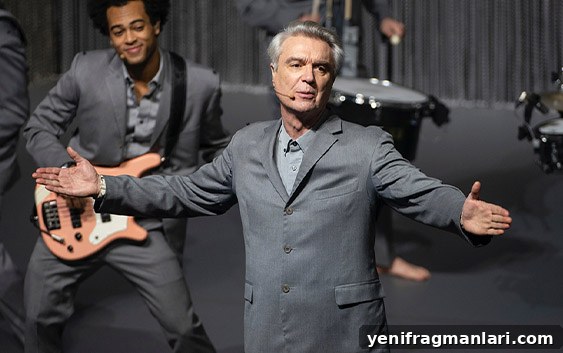
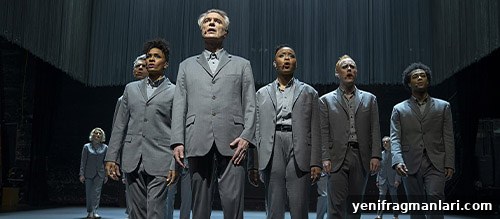
Adapted from Byrne’s solo album of the same name and threaded with Talking Heads favorites, the filmed show rejects spectacle for clarity. The performers wear nearly identical silver-grey suits and play instruments wirelessly attached to their bodies, freeing the music from the constraints of cables and amplifying a sense of movement and unity. Byrne, instantly recognizable by his silver hair and distinctive delivery, leads an ensemble of eleven barefoot musicians through an electric program that blends choreography, storytelling, and sharp musicality.
The production occupies a space between theatrical essay and concert spectacle. Byrne opens with “Here,” singing as he gestures to a model brain, then moves into a short, thoughtful lecture about how the brain’s early wealth of neural connections diminishes with age—what he playfully calls a “plateau of stupidity.” This observation anchors the film’s emotional and philosophical interrogations: how do we regain the openness and empathy we once had, and what role do shared experiences play in that recovery?
Byrne’s aesthetic is rooted in New Wave and the avant-garde sensibility of the Talking Heads era. The show uses robotic movement, geometric staging, bold electronic rhythms, and pop-art gestures to stage a kind of modern ritual. While other musicians have translated albums into theatrical forms—Green Day with American Idiot, or Madonna with her theatrical tours—Byrne’s approach feels less like a conventional musical and more like a communal experiment. The songs become prompts for reflection and connection, as when he muses on why watching a person can be more compelling than watching an object.
Throughout the film, the music itself remains central. Byrne and his band move through a litany of hits—“This Must Be the Place,” “Lazy,” “I Zimbra”—each arranged to emphasize rhythm and collective motion. The barefoot motif, initially a quirky detail, evolves into a symbolic gesture of hospitality and vulnerability. During “Everybody’s Coming to My House,” the stage transforms into Byrne’s home and the audience into invited guests: pull up a chair, remove your shoes, and join the gathering. The effect is warm, immersive, and genuinely celebratory.
But the show is not merely nostalgic or carefree. Byrne weaves explicit references to activism and social conscience into the set, honoring figures like Colin Kaepernick and performing a rendition of Janelle Monáe’s protest song “Hell You Talmbout.” He also invokes James Baldwin, using Baldwin’s belief in America’s capacity to change as a moral touchstone. These moments anchor the performance in a present-day urgency: the ideal Byrne imagines is not an aesthetic fantasy but a political aspiration built from human relationships and shared responsibility.
Spike Lee’s direction amplifies that aspiration. Working with cinematographer Ellen Kuras, Lee treats the stage as both theater and cinematic landscape, exploring it from high-angle vistas that reveal the choreography’s geometry to intimate close-ups that draw viewers into the performers’ faces and gestures. Kuras’s camera finds the empty spaces between performers as artful as their movements, and editor Adam Gough stitches footage from multiple nights into a single, seamless performance that feels like one unforgettable evening on Broadway.
The result is a finely crafted hybrid: a concert film that thinks like a play and a piece of theater that grooves like a band. Lee and Byrne invite us into a hopeful improvisation—an attempt to rebuild empathy and community through music and shared attention. It’s joyous, thoughtful, and strangely tender: a work that asks audiences to participate, not just watch.
24/24