
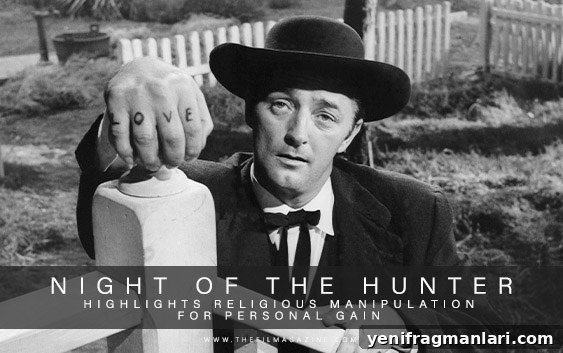
A film approaching its seventieth anniversary, Charles Laughton’s The Night of the Hunter remains unsettlingly relevant. The picture depicts a chilling scenario familiar in many forms: a self-proclaimed man of God who uses religious authority to exploit and destroy the vulnerable. Laughton’s adaptation preserves the raw terror of that premise while creating a striking, visually memorable work of cinema.
Set in Depression-era Appalachia, the story follows Harry Powell, played with unnerving calm by Robert Mitchum, a traveling preacher who marries, robs, and murders widows while convincing himself he is carrying out divine justice. That a film so openly centered on a murderous preacher was made during the Hays Code era speaks to its daring visual and narrative approach: it confronts religious hypocrisy and predatory charismatic authority without flinching.
The film opens with a children’s Bible study led by Rachel Cooper (Lillian Gish), who quotes Christ’s warning: “Beware of false prophets which come to you in sheep’s clothing but inwardly they are ravening wolves.” This biblical frame sets the tone. Powell frequently speaks to an imagined Lord, a device that reveals the twisted logic he uses to justify violence. He believes the scriptural killings of the unrighteous sanction his own crimes, and he harbors a deep loathing for women and their sexuality. The preacher’s tattoos—“LOVE” on one hand and “HATE” on the other—visually suggest the contradiction at the center of his personality: a man who preaches piety while committing monstrous acts.
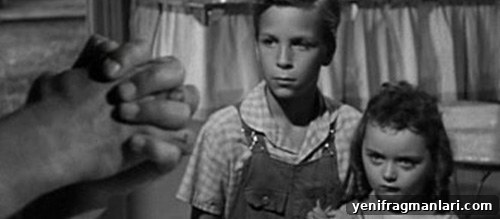
The catalyst for Powell’s intrusion into a family’s life is Ben Harper (Peter Graves), a desperate, blue-collar father who robs and kills during an armed theft, taking $10,000. Before Ben is arrested and sentenced to death, he makes his children, John (Billy Chapin) and Pearl (Sally Jane Bruce), swear not to reveal where he hid the money. He places a heavy, adult responsibility on John, making him protector and keeper of the secret. John’s premature assumption of maturity—his solemn speech and solemn manner—becomes crucial to the film’s emotional core and to the conflict with Powell.
In prison Powell shares a cell with Ben and interprets their proximity as destiny. He decides he was meant to marry Ben’s widow, Willa (Shelley Winters), take the money and then kill her and the children. After Ben’s execution, Powell arrives in the community posing as a devout minister and spins lies about his relationship with Ben, claiming Ben admitted to throwing the money in the river. The townspeople, eager to embrace a preacher, accept Powell without scrutiny—his clerical role functions as unquestioned social capital. Willa, softened by Powell’s apparent kindness, consents to marriage; Pearl takes to her new stepfather while John remains suspicious and protective of the secret he promised his father he would keep.
Powell’s charisma is rooted in his intimate familiarity with scripture and in his talent for performing humility. He lures the townspeople into trusting him by speaking their language of faith, then manipulates that trust to his advantage. He distorts scripture into tools of guilt and control—shaming Willa about sex and convincing her that her supposed moral failings led to her husband’s crimes. Women are made scapegoats under Powell’s logic: sex becomes a moral trap, and female influence a cause of male sin, a common but damaging theme in certain interpretations of religious doctrine.
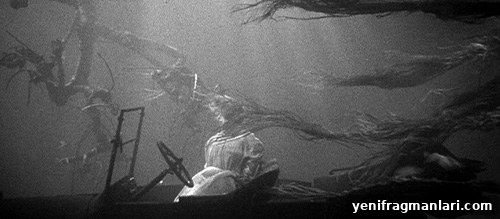
When Willa discovers Powell’s true intentions and confronts him, he murders her and constructs a new tale to reassure the town. The film’s haunting underwater image of Willa’s body bound to a car, and the description of the slit at her throat, carry grotesque symbolic weight—they underscore how Willa’s voice and agency were erased, and how religious pretexts were used to justify silence and violence.
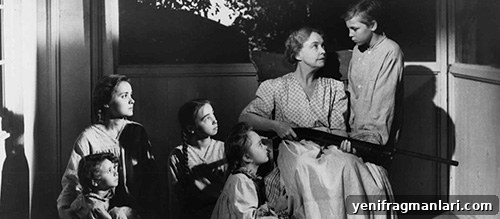
Powell’s methods closely mirror those used by abusive leaders and cult figures: mood swings calibrated to manipulate, selective kindness to gain trust, and calculated threats to coerce compliance. He threatens John’s life to force Pearl to reveal that the money is hidden inside her ragdoll. The children flee downriver in their father’s old boat and survive as wandering orphans until Rachel Cooper takes them in. Rachel, a stern yet compassionate Bible teacher, proves a powerful foil to Powell. Her faith is active rather than performative; she answers Powell’s weaponized scripture with countering passages and refuses to surrender the children to him, calling the authorities when he overreaches.
The film also explores the long shadow of trauma. John’s responses—his freezing at the thought of another father figure being taken away, the accidental revealing of the ragdoll’s secret during a public moment of panic, and his subsequent inability to testify—capture the lingering, confusing effects of abuse and loss on a child. Even those who mistrust an abuser can be deeply affected by brief but intense periods of manipulation and control.
Technically bold and morally complex for its time, The Night of the Hunter forces viewers to consider how easily communities can be deceived by religious authority and how authority is taught to children. Harry Powell is a predator who finds safety in plain sight, shielded by the cloak of faith. He is ultimately brought down not by institutional power but by a resolute, independent woman whose steady conviction exposes his lies. The film’s enduring power lies in its capacity to illuminate the mechanics of manipulation and the resilience of compassion and moral courage.
Written by Nicole Sanacore
Support Nicole Sanacore: Twitter @nicolesanacore • Instagram @nicolesanacore • Website nicolesanacore