
This article was written exclusively for The Film Magazine by Kevin Woodley.
The Winter Lake (2021)
Director: Phil Sheerin
Screenwriter: David Turpin
Starring: Charlie Murphy, Anson Boom, Emma Mackey, Michael McElhatton, Mark McKenna
The turlough, a seasonal lake that disappears and returns, provides the central metaphor for Phil Sheerin’s debut feature, The Winter Lake. Like buried emotions that resurface, the lake in this film dredges up past trauma and forces characters to confront what they hoped was long gone. Sheerin anchors this bleak, atmospheric domestic drama in rural Ireland, using the landscape itself as an oppressive character that reflects the mental and emotional state of the people who live beside it.
The story is centred on Elaine (Charlie Murphy) and her withdrawn son Tom (Ansoon Boons), who have returned to a rundown family cottage after an undisclosed trauma. The truth behind their flight is withheld for much of the film, but the effect is clear: both mother and son are damaged and fragile. Their isolation, and the desolate environment that surrounds them, amplify their emotional wounds. The film’s visual and sound design make the setting feel remote and threatening, as though the characters occupy a world on the edge of collapse.
Tom is a solitary, volatile boy who drifts through the marshy hills with a haunted expression, prone to sudden bursts of anger. His unsettling pastime—searching the turlough for bones—underscores his troubled psyche. Ansoon Boons delivers a quietly intense performance, conveying both vulnerability and a simmering danger. When Tom makes a shocking discovery at the lake, his initial horror gives way to a dangerous curiosity, and the film briefly shifts into territory more commonly associated with psychological horror. Sheerin does not shy away from showing the grotesque details of Tom’s find, and the score heightens the discomfort, signaling that buried secrets are resurfacing.
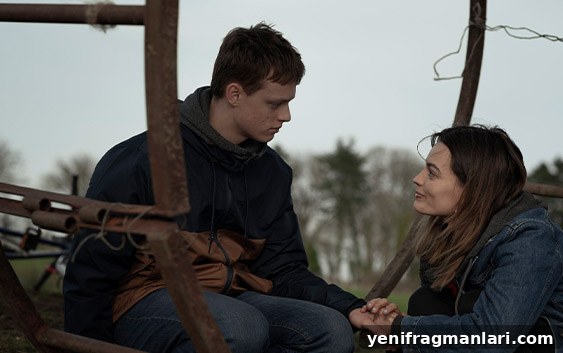
The arrival of nearby neighbours Ward (Michael McElhatton) and his daughter Holly (Emma Mackey) coincides with the lake’s unsettling returns. Ward and Holly are in many ways mirror images of Elaine and Tom: another fractured family carrying their own wounds. Elaine, desperate for stability and support, quickly gravitates toward Ward. He provides the promise of security—both emotional and financial—that she can no longer rely on for herself. Meanwhile, Tom and Holly form a fragile bond that appears to be a typical coming-of-age connection at first, but Sheerin steers their relationship into darker, more ambiguous territory.
Emma Mackey brings her characteristic charisma to Holly, masking deeper turmoil beneath a rebellious exterior. Her chemistry with Tom is complicated and unpredictable, creating a dynamic that intertwines the trajectories of both families. Holly’s strained relationship with her father parallels Tom’s fraught connection with Elaine, and as secrets emerge, tensions escalate. The marshland setting functions as a corrosive element, dragging every character deeper into their own emotional mire.
Sheerin’s film is strongest as a character-driven drama that uses mood and place to tell its story. The director’s restraint and control over tone are impressive; he builds unease through imagery and silence rather than overt shocks. The film’s aesthetic—earthy, cold, and unrelenting—recalls the gritty domestic intensity of films like Shane Meadows’ Dead Man’s Shoes, where environment and violence are intricately linked. Throughout, there’s a sense of inevitability: the audience is poised, waiting for the consequences of buried actions to unfold.
That said, the film occasionally falters in its narrative execution. While Tom and Holly’s arc reaches an unexpectedly bold conclusion, the adult storyline feels more predictable. Elaine’s tendency to make poor choices with men is established early, and her attraction to Ward plays out in ways that can feel conventional. At moments, David Turpin’s screenplay leans on familiar beats rather than pushing toward greater ambiguity. A particularly emotional outburst—Elaine’s tearful claim that she may be a bad mother but not a bad person—diminishes some of the tension Sheerin had carefully built, shifting the film toward clearer explanations instead of sustained mystery.
The ending ties up several turbulent threads more neatly than the film’s earlier tone promises, which may disappoint viewers who hoped Sheerin would plunge fully into darker, less certain territory. Despite this, The Winter Lake remains a compelling study of trauma and its aftermath. The performances—especially from Murphy, Boons, and Mackey—anchor the film, and the cinematography and soundscape create an immersive, haunting world.
In sum, The Winter Lake is a moody, visually striking debut that captures the corrosive effects of buried secrets. It is at its best when it lingers on atmosphere and character, though it occasionally retreats to safer narrative choices instead of fully embracing the unsettling potential suggested by its central metaphor. The result is a gnarly, emotionally charged drama that hints at darker possibilities but remains, in the end, cautiously restrained.
14/24
Available on digital download 15th March.
Written by Kevin Woodley
You can support Kevin in the following places:
Twitter – @kev_woodley