
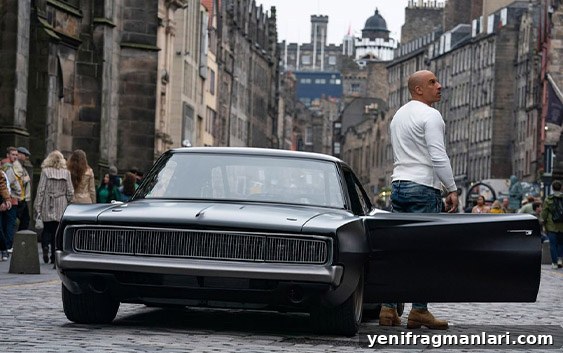

F9: The Fast Saga (2021)
Director: Justin Lin
Screenwriters: Daniel Casey, Justin Lin
Starring: Vin Diesel, Michelle Rodriguez, Tyrese Gibson, Chris “Ludacris” Bridges, John Cena, Jordana Brewster, Nathalie Emmanuel, Sung Kang, Michael Rooker, Helen Mirren, Kurt Russell, Charlize Theron
F9: The Fast Saga, directed by Justin Lin, continues the franchise’s steady drift into increasingly extravagant action territory while attempting to recapture the emotional core that made earlier entries memorable. The film centers on Dominic Toretto (Vin Diesel) and his chosen family as they confront Dominic’s estranged brother Jakob (John Cena), a trained operative whose pursuit of a powerful device—Project Aries—raises the stakes to global proportions.
Project Aries functions as the story’s MacGuffin: a split sphere and a corresponding key that together grant control over global weapons systems. With that device as the motivation, the plot moves through globe-trotting set pieces and set-piece confrontations, blending car-based action with spy thriller elements. Although traditional drag-racing sequences are limited, vehicle spectacle remains at the heart of the film, along with hand-to-hand fights and large-scale standoffs.
The film adds considerable backstory for Dom and Jakob, using flashbacks to deepen their sibling rivalry and to retcon events referenced in the original film. These scenes work surprisingly well, creating emotional context for Dominic’s fierce loyalty to his adopted family and his long-standing resentment toward Jakob. The new material helps explain why Dom’s crew, a group of street racers and mechanics, have been repeatedly pulled into international espionage—Jakob’s path into covert operations becomes the connective tissue that binds past and present entries in the franchise.
John Cena brings an imposing calm to Jakob that contrasts effectively with Diesel’s gruffer, more sentimental Dom. Their pairings give the film some of its strongest moments: intimate, physical confrontations between two brothers with deeply different moral codes. Still, the absence of Dwayne Johnson and Jason Statham is palpable—those characters previously contributed a significant portion of the franchise’s rough humor and kinetic energy. Paul Walker’s absence continues to loom as well, and the ensemble feels thinner for lacking these familiar presences.
Much of the runtime divides the surviving core crew—Letty (Michelle Rodriguez), Mia (Jordana Brewster), Roman (Tyrese Gibson), Tej (Ludacris), and Ramsey (Nathalie Emmanuel)—across locations and missions. Their chemistry remains one of the franchise’s strengths, particularly the banter between Roman, Tej, and Ramsey, which offers genuine warmth and comedic relief. However, many sequences emphasize spectacle over character interaction, leaving opportunities for deeper emotional beats underused or rushed.
Performances in F9 are a mixed bag. Longtime series regulars continue to inhabit their roles with ease, delivering recognizable rhythms that audiences expect. At times, though, the emotional scenes feel undercut by flat delivery, and some action moments lose tension because reactions are muted or staging prioritizes spectacle over clarity. For example, a tense sequence that should convey urgency instead plays as oddly casual, diminishing its impact.
The action is where F9 aims to satisfy franchise fans. It offers a buffet of set pieces—magnet arms attached to cars, extended chases, and large-scale combat—that strive to outdo previous installments. Many sequences are undeniably imaginative and heavily CGI-enhanced. The most effective action remains the close-quarters fights: Dom versus Jakob, Letty and Mia against armed foes, and smaller-team clashes that balance choreography and physical stakes. By contrast, some prolonged chase scenes feel repetitive and overlong, punctuated by faceless adversaries and visual effects that occasionally rob the sequences of urgency.
Pacing is a recurring issue. The film often spends long stretches on connective mayhem that could have been tightened, leaving the climax—where the stakes should be most intense—delivered through montage and expository monologue rather than in real time. That structural choice undercuts the emotional payoff of several plotlines and contributes to the sensation that the film is longer than it needs to be.
Ultimately, F9 preserves the franchise’s appetite for escalating spectacle and familial themes, but it doesn’t fully recapture the balance of heart and momentum achieved in the series’ strongest entries. There are moments of genuine excitement and emotional resonance, particularly in the brother-versus-brother confrontations and the quieter scenes that recall the series’ earlier focus on loyalty and redemption. Still, on balance this installment feels lighter on substance and heavier on bombast.
Fans of high-octane action and long-running franchise arcs will find plenty to enjoy, especially those invested in the Fast & Furious universe and its evolving mythology. For viewers hoping for tighter storytelling and sustained emotional payoff, F9 may fall short. The film sets the stage for future installments, and one can hope the franchise reassembles its broader ensemble for the next chapter to restore the full energy and camaraderie that made the series a cultural phenomenon.
12/24
Recommended for you: Every Fast and Furious Movie Ranked