


Written and directed by Sandra Wollner, Everytime opens with a powerful, emotionally shattering sequence that quickly reshapes the lives of its central characters. That early blow presents a difficult challenge: how to sustain the film’s emotional intensity without becoming repetitive or melodramatic. Wollner answers by deliberately pulling the film toward quietness. Rather than amplify the initial trauma, she follows three people as they attempt to carry on with ordinary daily routines while living with a permanent absence between them.
For a long stretch the approach is remarkably effective. The film lingers on small domestic details—homework, shopping, mundane conversations, meals, and travel around Berlin—allowing grief to infuse these moments without ever pausing for an explanatory monologue. This restraint gives the characters room to exist in private, unsettled ways; their feelings are implied through gesture, a lingering shot, ambient sound, and the textures of their surroundings. Those choices keep the film intimately grounded, and they make the later tonal shift feel earned rather than abrupt.
There are moments in the second act when the quietness risks becoming too steady and one might wonder whether the movie will remain staunchly naturalistic. But Wollner and cinematographer Gregory Oke have been quietly arranging visual and aural clues within that realism—small flashes that hint at something more. When the third act arrives, those hints coalesce into one of the most affecting conclusions I have seen in some time, transforming the film and inviting a second viewing to catch the earlier foreshadowing.
Screened at the 2026 Toronto International Film Festival after its Cannes Un Certain Regard premiere; Canadian distribution is handled by Films We Like.
What is Everytime About?
Everytime centers on Ella (Birgit Minichmayr), her younger daughter Melli (Lotte Shirin Keiling), and Lux (Tristan Lopez), who was the boyfriend of Ella’s older daughter, Jessie (Carla Hüttermann). After a tragedy that alters their family dynamic, the three decide to take a holiday that never occurred: a trip to Tenerife intended to occupy the space where the past and present begin to overlap.
Wollner spends much of the film with the routines of life to show how grief permeates the ordinary. Rather than dramatize feelings with speeches, the film keeps Jessie present through small sensory details: a melody she once played, the echo of footsteps, photographs, recordings, and the rooms she used to inhabit. The director’s initial image while writing—Ella on the couch hearing the small domestic sounds Jessie would make—becomes an organizing idea. These everyday auditory cues function as anchors, making the deceased character persist in the film’s atmosphere long after her physical absence.
Gregory Oke, Aftersun, and the Shape of Absence
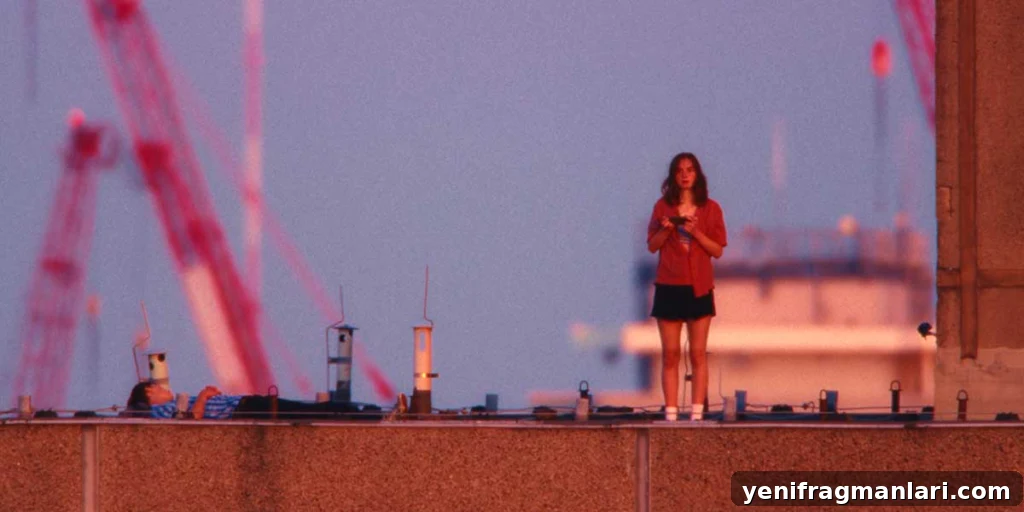
Because Gregory Oke was the cinematographer on both this film and Aftersun, comparisons are inevitable. Both films explore memory, family, loss, and the subjective experience of remembering. Wollner and Oke often use architectural elements—doorways, walls, different planes—to divide characters within the frame, a strategy that speaks to separation and the shape of absence. Those divisions visually communicate what words do not: people sharing a space who can no longer fully occupy it together.
Oke’s camera frequently adopts a removed viewpoint, looking through trees or using long lenses and environmental obstacles that partially obscure the frame. Sometimes this creates a voyeuristic sense, as if the audience is witnessing private family moments. At other times the camera glides more freely, taking on an almost spectral presence that moves through time and space. Shooting on film gives the images a tangible grain and a soft halation around highlights; a number of sequences—especially one involving Ella—are quietly beautiful because of that tactile, analog quality.
One sequence—an early elevator moment with Melli—stands out. It uses reflections to subtly shift our perception of the character and her surroundings, a moment whose timing and composition are particularly affecting. There is also a dance-club scene that echoes a sequence in Aftersun; while the comparison is understandable, the rest of the film’s visual language is distinct enough that such repetitions feel unnecessary.
Keeping Jessie Present: Sound, Space, and Digital Memory

Jessie’s presence is maintained through a mosaic of traces: a tune that returns, the percussion of steps, photographs, old audio, and the abandoned spaces she inhabited. Melli’s way of encountering Jessie is particularly contemporary—a digital world Jessie created inside a sandbox-style game. Rather than make a statement about technology, Wollner treats the game as another form of memorial: a three-dimensional space the living can enter to encounter remnants of the person they lost.
This idea modernizes the film’s treatment of memory without turning it into a techno-parable. The game functions like a photograph made navigable: an environment stitched from someone’s habits and choices, accessible to those who want to be in it. Across the first two acts, these various forms of lingering—sound, image, space, and digital architecture—build a consistent logic for how the living continue to meet someone who is gone. The film’s final act then asks how far that logic can be taken.
There are stretches in the middle that could be tightened; however, the patient, grounded quality of these scenes strengthens the impact of the film’s eventual slip into more explicit surrealism. Wollner intentionally planted small uncanny moments early on—hints that something shimmered beneath the surface—so that when the film becomes more metaphysical, the turn feels both surprising and coherent.
When Memory Becomes Physical

Water functions as a recurring motif, bridging the concrete and the uncanny. It appears in Berlin, on holiday, and in small everyday details—leaking from a bottle onto a shirt—serving as a sensory connector between different times and places. Wollner shot much of the holiday portion in Tenerife, specifically Punta del Hidalgo, because the location felt slightly out of time—an aesthetic quality that amplifies the film’s bending of reality.
The film’s surreal turn does not feel arbitrary; it grows out of how memory actually behaves. Grief often makes perception unreliable: one can sense someone’s presence in an empty room, hear a familiar sound that belongs to the past, or expect a loved one to appear at a doorway. Wollner follows that emotional logic into a territory where memory feels almost tangible. A phrase she followed in the writing process—“The sun did not set”—became an image that guided the film toward a central question: what would happen if memory were so vivid you could enter it and try to bring someone back, even momentarily?
When the film embraces that question, the earlier elements—photographs, recordings, empty rooms, and digital spaces—reconfigure into methods for accessing someone who is gone. The result is an ending that is as emotionally daring as it is difficult to describe without spoiling. It magnifies the stakes of remembrance and asks what one might do if given the impossible chance to touch a vanished life again.
Is Everytime Worth a Watch?
Yes. Everytime is a film that rewards patience. Its deliberate pacing and attention to small, sensory details create a realistic emotional terrain that makes the eventual metaphysical shift unexpectedly powerful. The film begins as an intimate study of people trying to live with loss and evolves into an exploration of how memories attach to places, sounds, images, and even virtual spaces. When Wollner takes the film beyond strict realism, she does so in a way that feels emotionally authentic and visually resonant.
My experience was uneven at times, but in a way that increased my desire to revisit the film with the knowledge of its trajectory. If you appreciate films that treat grief with nuance, that use sound and image to keep an absent presence alive, and that allow surreal elements to emerge organically from emotional truth, Everytime is well worth your time.
Read More:
- Interviews
- Film Reviews