Albert Camus and Jean-Paul Sartre. Edgar Allan Poe and Charles Dickens. The Beatles and Elvis Presley. It’s always compelling when two giants of a field meet: Camus and Sartre debated existentialism for years; Poe and Dickens exchanged stiff, occasional conversation; and The Beatles’ brief jam with Elvis left both sides surprised. What, then, is the opposite of such meaningful encounters—two minds engaging productively?
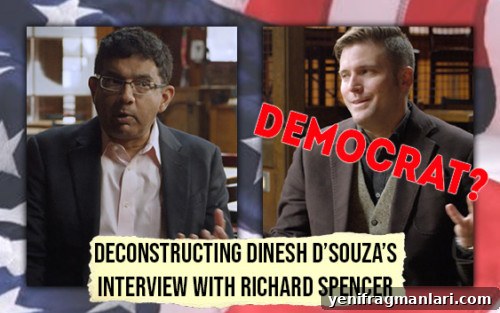
Easy. It’s the moment Richard Spencer is “interviewed” by Dinesh D’Souza in D’Souza’s documentary-style film, The Death of a Nation.
Dinesh D’Souza styles himself as a filmmaker and conservative provocateur. He has written and directed a number of partisan films that boil down to the same basic claim: conservatives are right, liberals are wrong. His recurring arguments can be summarized as:
- American political parties and their core identities have remained the same since the 19th century.
- The labels “Republican” and “Democrat” carry fixed meanings and cultural stereotypes that define people’s politics.
- Progressive policies have dangerous historical parallels, and modern Democrats can be compared, inaccurately and provocatively, to historical authoritarian movements.
These claims are not harmless hyperbole. In The Death of a Nation, D’Souza explicitly compares modern progressive support for public services to historical totalitarian regimes, implying that today’s advocates of national healthcare or education are aligned with or will lead to atrocities. That leap is historically and logically unsound, yet it drives the film’s narrative.
Where D’Souza traffics in patriotic myth—Founders, rugged individualism, and an idealized American past—Richard Spencer traffics in an even darker obsession: white identity, ethnostate theory, and overt white nationalism. Spencer is a leading figure in the alt-right movement who openly endorses ethnonationalist ideas and has advocated for policies that exclude non-white people from full participation in the country. He is widely known for being struck in public and for creating debates about how to respond to violent or extremist speech.
The premise of D’Souza’s conversation with Spencer is revealing. D’Souza appears to be attempting to separate his own brand of pro-Trump conservatism from Spencer’s explicit white nationalism—to demonstrate that not all Trump supporters are racist. Instead, the segment plays like a series of leading questions, awkward edits, and missed opportunities for real critique. The setting is informal—a coffee-shop style sit-down—where D’Souza, serious-faced, and Spencer, grinning to be heard, exchange clipped remarks that are frequently cut off in post-production.
The following transcript excerpts and paraphrases reflect that interaction, cleaned up for clarity:
Dinesh: “People have called you a Nazi. Are you a Nazi?”
Richard: “No, I’m not a Nazi. I’m not a neo-Nazi.”
That denial, unsurprisingly, is not persuasive on its own. D’Souza himself has defended politicians who have promoted discriminatory policies, yet he seems momentarily unsettled when a self-identified white nationalist uses the same rhetorical shield. The exchange quickly shows D’Souza’s discomfort when ideology and labels collide in a way that undermines his narrative.
Dinesh: “You were seen at that rally. You didn’t repudiate them. Are you okay with that?”
Richard: “I said ‘Hail Trump…’”
Dinesh: “Doesn’t ‘Hail Trump’ sound unnervingly like ‘Heil Hitler’?”
That rhetorical question is clumsy but not entirely without context: public praise for authoritarian figures and crowds chanting extremist slogans make comparisons inevitable for many observers. D’Souza’s trouble is that he tries to thread a needle—defend conservative figures while distancing them from clearly extremist elements—without engaging the real ideological substance of Spencer’s beliefs.
Dinesh: “Would you restrict immigration entirely, not just illegal immigration?”
Richard: “[It’s fine if they’re white].”
Spencer’s answer is blunt and damning: his opposition to immigration is racially selective. D’Souza, who earlier in his film claimed that modern party alignments haven’t changed, appears simultaneously eager to separate Trump from extreme racism and unwilling to acknowledge how Trump’s rhetoric and policies have appealed to white nationalist audiences.
D’Souza attempts several tactics in the conversation: he frames historical comparisons (arguing that early 20th-century progressivism included elements later associated with racial movements), he tries to force Spencer into admitting party allegiance to make an ideological point, and he invokes constitutional ideals as a defense of limited government. Spencer, for his part, at times offers florid and provocative statements and at times makes oddly reductive claims about the nature of rights and the state—remarks often interrupted or edited in the final cut.
Dinesh: “Isn’t progressivism—early 20th century—similar to some of what you express?”
Richard: “You can sometimes find elective affinities.”p>
That answer—careful, evasive, and strategic—allows Spencer to suggest historical commonalities without embracing any forced classification. D’Souza uses such moments to argue that contemporary political labels are confusing or interchangeable, but the substance of Spencer’s identitarian claims is distinct from twentieth-century labor and social reform movements.
Other moments in the dialogue are notable for how badly they land. D’Souza compares the rhetorical aims of Spencer to a “white Malcolm X” at one point—an equivalence that is historically tone-deaf and morally inverted. Spencer’s praise of films like Birth of a Nation, which glorified a racist vision of American history, is treated as another data point D’Souza tries to fold into a larger argument about party continuity—an argument that ultimately relies on conflation rather than careful historical analysis.
Throughout, the interview exposes both men’s limitations. D’Souza’s approach is defensive and loaded with leading questions aimed at proving a preexisting thesis rather than learning or refuting. Spencer’s answers reveal the exclusionary logic at the heart of white nationalism and the intellectual strategizing that cloaks it in euphemism and historical analogy. Where a genuine intellectual exchange might have tested these ideas with rigor, the segment instead functions as spectacle: an attempt to sanitize or explain away extremist views by folding them into partisan talking points.
By the end of the conversation, the broader point becomes clear: sloppy analogies about party labels and selective appeals to history cannot neutralize the real harms of white nationalism or the political movements that enable it. D’Souza’s efforts to place Spencer within a tradition he can tolerate only emphasize how shallow that tradition is when it refuses to confront racism directly.
Ultimately, the sit-down offers no reconciliation, only a reminder that labeling and posturing are poor substitutes for honest debate. D’Souza’s desire to preserve a comfortable narrative about American conservatism clashes with Spencer’s unapologetic ethnonationalism—and the result is an awkward, revealing exchange that does neither argument justice.
Fucking idiot.