
Sleeping Beauty (1959)
Directors: Clyde Geronimi, Eric Larson, Wolfgang Reitherman, Les Clark
Screenwriters: Erdman Penner, Joe Rinaldi, Winston Hibler, Bill Peet, Ted Sears, Ralph Wright, Milt Banta
Starring: Mary Costa, Bill Shirley, Eleanor Audley, Verna Felton, Barbara Luddy, Barbara Jo Allen, Taylor Holmes, Bill Thompson, Marvin Miller
Disney has long held a dominant place in the world of animation. Over its first century the company accumulated countless accolades, established characters like Mickey Mouse as global icons, and absorbed major studios and franchises. That success, however, did not come without uneven periods. In the years leading up to Walt Disney’s death in 1966, the studio experienced a creative lull and several disappointing box office results. One notable example from that era is Sleeping Beauty, which premiered in 1959. Initially met with a muted reaction, the film’s fairy-tale style and reception contributed to a temporary decline in Disney’s production of similar stories until the late 1980s revival of the genre.
The film draws its narrative from Charles Perrault’s 17th-century version of the tale and borrows musical inspiration from Tchaikovsky’s ballet of the same name. It opens with the image of an ornate storybook titled “Sleeping Beauty,” a visual nod to medieval illuminated manuscripts. Narration sets a classical fairy-tale tone as richly detailed page designs come to life and lead into a grand castle celebration. The animators intentionally adopted a stylized, medieval-inspired look rather than a strictly realistic approach, making the movie stand out visually among Disney’s animated features of the period.
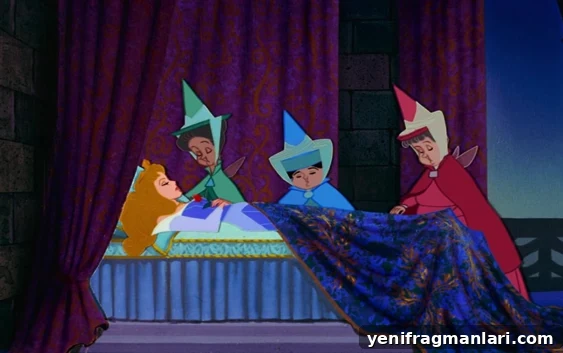
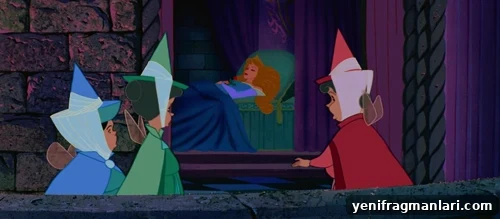
At King Stefan’s court, the birth of Princess Aurora is celebrated by the kingdom. Three good fairies—Flora, Fauna, and Merryweather—appear to bestow gifts: beauty and song, while the final fairy is interrupted before delivering her full blessing. Into this celebration strides Maleficent, the “Mistress of All Evil,” who curses the infant princess in revenge for being excluded. She proclaims that on her sixteenth birthday Aurora will prick her finger on a spinning wheel and fall into a sleep from which she cannot awaken. Though the third fairy cannot fully undo the curse, she mitigates it by declaring that true love’s kiss will ultimately break the spell. To protect Aurora, the fairies hide her and raise her disguised as a peasant in a forest cottage. Years later, despite their efforts, Aurora is lured back and the curse is fulfilled, setting the stage for Prince Philip and the fairies to try to save her.
Criticism of the film often centers on the heroine’s limited development. Contemporary commentators note that Aurora is a quiet, almost passive presence for much of the story; her character arc is less complex than those of other Disney protagonists. Feminist critiques point out that her defining traits are surface-level gifts—beauty and song—given by the fairies, and that she quickly falls in love with a stranger. Viewed through a modern lens, Aurora can feel underwritten and lacking in agency compared with later, more fully formed Disney heroines.
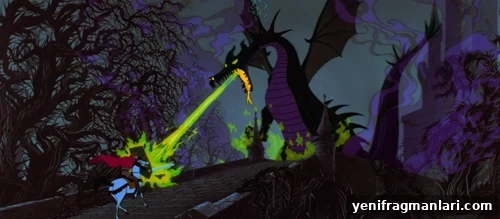
Yet focusing only on Aurora’s shortcomings overlooks other strengths. The story is largely driven by women: the three fairies and Maleficent are central to the plot and offer a range of personalities and abilities. Flora is practical and nurturing, Fauna is gentle and well-meaning, and Merryweather is outspoken and resourceful. They take on crucial tasks—raising Aurora, protecting her, rescuing Philip when he is captured, and using their magic to overcome obstacles. While their efforts are portrayed in familiar domestic terms at times, their magic reframes these chores as acts of competence and teamwork rather than mere background detail. Maleficent, meanwhile, remains one of Disney’s most iconic villains: elegant, commanding, and theatrically designed. Her transformation into a dragon in the film’s climactic sequence is a memorable embodiment of classic villainy and spectacle.
Musically, the film has notable moments: “Once Upon a Dream,” the duet between Aurora and Philip, remains a recognized melody and Mary Costa’s performance is often praised. However, unlike some Disney musicals that contain multiple standout numbers, Sleeping Beauty relies more heavily on its orchestral and ballet-inspired score and visual design than on a string of pop-style showstoppers. The film was created in Technicolor and is distinguished by a bold, saturated palette—especially evident in scenes where the fairies magically change Aurora’s dress from pink to blue, a vivid display of the animators’ color choices.
The film is rich with familiar fairy-tale elements—animal companions, destiny, and happily-ever-after endings—and some of these conventions have not aged well for modern audiences. The idea of an unconscious “true love’s kiss” raises ethical concerns for contemporary viewers, and the romance between Aurora and Philip is rooted in an idealized notion of love at first sight. At the same time, Sleeping Beauty should be appreciated for its artistic ambitions: the stylized medieval art direction, the Tchaikovsky-inspired music, and the clear emotional impact of its villain and supporting characters.
While not the studio’s most celebrated classic, and often overshadowed by films from the Disney Renaissance and by earlier landmarks like Snow White and the Seven Dwarfs, Sleeping Beauty remains worth revisiting. Its visuals are among Disney’s most striking, its score is classically influenced and lush, and the story gives space to memorable female figures—both heroic and villainous. On its anniversary, the film offers a blend of artful design and storytelling that still rewards viewers willing to appreciate it on its own terms.
Score: 18/24
Rating: ★★★ out of ★★★★★
Rating: 3 out of 5.