
Hidden Figures (2016/2017)
Director: Theodore Melfi
Screenwriters: Theodore Melfi, Allison Schroeder
Starring: Taraji P. Henson, Octavia Spencer, Janelle Monáe, Kevin Costner, Jim Parsons
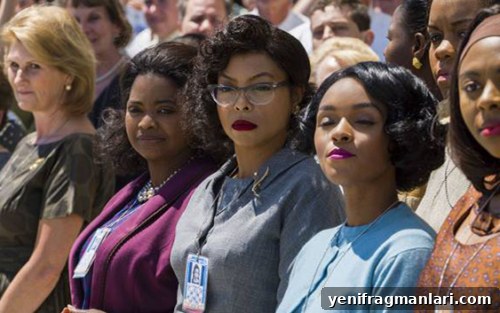
Hidden Figures recounts the remarkable stories of three African American women who worked at NASA in the early 1960s, as the American space program prepared to send men into orbit. The biographical drama examines the obstacles they faced under segregation and systemic bias and celebrates their achievements through an uplifting narrative. Taraji P. Henson portrays Katherine Goble, a mathematical prodigy whose contributions became essential to the safety of the first astronauts. Octavia Spencer plays Dorothy Vaughan, an unofficial supervisor guiding a group of Black women serving as human “computers” in a segregated section of NASA. Janelle Monáe is Mary Jackson, a sharp and determined woman who aspires to become an engineer and must clear numerous institutional hurdles to pursue that goal.
Karl Zielinski: “If you were a white male, would you wish to be an engineer?”
Mary Jackson: “I wouldn’t have to. I’d already be one.”
The film is both empowering and inspiring, offering thoughtful reflections on how the protagonists navigated prejudice while making crucial contributions to the space program. An early scene in which the three women’s car breaks down and a white police officer arrives captures the anxiety of the era and the risks they faced. The officer’s measured reaction, and the scene’s placement in the film, demonstrate how the movie blends social commentary with human-centered storytelling rather than relying on overt polemic.
Many of the film’s conflicts stem from interactions within the Black community as well as the broader society. Romantic and family relationships reveal additional layers of tension: Jim Johnson (Mahershala Ali), a potential love interest for Katherine, can be dismissive and underestimates her intellect; Mary Jackson’s husband, Levi (Aldis Hodge), also struggles with the social pressures of the time. These domestic and interpersonal dynamics function as political statements in themselves, highlighting the everyday realities of the characters. Kirsten Dunst’s Vivian Mitchell serves as an institutional antagonist, her condescension reflecting the systemic biases the women must navigate.
Octavia Spencer’s performance earned recognition with a nomination for Best Supporting Actress, and it’s easy to see why. Her portrayal balances humor and authority, making Dorothy’s leadership and small rebellions feel authentic and emotionally resonant. The omission of Taraji P. Henson from the Best Actress category felt especially glaring given her powerful, nuanced performance. Henson convincingly expresses Katherine’s fierce intellect and quiet determination, grounding the film’s emotional core and elevating the screenplay’s inspirational beats.
One of the film’s stylistic strengths is the use of archival footage interwoven with dramatized scenes. This technique, increasingly common in recent historical dramas, reminds viewers that the events depicted are rooted in real history and serves as an emotional anchor that amplifies the film’s impact. These documentary flashes strengthen the sense of authenticity and make key moments particularly poignant.
The movie is not without its dramatic licenses. Certain scenes amplify or rearrange historical events for cinematic effect. For example, a moment in which Katherine is mistaken for a cleaner when she enters the Space Task Group’s area functions as a stark metaphor for the assumptions she confronted, but it may feel heightened compared to other, subtler portrayals of discrimination. Another memorable scene shows Al Harrison (Kevin Costner) breaking down a bathroom sign in a symbolic gesture of equality; while visually striking and narratively satisfying, this specific moment did not occur exactly as depicted. The filmmakers appear to have chosen these embellishments to underline the film’s themes of resistance and change, using a few larger-than-life beats to represent broader institutional shifts.
Similarly, Jim Parsons’ character Paul Stafford is largely a fictional composite who embodies sexist and racist obstacles Katherine faces. Though figures like Stafford likely existed, the introduction of a composite antagonist compresses and simplifies complex historical interactions. At times, this produces a clearer dramatic arc, but it also smooths over real-life collaboration and nuance that might have been equally compelling on screen.
Despite those invented details, the film feels largely authentic and emotionally truthful. Its greatest achievement is centering the personal courage, intelligence, and resolve of three women who helped shape a pivotal moment in history. The screenplay balances humor, irony, and emotional stakes so that characters feel lived-in and real, and the performances are committed and affecting throughout.
In short, Hidden Figures is a richly human and motivating film that I recommend to a wide audience. You do not need a background in mathematics to appreciate it—many of the men at NASA in the film don’t fully grasp the technical work either, which helps make the material approachable. The fictionalized elements are not enough to diminish the overall experience: the movie remains moving, inspiring, and well-crafted. The cast delivers uniformly excellent performances, and even characters who begin as antagonists become sympathetic as the story unfolds. Accept a few dramatic liberties, embrace the characters, and let their achievements and resilience resonate. Films like this—shining a light on lesser-known figures who made vital contributions—are essential and welcome.
Score: 19/24
Written by Elle Cole