
This article was written exclusively for The Film Magazine by Samuel Sybert.
Quentin Tarantino’s long-awaited Once Upon a Time… in Hollywood premiered to a seven-minute standing ovation at Cannes 2019, and early praise has sparked renewed debate over a familiar question: can Tarantino ever top Pulp Fiction? Some critics now whisper that Hollywood might be the film to do it. For those who prefer a concrete answer rather than conjecture, it’s worth revisiting Tarantino’s 2009 film Inglourious Basterds — a movie that, in many ways, already proved his mastery.
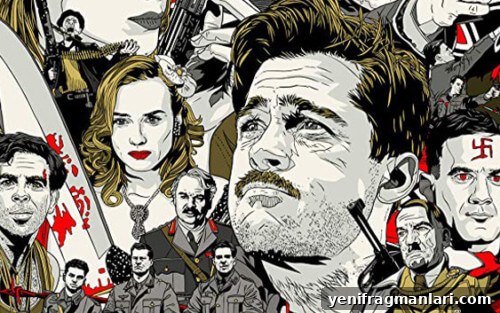
Set in Nazi-occupied France during World War II, Inglourious Basterds follows a small, unconventional squad of Jewish-American soldiers led by Lieutenant Aldo Raine (Brad Pitt). Raine’s blunt orders establish the film’s tone early: their mission is singular and brutal — to hunt down and kill Nazis. Tarantino layers coarse humor over physical menace, creating characters who are at once larger than life and intensely human. The film has moments of shocking violence, but its real power often comes from the subtleties of performance and the precision of its dialogue.
Beyond Aldo Raine and his crew, the film introduces several central players who shape the story. Christoph Waltz’s Colonel Hans Landa, an unnervingly polite and intelligent Nazi interrogator, dominates the screen with a performance that earned him an Academy Award. Shoshanna Dreyfus (Mélanie Laurent) survives Landa’s early atrocity and later adopts the alias “Emmanuelle Mimieux” as she runs a small Parisian cinema. Her path toward vengeance intersects with the career-obsessed German war hero Frederick Zoller (Daniel Brühl), who becomes the subject of a Nazi propaganda film, Nation’s Pride — a project promoted by Joseph Goebbels (Sylvester Groth).
When Zoller convinces Goebbels to premiere Nation’s Pride at Shoshanna’s theatre, she seizes the opportunity for retribution. Shoshanna and her lover and employee Marcel (Jacky Ido) plan to burn the theatre during “Nazi night.” Meanwhile, Aldo Raine and his team are given a parallel mission: with help from a German-speaking British soldier (Michael Fassbender) and the double agent movie star Bridget von Hammersmark (Diane Kruger), the Basterds are tasked with sabotaging the premiere. Tarantino fits these converging plans into a finale that explodes with equal parts violence and dark catharsis.
Tarantino’s craft is most evident in how he builds tension. Rather than relying on constant shocks, he mines extended exchanges and small gestures to ratchet up suspense until it feels almost unbearable. A standout example is the tavern basement scene where Fassbender and Kruger’s undercover pair sit among real German soldiers alongside two of the Basterds. Tarantino constructs a series of escalating beats — a suspicious question, a dubious accent, an offhand remark about stationing — each one increasing the danger. The final, tiny hand gesture that betrays Fassbender’s character is a masterclass in silent storytelling: a single close-up on August Diehl’s face communicates the shift from pretend normalcy to imminent threat without a line of dialogue.
Tarantino times his close-ups with surgical precision. Moments that focus tightly on faces let the actors reveal inner stakes — fear, triumph, calculation — in a single frame. Waltz’s Landa benefits enormously from this approach; many of his most memorable beats are conveyed through expression and eyes rather than exposition. The screenplay itself bristles with layered dialogue, and the rhythms of speech are as crucial as physical action. Viewers who dismiss lengthy conversations as “throwaway” miss the point: Tarantino’s dialogue often contains the film’s emotional and thematic core.
Inglourious Basterds also revels in rewriting history. Tarantino’s alternate-history finale allows him to dismantle and satirize Nazi mythology, turning grotesque power into comic humiliation. The film peppers pop-culture references and period-specific details — nods to directors like Leni Riefenstahl and G.W. Pabst, songs that jar against the visuals, and cinematic satire — all of which deepen the film’s texture without ever collapsing into mere pastiche. Tarantino keeps the Nazis dangerous enough to respect the real stakes while simultaneously inviting audiences to laugh at their pretensions. Goebbels emerges as buffoonish, and even the film’s depiction of Hitler (Martin Wuttke) undermines his dread by rendering him absurd in certain scenes.
For all its moments of awkwardness and rough edges, Inglourious Basterds is a towering achievement. Tarantino assembles a diverse cast of characters, each propelled by distinct motives, and places them in a story that blends genre thrills, incisive satire, and emotional payoffs. When Aldo Raine carves a swastika into a captive’s forehead and muses that “it just might be his masterpiece,” the line feels like a proclamation about the film itself. Inglourious Basterds is audacious, darkly funny, and boldly original — a film that affirms Tarantino’s voice and ambition.
Written by Samuel Sybert