
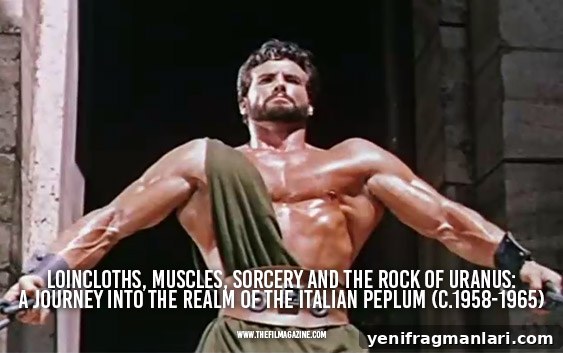
‘Or if you want something visual that’s not too abysmal’, Frank-N-Furter sings to Brad and Janet in The Rocky Horror Picture Show (1975), ‘We could take in an old Steve Reeves movie’. The reference points to the beefcake spectacle of Steve Reeves and other bodybuilders who headlined Italian sword-and-sandal films—commonly called pepla—during the 1950s and 1960s. These films built a distinct camp aesthetic around the muscular male body while combining historical costume, elaborate sets and widescreen spectacle.
The term peplum comes from the Greek word for “tunic.” Although originally used by French critics in the 1960s as a mildly mocking label, it underscores how these Italian sword-and-sandal pictures foregrounded visual spectacle: costumes, large-scale sets, action sequences, photography and, notably, the muscular stars in minimal costume. Widescreen processes amplified the sense of scale, so everything—sets, action, photography, bodies—was presented as big and bold.
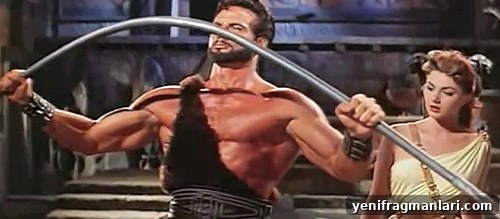
Steve Reeves as Hercules in Le fatiche di Ercole.
Typically starring an American or British bodybuilder—Steve Reeves, Reg Park, Paul Wynter, among others—pepla retold myths and legends featuring Hercules, Maciste, Samson or Goliath. The cycle took off with Pietro Francisci’s 1958 Le fatiche di Ercole (Hercules), starring Reeves, and remained immensely popular in Italy through the mid-1960s. By 1964, with the international success of Sergio Leone’s A Fistful of Dollars, Italian studios shifted many resources to westerns all’italiana (Spaghetti Westerns), which then became the dominant filone (strand) of popular production.
The idea of the filone—singular filone, plural filoni—is central to Italian popular cinema of the period. Comparable to genre cycles in other film industries, a filone is an industrially exploited trend that yields numerous films until the next wave takes over. The peplum was one of the first major filoni and was followed by gothic horror, mondo documentaries, giallo thrillers, commedia sexy, poliziesco crime pictures, jungle/cannibal adventures and others. Many pepla were international co-productions, often involving France, West Germany or Spain, and commonly featured Anglicised credits to appeal to overseas markets.
Actors and crew often used English-sounding names for international releases. Italian bodybuilder Adriano Bellini became “Kirk Morris” in several films; Riccardo Freda was sometimes credited as “Robert Hampton.” Even Italian-American or US-born bodybuilders adopted screen names—Lorenzo Luis ‘Lou’ Degni appeared as “Mark Forest” in export releases. US distributors such as American International Pictures frequently dubbed, rescored and re-edited pepla for English-speaking audiences, sometimes cutting substantial footage for theatrical release.
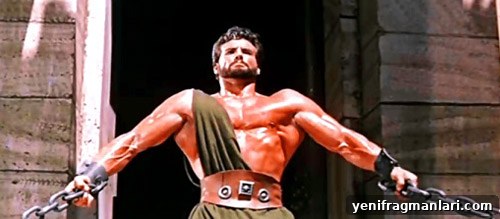
Le fatiche di Ercole (1958)
Pietro Francisci’s Hercules is widely credited with launching the peplum boom. The film mixed mythic material—the Argonauts and the Golden Fleece—with widescreen spectacle and generous marketing overseas, where Joseph E. Levine promoted it successfully in the US. Hercules proved lucrative, helping to establish an international market for similar Italian productions. The pepla drew on the studio resources built up by Hollywood epics shot in Italy at Cinecittà—Ben-Hur and Cleopatra among them—reusing sets and skilled crews to stage more modest, often fantasy-leaning adventures.
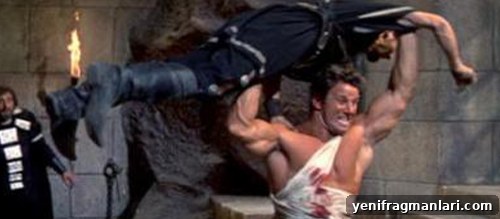
Reg Park in Ursus, il terrore dei Kirghisi (Hercules, Prisoner of Evil – 1964).
Pepla proved remarkably flexible. Though they began with Greek myth, their settings broadened to Rome, the medieval era, even Mongol-period Asia and pirate-infested seas. Producers and US distributors often retitled and redubbed films so heroes such as Maciste or Ursus became “Hercules” or “Goliath” for English-speaking audiences. This practice created a loose but marketable identity that linked otherwise diverse costume adventures to a handful of recognizable heroic names.
Common motifs recur across many pepla: an opening demonstration of the hero’s prodigious strength; a wandering champion arriving to liberate an oppressed community; an evil, manipulative ruler or seductive villainess; and redemption arcs that often conclude with love overcoming corruption. Fantastic elements—monsters, magic, underworld journeys—blend with physical spectacle. Early effects ranged from clever forced perspective and creature suits to stop-motion and compositing, and as the cycle progressed some films leaned further into imaginative, occasionally bizarre fantasy scenarios.
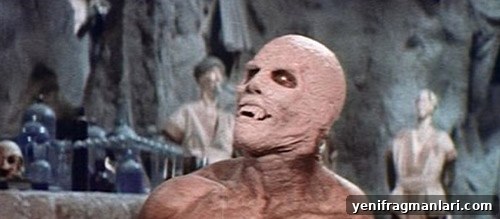
Maciste contro il vampiro (Goliath and the Vampires, 1961)
Directors associated with other Italian filoni—Mario Bava and Riccardo Freda among them—made some of the most striking pepla. Freda’s Maciste all’inferno (Maciste in Hell, 1962) blends sword-and-sandal spectacle with vivid depictions of the underworld and Dantean imagery. It opens in 16th–17th century Scotland, where a witch’s curse terrorizes a community and the amnesiac hero Maciste must descend into Hell to lift it. The film uses Hell as a landscape of spectacle—groaning damned, tortured souls and surreal trials—while incorporating flashbacks and references to earlier Maciste adventures.
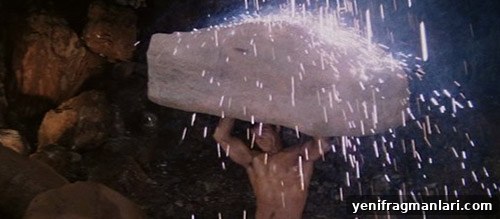
Maciste all’inferno (The Witch’s Curse, 1962)
Mario Bava’s Ercole al centro della terra (Hercules in the Haunted World, 1961) stages another mythic descent. Christopher Lee appears as Lyco, a necromancer who holds Princess Deianira under a dark spell, while Hercules ventures beyond the portal of Hades to face illusions, lava and animated statues. Bava’s film underlines the dualities central to many pepla—light against darkness, surface world versus subterranean evil, brute force versus deception—and demonstrates Bava’s gift for visual storytelling, bold lighting and striking widescreen compositions.
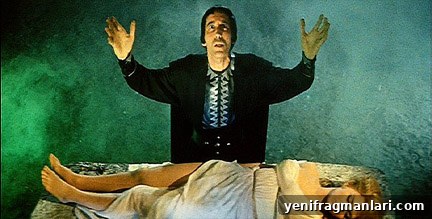
Christopher Lee and Leonora Ruffo in Ercole al centro della terra (Hercules in the Haunted World, 1961).
Late-period pepla sometimes shifted away from pure heroics toward political allegory and darker themes. Giuseppe Vari’s Roma contro Roma (Rome Against Rome, 1964), released in the US as War of the Zombies, combines necromancy with a critique of authoritarian rule and colonial violence. Its necromancer revives slain legionnaires as obedient, unkillable soldiers, and the film depicts reprisals and atrocities that read as implicit commentaries on collective guilt and imperial hypocrisy.
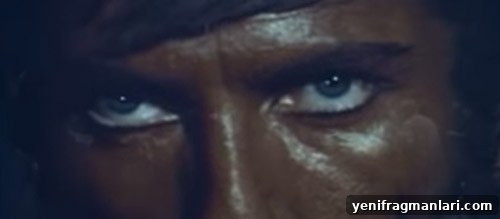
John Drew Barrymore in Roma Contro Roma (War of the Zombies, 1964).
The international popularity of the peplum opened pathways for other Italian exports—Spaghetti Westerns, gialli and poliziotteschi—to reach English-speaking audiences. Pepla also anticipated the 1980s sword-and-sorcery boom in both Italy and the US. Despite being overshadowed in critical discussion by later filoni, the peplum deserves attention both for its sheer spectacle and for the ways stronger examples function as allegories: wrestling with authoritarian legacies, confronting collective trauma and imagining moral redemption through strength and solidarity.
At their best, pepla merge the absurd and the profound, the historical and the fantastical. Whether enjoyed as campy pantomime or read as cultural commentary, these films remain vivid artifacts of mid-20th-century Italian popular cinema—big in scale, bold in color and enduring in influence.
Written by Paul A J Lewis
You can support Paul A J Lewis in the following places:
Website – paul-a-j-lewis.com
Twitter – @Krycek_Facility