
This article was originally published by Sam Sewell-Peterson at SSP Thinks Film.
Searching (2018)
Director: Aneesh Chaganty
Screenwriters: Aneesh Chaganty, Sev Ohanian
Starring: John Cho, Debra Messing, Michelle La, Sara Sohn, Joseph Lee
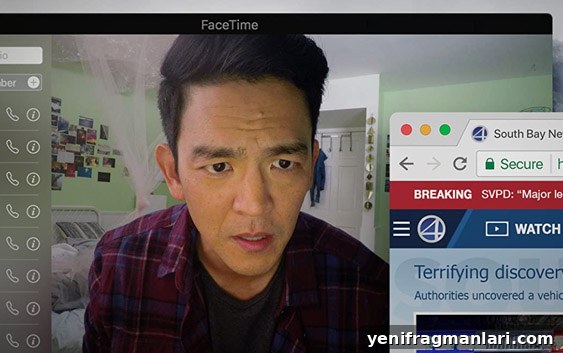
Searching is both a technical innovation and a compelling, old-fashioned mystery-thriller. Aneesh Chaganty’s film reinvents how a story can be told by using the devices and online platforms that already shape so much of our lives. The result is a tense, emotionally resonant film that keeps the audience actively engaged by guiding our attention across screens, windows and browser tabs in ways that feel fresh and organic.
The premise is straightforward but rich in emotional stakes: a widowed father (John Cho) desperately searches for his missing teenage daughter, Margot (Michelle La), using the technology they depended on daily. As the investigation deepens and attracts wider attention, David realises how little he really knows about his daughter’s inner life. The film’s investigation is as much about the gaps between people as it is about clues, and the mystery becomes a vehicle for exploring trust, privacy and the limitations of communicating through screens.
From its very first sequence, Searching demonstrates a mastery of economical emotional storytelling. The opening scene delivers a compact, heartfelt portrait of family life that quickly earns your investment. It’s an example of how visual storytelling can convey a lifetime of feeling in a few carefully chosen moments — the kind of efficiency that recalls the emotional clarity of a great animated short, and it primes the audience for a story that is as much about relationships as it is about suspense.
Technically, the film is remarkable. Chaganty and co-writer Sev Ohanian construct the narrative almost entirely through screens: video calls, social media profiles, search results, surveillance footage and messaging threads. Rather than feeling gimmicky, this approach enhances the drama. The filmmakers use on-screen movement and the composition of digital spaces to control where the audience looks and what we assume is important. That control is central to the film’s misdirection — just when you think you’ve worked out the trajectory, the perspective shifts and reveals something new, often in a small, easily overlooked corner of the interface.
The screenplay balances procedural investigation with intimate, human moments. David’s reliance on technology to preserve memories and maintain contact with Margot is portrayed with nuance. Technology is neither wholly villainised nor blindly celebrated; it is a tool that reflects how people chose to use it. The story points out that text messages and social feeds can feel safe and curated, allowing people to hide what they might say in person. That barrier becomes a thematic core: what remains unsaid when conversation happens behind glass and through typed words?
John Cho anchors the film with a performance that mixes raw vulnerability and dogged determination. The supporting cast, including Debra Messing, contributes to a realistic web of adults trying to cope and help. Michelle La’s Margot exists largely through traces — posts, videos and archived moments — and those fragments are handled with care so the audience feels the loss and the mystery at the same time.
For viewers, the experience is immersive and often unnerving. The film stages a procedural that asks the audience to act as an investigator, piecing together clues from digital detritus. The structure creates real suspense: small discoveries on a laptop or a brief video clip can change the entire understanding of a character. And when the narrative deploys a clever plot device late in the film, it takes the story to an emotionally jolting conclusion that feels earned rather than contrived.
Searching stands out among films that engage with technology because it does not let form eclipse emotion. The story and characters are never reduced by the production’s inventive framing; if anything, the digital presentation heightens the stakes and the intimacy. It is an important and engaging film that demonstrates how contemporary storytelling can evolve while still delivering the core pleasures of suspense and human drama.
23/24