
She’s the Man (2006) — Review and Analysis
Director: Andy Fickman
Screenwriters: Ewan Leslie, Karen McCullah, Kirsten Smith
Starring: Amanda Bynes, Channing Tatum, Laura Ramsey, Vinnie Jones, Julie Hagerty, David Cross, Robert Hoffman, Alexandra Beckenridge, James Kirk, Robert Torti
Before Hollywood became dominated by endless sequels and superhero universes, mainstream teen comedies sometimes served as unexpected gateways to classic literature and conversations about gender. Films like Clueless and 10 Things I Hate About You updated canonical texts for a new generation. In the same spirit, Andy Fickman’s 2006 film She’s the Man, loosely adapted from Shakespeare’s Twelfth Night, blends broad high-school comedy with a surprisingly reflective take on gender roles and identity.
Plot overview
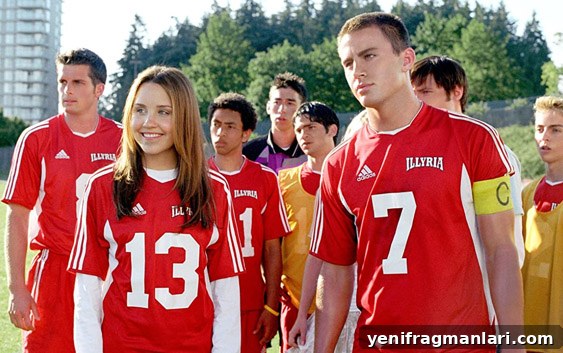
The story follows Viola (Amanda Bynes), captain of her high school girls’ soccer team, who is devastated when the program is cut. Determined to prove that girls can compete equally with boys, she clashes with dismissive teammates and even her own boyfriend, the boys’ goalkeeper. When her twin brother Sebastian jets off to London with his band and asks Viola to cover for him at his new school, she seizes the opportunity. Disguised as Sebastian, Viola enrolls at Illyria Preparatory, joins the boys’ soccer squad, and plans to beat Cornwall High while exposing the unfairness of gender assumptions.
Disguise, comedy and complications
Viola’s transformation involves wardrobe, a wig, stick-on facial hair and a crash course in boyish mannerisms. The resulting comedy comes from physical performance and the inevitable slips where her true self peeks through the mask. Complications deepen when Viola’s roommate, the handsome and charismatic Duke Orsino (Channing Tatum), becomes a distraction. What plays out is a mix of pratfalls, romantic confusion and moments that challenge the stereotype-driven assumptions surrounding masculinity and femininity.
Gender, performance and satire
Viewed today with a more nuanced understanding of gender, She’s the Man reads as an attempt to dismantle simplistic ideas about sex and identity. Viola’s exaggerated grunts, swagger and offhand sexism are less an accurate portrait of men and more a window into how a teenage girl perceives masculinity based on her lived experiences. The film uses those impressions to reveal how much gender can be a performance, exposing the scripts society often expects people to follow.
Scenes where Viola’s mother coaches her on “ladylike” behaviour—complete with comic instructions like “Chew like you have a secret”—satirize rigid female expectations, while moments when Viola inadvertently slips into complimenting another woman’s shoes or fainting at a frog dissection mock the brittleness of gender role policing. The film invites viewers to laugh at those extremes while also recognizing their absurdity.
What feels dated and what endures
Some elements of the film have not aged as neatly. The big reveal hinges on bodies being exposed to prove biological sex, a conceit that feels outdated in light of contemporary conversations about gender as a spectrum and the visibility of non-binary identities. The movie only lightly touches on homoerotic subtext and flirts with an LGBTQ+ reading without committing to a deeper exploration, which is a missed opportunity given the material’s origins in Shakespeare, who often played provocatively with gender and desire.
Performances and comic strengths
Amanda Bynes is the film’s undeniable engine. Her physical comedy, energy and timing carry the material; she often recalls the explosive presence of young comedic performers who could command a movie by sheer force of personality. Channing Tatum provides appealing chemistry and early flashes of the easy charisma he would refine in later roles. Supporting players add texture, keeping the film lively and broadly entertaining.
Context and later reflections
At the time of its release, She’s the Man did well at the box office and earned a strong following among teen audiences. Critics were mixed, and some dismissed the film’s approach to gender and humor. Looking back now, it’s also hard not to consider Amanda Bynes’ public struggles in subsequent years and how the media’s handling of young performers has evolved. Conversations about mental health, celebrity and media treatment of youth have become more prominent, adding a bittersweet dimension to revisiting performances from that era.
Conclusion
Ultimately, She’s the Man remains a pleasurable, spirited teen comedy. Its jokes still land, and its central conceit—using disguise and misunderstanding to question social norms—retains charm. While some of its solutions and plot devices feel rooted in a 2000s sensibility, the film’s playful critique of gender performance and Amanda Bynes’ standout work make it worth revisiting. It may not fully satisfy modern conversations about gender and identity, but it succeeds as an entertaining, thoughtful piece of mainstream teen cinema that encouraged audiences to think, even if indirectly, about who we are expected to be.
19/24