
The Darjeeling Limited (2007)
Director: Wes Anderson
Screenwriters: Wes Anderson, Roman Coppola, Jason Schwartzman
Starring: Owen Wilson, Jason Schwartzman, Adrien Brody, Amara Karan, Waris Ahluwalia, Natalie Portman, Anjelica Huston, Bill Murray
“Yes, the past happened. But it’s over, isn’t it?” – one of the many very poignant lines in Wes Anderson’s emotionally charged The Darjeeling Limited.
Released in 2007, The Darjeeling Limited is Wes Anderson’s fifth feature and a vivid example of his distinctive filmmaking voice. The film combines Anderson’s characteristic visual precision, deadpan dialogue, and a carefully curated soundtrack to tell a story about grief, reconciliation, and the fragile bonds between brothers. Set primarily on a cramped Indian train, it uses location, color, and composition to create a strikingly memorable atmosphere that supports the emotional arc at the heart of the film.
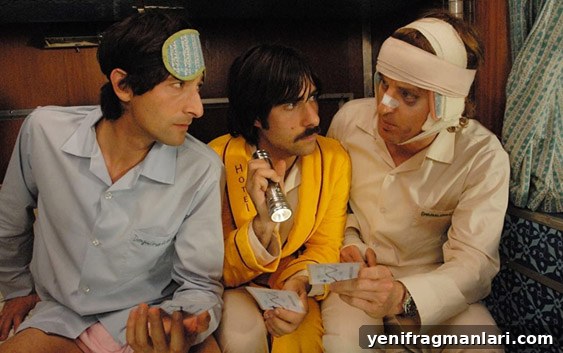
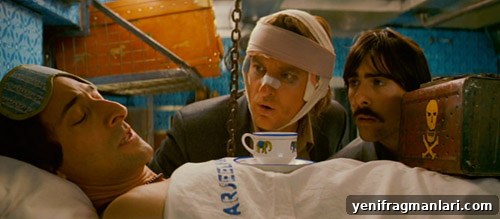
The story follows three estranged brothers—Francis (Owen Wilson), Peter (Adrien Brody), and Jack (Jason Schwartzman)—who reunite in India a year after their father’s death for a self-styled spiritual journey aboard the Darjeeling Limited. They hope the trip will help them reconnect and find closure, but the journey quickly exposes long-standing tensions and secrets. Along the way they are forced off the train, attend a funeral they did not expect, have moments where each contemplates leaving, and visit their mother briefly; the narrative moves through surreal and tender episodes as the brothers confront their shared and private wounds.
Visual storytelling is central to Anderson’s filmmaking, and The Darjeeling Limited showcases that strength. From the opening rickshaw ride through bustling streets to the saturated interiors of the train, every frame is composed with care. Costumes—especially the train staff and the brothers’ uniforms—are bright and meticulously arranged, while the film contrasts color palettes in different sequences to reflect emotional shifts. Anderson’s penchant for symmetrical framing, controlled camera moves, and decisive zooms all serve the story: composition highlights the characters and uses the world around them as a living backdrop to their intimate struggles.
Dialogue in Anderson’s films often reads as stylized and slightly removed from natural speech, and here that approach reinforces the film’s tone. The brothers’ exchanges can feel clipped or mannered, which intensifies the sense that they are performing roles for one another and for themselves as they process grief. That emotional distance makes their quieter moments—glimmers of vulnerability or rare admissions—land harder, transforming what might be comic beats into meaningful character revelations.
The soundtrack is another essential component of the film’s identity. Anderson blends traditional Indian music with carefully chosen Western songs to anchor the setting and underscore the brothers’ sense of being outsiders. Music is used thoughtfully to move the narrative forward, punctuate emotional beats, and deepen the film’s cultural texture without ever overwhelming the characters’ personal journeys.
Performance-wise, the film benefits from a strong ensemble. Owen Wilson’s Francis carries the sense of a man desperately trying to hold his life together while orchestrating the spiritual pilgrimage; Jason Schwartzman brings a nervous, intellectual energy to Jack; and Adrien Brody gives Peter a quiet, haunted quality as he faces impending fatherhood. Supporting performances from Amara Karan, Waris Ahluwalia, Natalie Portman, Anjelica Huston, and Bill Murray add warmth, eccentricity, and grounding to the brothers’ odyssey.
At its core, The Darjeeling Limited is an exploration of how people cope with loss and how relationships can be mended, however imperfectly. Each brother grapples with his own private crises—near-death recovery, impending parenthood, and heartbreak—yet they are united by the common task of grieving a shared loss. Anderson lets moments of comedy and quirk coexist with genuine emotional ache, making the film resonate as both a visual feast and a humane portrait of frailty and redemption.
More than a decade after its release, the film still stands as a notable entry in Wes Anderson’s body of work: visually ambitious, emotionally complex, and distinctively styled. It is a film that appeals to viewers drawn to meticulous production design and to those who appreciate intimate, character-driven stories about family, memory, and the uneasy path toward healing.
21/24