
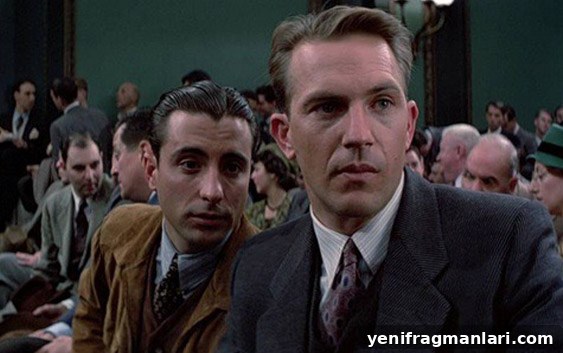
The Untouchables (1987)
Director: Brian De Palma
Screenwriter: David Mamet
Starring: Kevin Costner, Sean Connery, Andy Garcia, Robert De Niro, Charles Martin Smith, Patricia Clarkson
Brian De Palma’s 1987 crime drama The Untouchables is a vivid, stylistically bold retelling of the story of Eliot Ness’s efforts to bring down Al Capone in 1920s Chicago. Drawing on noir traditions and the visual language of classic cinema, De Palma blends tense action, period detail, and strong performances to create a memorable entry in the gangster genre. The film both honors its 1950s television origins and updates them with modern cinematic flourishes, resulting in a picture that remains engaging decades after its release.
David Mamet’s screenplay structures the narrative around Ness and a small team of Treasury agents determined to prove Capone’s criminal enterprise. The script is information-rich, sometimes leaning into exposition to cover historical and legal nuances, but the cast’s performances keep the drama compelling and focused. The story balances investigative procedure with personal stakes, showing Ness’s determination and the toll the campaign takes on his family and conscience.
One of the film’s clear strengths is its meticulous recreation of the period. Costume and production design capture the look and atmosphere of Prohibition-era Chicago, while cinematography channels influences from classic film noir and mid-century cinema. De Palma wears his influences on his sleeve—echoes of Jean-Luc Godard, Billy Wilder, and Raymond Chandler are visible—but he combines them in a distinctive, contemporary style that makes the film feel original rather than merely derivative.
The Untouchables is best remembered for several set-piece sequences that showcase De Palma’s command of tension and composition. The stairwell scene, in which Ness confronts Capone’s men amid escalating violence and the presence of a child’s pram, is an especially iconic moment. That sequence deliberately references the Odessa Steps montage from Battleship Potemkin, recontextualizing the visual technique for a modern American crime film and underlining De Palma’s interest in cinematic homage.
Performances anchor the film. Sean Connery won an Academy Award for his portrayal of Jim Malone, a seasoned, no-nonsense cop whose old-school methods and moral steadiness provide a crucial counterpoint to Ness’s youthful zeal. Connery’s deliverance lends depth and warmth to a character who might otherwise have been a simple archetype. Kevin Costner, in one of his early leading roles, brings dogged determination and emotional restraint to Eliot Ness, making the character’s pursuit of justice feel urgent and human. Andy Garcia adds nuance as a capable member of Ness’s team, while Charles Martin Smith and Patricia Clarkson contribute solid supporting turns.
Robert De Niro’s depiction of Al Capone divides opinion. His performance is brief and stylized, leaning toward caricature at times, which contrasts with the film’s generally grounded tone. While De Niro’s presence is undeniably magnetic, some viewers find this portrayal less successful compared with more restrained or historically grounded interpretations of Capone seen elsewhere.
A major asset of The Untouchables is Ennio Morricone’s score. Morricone crafts a memorable musical identity for the film by fusing classic orchestral textures with period-appropriate touches and contemporary synth elements. The result underscores emotional beats, differentiates characters, and heightens suspense without overwhelming the drama. His music remains one of the film’s most enduring legacies.
Though occasionally showy and sometimes heavy-handed with its visual references, The Untouchables succeeds as a finely acted, well-crafted crime drama. Its strengths—precise production design, arresting action sequences, standout performances, and a distinctive score—combine to make it a richly textured film that updates its source material effectively. For viewers interested in Prohibition-era crime stories, classical noir influences, or the work of De Palma and Morricone, The Untouchables remains a compelling and rewatchable experience.
19/24