
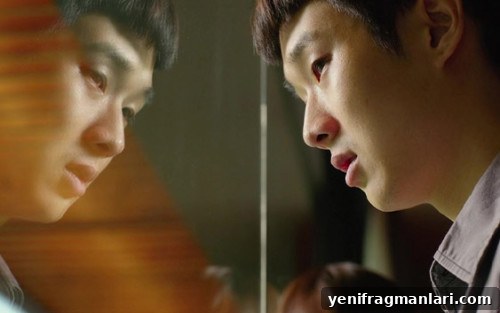
Today I want to invite you to look at windows. Before you scroll on, hear me out — in Bong Joon-ho’s Oscar-winning 2020 film Parasite, windows are far more than set dressing. They are deliberate stylistic choices that reinforce the film’s concerns about class, separation, and perception.
When we focus on how Bong uses panes of glass, reflections, and screens throughout Parasite, a visual language emerges: windows divide worlds, allow selective visibility, and constantly remind viewers of the social chasms between characters. This article examines how those transparent barriers operate as metaphors for the film’s central themes.
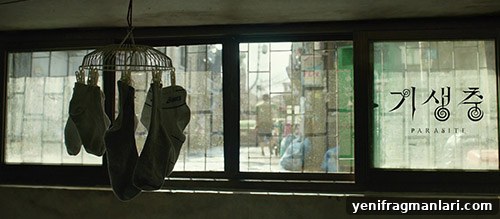
Parasite opens with a window: the title etched onto a fogged pane, a small, melancholy scrawl. That grimy glass is the world through which the impoverished Kim family inhabits the city — their semi-basement dwelling looks out at a street life they can observe but not fully access. The camera physically lowers from street level to meet Kim Ki-woo (Choi Woo-sik), immediately establishing scale and social distance.
From their small window the Kims watch the world pass by. They see people hurry along the street, fumigators spraying the neighborhood and a local drunk who repeatedly urinates nearby — mundane details that take on symbolic weight. These moments emphasize how their lives are assaulted by circumstances beyond their control. The glass between them and the street is a screen of observation, a place where aspirations are visible but practical access is blocked.
The same window later becomes literal and devastating when the Kims’ semi-basement floods. Water pours in from the street, washing filth into their home and brutally reasserting their precarious social position. The window that once allowed a distanced view of possibility also becomes the entry-point for the neighborhood’s waste — a stark reversal that reinforces the fragile boundary between hope and ruin. In the film’s closing image, we return to that same pane, with Ki-woo seated beneath it once again. The loop underscores a tragic stability: despite upheaval, many structural inequalities remain intact.
By contrast, the Parks inhabit a luminous, modern home that resembles an art gallery: clean lines, open space, and generous floor-to-ceiling windows. These expansive panes present wealth as a spectacle — inviting to look at yet designed to keep distance. The house is a stage showing an aspirational lifestyle that the Kims can mimic but cannot truly enter. Those glass walls are emblematic of a society that is transparent only enough to be observed, but not touched.
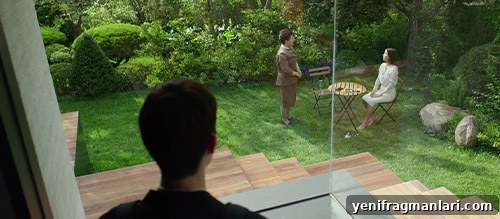
Bong uses angles and panes to reinforce class separation. In one scene a corner of glass slices the frame, visually separating the Parks’ housekeeper Moon-gwang (Lee Jeong-eun) from her employer, Mrs. Park (Jo Yeo-jeong), so that the “help” occupies one portion of the frame and the “madam” another. Small compositional choices like this make the film’s social commentary literal and unavoidable.
Even in professional settings, glass communicates control and distancing. When Mr. Park (Lee Sun-kyun) meets Mr. Kim (Song Kang-ho), the exchange takes place with a glass barrier between them. Park can peer through and return to his work at will; the partition gives him the luxury of selective attention. This type of transparent separation reinforces the idea that privilege enables a willful blindness to the struggles of others.
The Parks’ living room is almost entirely glazed, and when the Kims pretend to be the household staff while the family is away, we see them through rain-streaked windows — a poor family performing wealth behind a transparent barrier. Their fantasy is fragile: soon after, glasses on the table shatter, an image that collapses illusion, privilege, and the pretense of control in one sharp sound. The breaking glass is as much a narrative beat as a visual metaphor.
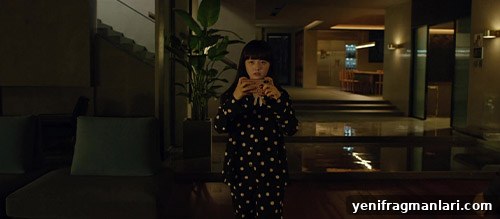
Beyond architectural glass, modern screens function as another kind of window in Parasite. Phone displays enable clandestine communication and capture key evidence that advances the plot. Mobile devices act as portals into other people’s lives: a temptation for secret romance between Park Da-hye and Ki-woo, an addiction when the Kims celebrate restored Wi-Fi, and a tool for leverage when incriminating content threatens exposure. These digital windows mirror the physical panes: they allow observation, but not full understanding or access without consequences.
So what do these windows reveal? Bong Joon-ho’s use of clear but solid barriers returns us to Parasite’s core argument: visibility alone does not equal equality. Glass makes class differences visible, but visibility does not dissolve the structures that keep people apart. Reflections can distort, perspectives can be partial, and permeability is limited — windows let us see into other lives, but they rarely let us walk through into them. In that way, the film’s recurring panes of glass remain a powerful, haunting metaphor for systemic inequality and the illusion of social mobility.