
Juste un mouvement / Just A Movement (2021)
Director: Vincent Meessen
“Cinema can serve to explore the creation of forms, their embryology.”
Jean-Luc Godard
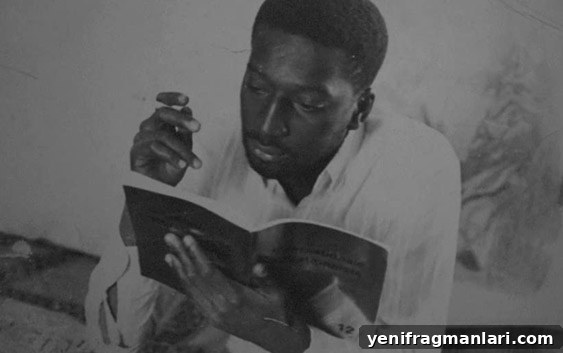
Vincent Meessen’s documentary Juste un mouvement (Just A Movement) revisits the life, ideas and political legacy of Omar Blondin Diop, a Senegalese student activist who briefly appeared in Jean-Luc Godard’s 1967 film La Chinoise and later became a leading figure in anti-colonial protests. Meessen adopts a reflexive, self-conscious filmmaking style inspired by Godard, deliberately exposing the constructed nature of documentary storytelling while probing Diop’s radicalism and the contested formation of Senegalese national identity.
At the heart of Meessen’s film is a question that reads like a true-crime hook: what really happened to Diop in prison—an accident, suicide or a politically motivated killing? Rather than pursue a single forensic answer, the documentary widens its gaze into a political essay that explores Diop’s life, his network of friends and family, and the broader social forces that shaped his generation. Interviews with those who knew him—relatives, fellow activists and contemporaries—provide a compassionate, often intimate portrait of a young man committed to revolutionary change.
Meessen intentionally blurs the boundary between reenactment and testimony. The film interweaves staged reconstructions with raw interview footage, sometimes leaving in technical slips or moments of direction to emphasize that documentary images are not transparent windows on reality but crafted representations. This formal choice mirrors Godard’s own experimentation with cinematic form and invites viewers to reflect on how film constructs historical memory.
Several scenes in Juste un mouvement explicitly reference La Chinoise, underlining the intellectual and aesthetic connection between the films. In one striking, self-referential sequence, viewers watch a student film about Godard and La Chinoise within Meessen’s film, creating a layered meditation on representation and influence. Thematically, both films engage with leftist theory and the question of whether revolutionary thought can reshape society. Meessen’s affinity for Godard’s metatextual style yields thoughtful moments but sometimes competes with the film’s political clarity.
The interviews are filmed with careful composition—many subjects appear in profile, speaking directly from personal memory. Meessen allows conversations to breathe, and the testimony of those closest to Diop forms the emotional core of the film. Through these recollections we learn of Diop’s activism in France and Senegal, his involvement in organizing student protests, and the heavy consequences he and his family faced for challenging political authority. Meessen shows how activism, exile and repression intersected in Diop’s life, shaping both his personal trajectory and his symbolic status.
Historical context is central to Meessen’s argument. The film juxtaposes student movements in 1960s France and China with contemporary struggles in Senegal, asking how anti-imperial thought was translated and transformed across continents. Meessen explores how colonial legacy and cultural dependency hindered the formation of an autonomous national identity in Senegal. He presents this not merely as political history but as a question of cultural inheritance: how do post-colonial societies reconstruct a sense of self after prolonged foreign influence?
Specific episodes in the film reveal the stakes of Diop’s activism. Plans for violent protest during a state visit by French President Georges Pompidou to Dakar are described as having been contemplated but not fully executed. Those implicated suffered arrest and political persecution. Diop himself abandoned doctoral studies, underwent militant training and became involved in plots intended to force diplomatic concessions. Whether or not these plans were carried out, they were sufficient to attract harsh state repression and ultimately contributed to his imprisonment and death under dubious circumstances.
Meessen also examines shifting global influences on Senegalese cultural life. He contrasts overt French political interference with softer forms of external engagement, noting, for instance, that international gifts and cultural diplomacy can function as subtle extensions of influence. This broader geopolitical framing helps explain tensions in national identity formation and why figures like Diop came to embody both a critique of neo-colonial dynamics and a hope for a more self-determined future.
Juste un mouvement offers a measured, sometimes elegiac account of Diop’s life and legacy. The film’s formal experiments and Godard-inspired reflexivity enrich its intellectual aims, yet at times the stylization interferes with the immediacy of the political narrative. Still, Meessen’s work contributes a valuable meditation on memory, representation and the unfinished project of post-colonial identity. Through testimony, archival traces and layered cinematic strategies, the film resists easy conclusions while insisting on the enduring relevance of Diop’s critique.
15/24