
Beauty and the Beast (1991)
Directors: Gary Trousdale, Kirk Wise
Screenwriters: Linda Woolverton, Brenda Chapman, Chris Sanders
Starring: Paige O’Hara, Robby Benson, Richard White, Angela Lansbury, Jerry Orbach, David Ogden Stiers, Jesse Corti, Rex Everhart, Bradley Pierce
One of the most enduring and frequently adapted Western fairy tales is the 18th-century French story “La Belle et la Bête.” Across stage, television, and film, it has inspired countless retellings. After Jean Cocteau’s surreal 1946 interpretation, Disney’s 1991 animated musical stands out as the version that captured the widest popular imagination. It earned Disney its first Academy Award nomination for Best Picture, a milestone that underscored the film’s cultural and artistic impact. Decades later, the animated original continues to resonate for its artistry, emotional clarity, and musical brilliance.
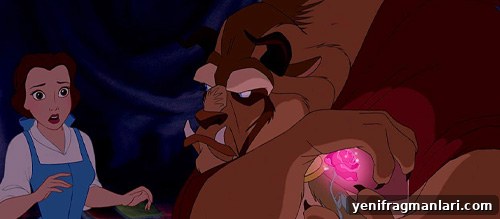
At the heart of the story is Belle, an intelligent and curious young woman (voiced by Paige O’Hara) who feels out of place in her small provincial town. She avoids the arrogant suitor Gaston (Richard White) and cares deeply for her absent-minded inventor father Maurice (Rex Everhart). When Maurice becomes lost and seeks shelter in a mysterious castle, Belle goes searching for him. To save her father, she offers herself as the castle’s prisoner, where she encounters the castle’s cursed master: a prince trapped in the form of a Beast (Robby Benson) until he learns to love and be loved in return.
The film thrives on contrasts: Belle’s gentle intelligence versus Gaston’s blustery vanity, domestic village life versus the enchanted, isolated castle, and most importantly, the Beast’s animalistic instincts transforming into vulnerability and tenderness. The filmmakers use animation’s unique expressive possibilities to make the Beast’s evolution convincing. Early in the story he moves in a raw, animal way, stalking on all fours; as his relationship with Belle grows, his posture becomes more human, awkward, and fragile—a visual metaphor for his reawakening of empathy and self-understanding.
Composer Alan Menken and lyricist Howard Ashman were at the peak of their collaboration when they created this score. Their songs carry narrative weight and emotional truth, elevating scenes while revealing character. From the bustling opening number “Belle” to the exuberant showpiece “Be Our Guest,” and from the gleefully sinister “Gaston” to the stirring “Beauty and the Beast” ballad, the soundtrack balances charm, humor, and pathos. Menken’s orchestration provides rich atmosphere and emotional lift, complementing Ashman’s incisive lyrics. The musical elements feel integral to the storytelling, though the film was not originally conceived as a full musical.
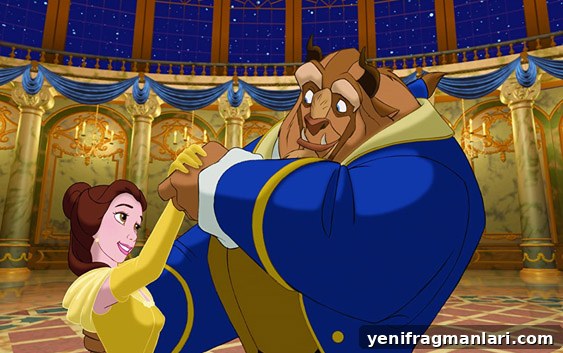
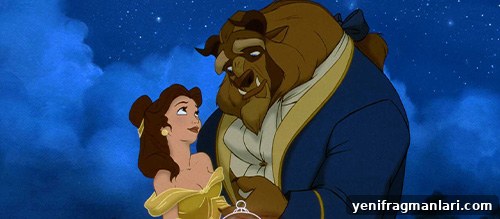
Paige O’Hara and Robby Benson form a deeply affecting pairing. Their vocal performances, matched to expressive animation, create a believable slow-blooming romance shaped by small gestures, moments of awkwardness, and growing mutual respect. The iconic ballroom sequence—accompanied by Angela Lansbury’s warm rendition as Mrs. Potts—remains one of animation’s most moving romantic set pieces. Supporting performances help the world feel alive: David Ogden Stiers and Jerry Orbach craft a memorable comedic duo as Cogsworth and Lumière, while Richard White’s Gaston is a disturbingly effective portrait of charismatic entitlement.
Though the film runs just about 90 minutes, animation allows time to feel elastic; we sense a fuller arc in Belle and the Beast’s relationship than the runtime might imply. The film sometimes shifts into broader, more physical comedy—particularly during the lively tavern and mob sequences—which can undercut the darker emotional notes of the climax. Still, these moments preserve a family-friendly energy and showcase imaginative character animation and staging.
Technically, the film marks a high point in hand-drawn animation augmented by early computer-assisted techniques. Disney used CGI selectively to enhance traditional craftsmanship, blending methods to serve storytelling rather than spectacle. The result is an artful marriage of technologies that enriches the cinematic experience without overshadowing character or song.
More than three decades on, Disney’s 1991 Beauty and the Beast remains a landmark of the studio’s Renaissance era and a defining example of American animation. It tells a timeless story about looking beyond appearances, selflessness, and the transformative power of love. While numerous adaptations—including later live-action remakes—have reinterpreted the tale, the original animated film endures because of its emotional honesty, musical richness, and visual imagination.
23/24
Recommended reading: Disney Renaissance movies ranked