
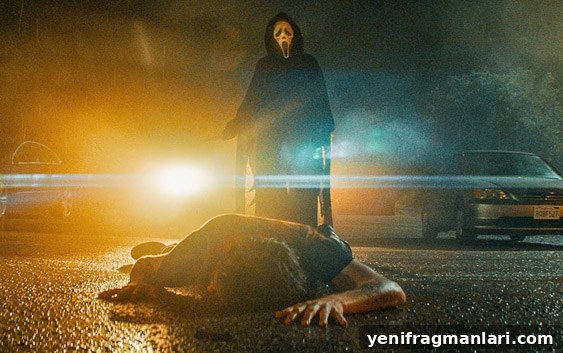

Scream (2022)
Director: Matt Bettinelli-Olpin, Tyler Gillett
Screenwriters: James Vanderbilt, Guy Busick
Starring: Neve Campbell, David Arquette, Courteney Cox, Marley Shelton, Melissa Barrera, Jenna Ortega, Dylan Minnette, Jack Quaid, Jasmin Savoy Brown
Return to Woodsboro: the Ghostface legacy is revived. After an eleven-year gap in the franchise, Scream (2022) brings the familiar masked killer back to the screen with a fresh generation of victims and a cast that reunites franchise veterans with energetic newcomers. The new film asks familiar questions about legacy, fandom, and horror tropes while delivering a series of violent set pieces and pacey, often self-aware thrills.
Directors Matt Bettinelli-Olpin and Tyler Gillett take the reins from the late Wes Craven and bring a distinct visual stamp while honoring the franchise’s roots. Their use of canted angles, selective dolly-zooms, and a modern editing sensibility give the film a contemporary edge even as it echoes the original’s approach to suspense. The film balances nostalgic callbacks with a clear desire to forge its own identity, and much of its success stems from a committed ensemble. Returning leads Neve Campbell, David Arquette, and Courteney Cox ground the story with familiar faces, while the younger cast—led by Melissa Barrera and Jenna Ortega—injects fresh energy and likable dynamics.
When it comes to on-screen violence, Scream (2022) leans harder into gore than some previous entries. The makeup and practical effects teams deliver detailed, visceral work that makes the kills feel immediate and brutal. Composer Bryan Fuller, stepping in after Marco Beltrami’s long association with the series, provides a competent score that supports the action. Fuller’s music lacks Beltrami’s signature haunting choir textures, but it serves the film well in moments of tension and shock.
At its heart, this Scream is as much a commentary as it is a slasher. Much like The Matrix: Resurrections explored its own legacy and the relationship between franchise and fandom, Scream (2022) analyzes its place within horror culture. The screenplay addresses the trend of “re-quel” films—sequels that also function as reboots—by directly engaging with the expectations of a fan base that wants respect for the original while craving something new. That meta-textual angle is a hallmark of the franchise and remains central here.
However, the film struggles at times with competing ambitions. Trying to simultaneously honor the original, critique fandom, and reinvent itself creates narrative and tonal friction. The result is that several scares rely on jump moments rather than building long, suffocating suspense. Some supporting characters, including members of the older generation of the series, are sidelined for large stretches, which can make the story feel unbalanced and occasionally forgetful of its own history.

The film’s focus on legacy works in some ways and misfires in others. Scream (2022) emphasizes the original murders as the foundational event, effectively treating those incidents as the genesis of the Ghostface phenomenon. In doing so, it downplays elements from the intervening sequels and simplifies certain franchise details, such as the recurring pattern of multiple killers. That narrowing of focus helps the film establish a clear throughline, but it also glosses over franchise complexities that longtime fans may expect to see acknowledged.
One notable return is Marley Shelton’s Judy Hicks from Scream 4. Her presence draws attention to a recurring theme in the new film: the uneasy relationship between honoring prior entries and rebranding them. Early on, the film’s characters discuss how studios disguise reboots as sequels to appease fans—an observation that mirrors this movie’s own approach. By the time the killer’s identity and motives are revealed, the emotional impact is muted because the film’s primary investment is in its commentary and reinvention rather than in the mysteries themselves.
Despite those flaws, Scream (2022) remains an entertaining slasher experience. Fans who enjoy playing detective with the “guess the killer” format will find plenty to enjoy: red herrings, sudden shocks, and tightly staged set pieces. The film is both self-aware and indulgent, celebrating the tropes it simultaneously critiques. It’s gory, fast-paced, and often clever, even if it occasionally struggles with an identity crisis about whether to revisit the past or move decisively forward.
For viewers who want a modern take on the Ghostface legacy—one that mixes nostalgia with contemporary horror filmmaking—Scream (2022) delivers a fun, bloody ride. It isn’t flawless, and its meta-commentary sometimes undercuts character-driven suspense, but it succeeds in reviving the franchise for a new audience while keeping the spirit of the original alive.
15/24