
Texas Chainsaw Massacre (2022)
Director: David Blue Garcia
Screenwriters: Chris Thomas Devlin, Fede Alvarez, Rodo Sayagues
Starring: Sarah Yarkin, Elsie Fisher, Mark Burnham, Jacob Latimore, Moe Dunford, Olwen Fouéré, Jessica Allain, Nell Hudson
This review is intentionally concise. With a film like Texas Chainsaw Massacre (2022), the more you dwell on it, the more it seems to magnify its own problems. Unlike the original 1974 film, which earned its infamy through atmosphere and ingenuity, this latest installment aims for shock and recognition rather than genuine creativity.
Nearly fifty years after Tobe Hooper’s original, this movie follows a new group of young people who arrive in the near-abandoned town of Harlow. The premise is straightforward: the town has been repopulated by well-meaning urbanites eager to reconnect with rural life, and—through a string of ill-timed decisions—Leatherface’s backstory is reintroduced into the modern world. The film leans heavily on the idea of retconning previous sequels and positioning itself as a direct thematic descendant of the 1974 original.
David Blue Garcia’s direction feels flat and workmanlike, lacking the atmospheric tension that made the first film so effective. Colin Stetson’s score, which could have added a menacing undercurrent, rarely registers beyond background noise. Characters are sketched with minimal depth, often reduced to vehicles for exposition rather than believable people. Dialogue frequently explains what the audience can already see, leaving little room for nuance or discovery.
The return of Sally Hardesty, the lone survivor from the original film, is one of the production’s most promising ideas, but it is handled in a way that disappoints. Where a veteran survivor’s arc could have added emotional weight and thematic resonance, her role is underused and sidelined. The film repeatedly invokes the original through visual callbacks and shout-outs, but many of these references read as awkward fan service rather than meaningful homage.
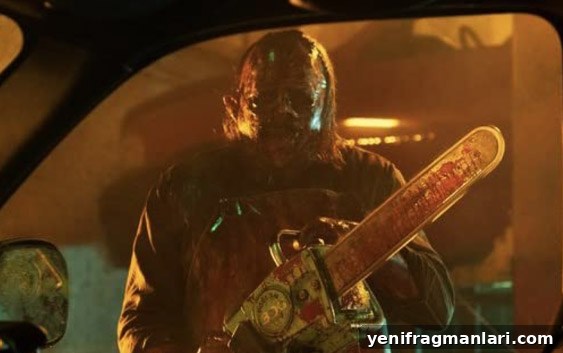
In terms of tone, this entry substitutes relentless gore for suspense. Leatherface is presented in a more overtly lethal, almost invincible form—able to withstand what would logically stop a human antagonist—echoing a trend in modern horror where the monster becomes a near-supernatural force. Unlike slasher figures with explicit mythic explanations, this film offers little rationale for invulnerability, which undermines tension because stakes feel artificially lowered. Suspense is sacrificed for spectacle.
Several secondary characters exist solely to populate the kill list. Set pieces meant to excite—such as a chaotic corridor massacre—are filmed with polished brutality but lack the emotional underpinning that would make them memorable for the right reasons. One particularly jarring sequence involves modern bystanders reacting to violence primarily through their phones and social media instincts; this moment is intended as commentary but instead reads as a shallow, awkward critique of contemporary behavior.
Despite its flaws, the film has a few redeeming aspects. There are moments that clearly nod to classic horror filmmaking, which remind the viewer that good cinema still informs modern attempts. The production’s relatively short running time—around 74 minutes before a brief post-credits tease—keeps the film from overstaying its welcome. Additionally, as a streaming release, it avoids altering the theatrical landscape and so feels more contained in scope.
For viewers seeking atmospheric dread, psychological nuance, or a thoughtful continuation of the original’s themes, this version of Texas Chainsaw Massacre will likely frustrate. For audiences who prioritize visceral gore, fast pacing, and frequent set-piece kills, it will deliver more of what they expect, but still without the craft or emotional logic that made the best entries in the franchise resonate.
The film ultimately reads as a missed opportunity: a chance to explore legacy, trauma, and survival through a modern lens that instead chooses spectacle and nostalgia cues. It may prompt discussion among franchise fans about fidelity to source material and the value of restraint in horror filmmaking, but as a standalone experience it rarely rises above competent execution and occasionally revels in the worst impulses of contemporary horror trends.
Score: 3/24
Recommended for you: Texas Chainsaw Massacre Movies Ranked