The Bubble (2022)
Director: Judd Apatow
Screenwriter: Judd Apatow, Pam Brady
Starring: Karen Gillan, Iris Apatow, Pedro Pascal, Leslie Mann, Fred Armisen, David Duchovny, Keegan-Michael Key, Kate McKinnon, Guz Khan, Peter Serafinowicz, Maria Bamford, Vir Das, Maria Bakalova
Judd Apatow is a filmmaker with a long and influential track record in comedy, known for projects that often balance humor with human observation—films like Knocked Up and the sensitive, honest Funny People highlight his interest in career, fame and mortality. In The Bubble (2022), a Netflix comedy about a fractured cast filming the sixth entry of a dinosaur-action franchise during the COVID-19 pandemic, Apatow returns to the subject of show business. The result is an uneven satire that struggles to find the right tone while trying to comment on celebrity culture and filmmaking amid a global crisis.
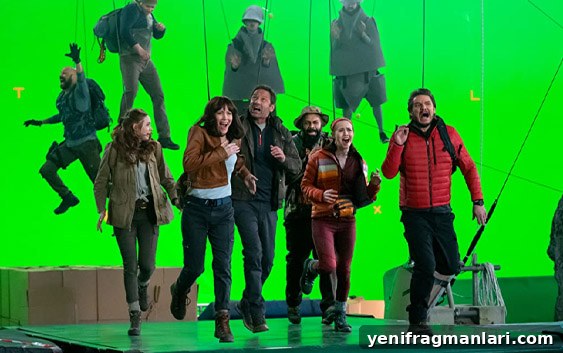
The Bubble sets itself inside an intentionally artificial production environment: Cliff Beasts 6, a blockbuster franchise, is being shot under pandemic protocols, producing absurd logistical challenges and personal conflicts. The premise could offer sharp material about privilege, insecurity and the surreal nature of spectacle when the world is in turmoil. Instead, the film often feels unsure whether it wants to ridicule its characters or invite sympathy for them. That ambiguity weakens the satire because the film repeatedly raises provocative questions—about studio excess, unsafe working conditions, and celebrity performativity—without ever fully committing to a clear perspective.
The movie’s self-awareness is intermittent and defensive rather than incisive. There are moments when The Bubble acknowledges its own contradictions, most notably in the final scenes where characters reflexively judge their own franchise’s weaknesses. But these moments read as tentative rather than bold; the film seems more interested in avoiding criticism than in confronting the industry it lampoons. When a movie about shooting frivolous entertainment during a global pandemic fails to interrogate the ethics of that very endeavor, it undercuts its thematic aims.
Visually, The Bubble lacks the naturalism that made much of Apatow’s earlier work feel grounded. The film’s aesthetic often mirrors the bland uniformity associated with many streaming productions, and the distinction between the movie being made within the film and the film itself is minimal. That visual sameness dilutes the satire’s bite and contributes to a broader sense that the film doesn’t fully respect the craft it depicts. At points the screenplay leans on broad jokes about the potential demise of movie theaters and the commodification of content, but those observations are rarely developed into sustained critique.
Where the film does show flashes of promise is in its supporting ensemble. Apatow casts familiar collaborators alongside newer talent: Karen Gillan portrays the insecure returning star who skipped the previous installment only to find herself adrift; Pedro Pascal, Keegan-Michael Key, David Duchovny, Leslie Mann and others play a range of self-involved celebrities and film personnel. Several of the younger or less established actors—Samson Kayo, Maria Bakalova, Galen Hopper and Harry Trevaldwyn—stand out as the most authentic presences. These performers bring texture to the film’s depiction of the crew and background players, characters who are exposed to risk without enjoying the protections and perks of stardom. Had Apatow centered their perspective more consistently, The Bubble might have found a clearer moral center and sharper comic focus.
Karen Gillan’s protagonist encapsulates the film’s dilemma: she is portrayed with understandable insecurity and pragmatic concerns about safety, creative control and relevance. But the screenplay fails to indicate whether the audience should empathize with her anxieties or regard them as shallow celebrity whining. This uncertainty often undermines the film’s attempts to tackle legitimate issues—unsafe conditions on set, the role of social media and the performative defenses celebrities adopt when criticized. In one telling moment, the film declines to let a character leverage a large social-media following to speak out—a plot choice that raises questions but doesn’t fully engage with the realities of power dynamics in entertainment.
The Bubble’s runtime and narrative structure also hamper its effectiveness. The film moves through vignettes and set-piece moments rather than developing a cohesive arc, which leaves several promising characters underused and many themes half-explored. Apatow’s usual gift for assembling talented ensembles and integrating playful cameos is present but muted; the cameos and bit parts here don’t land with the same energy his best films have delivered. The end result feels like a missed opportunity: a project with interesting ingredients that never coalesces into a focused satire or a compelling character study.
Ultimately, The Bubble is a mixed experience. It offers comic sparks, strong supporting performances and an occasionally sharp eye for industry absurdities, but it is held back by tonal indecision, visual blandness and a reluctance to probe its own complicity in producing frivolous entertainment during a global crisis. For those interested in Apatow’s career or in satire about Hollywood, there are moments worth watching; for viewers seeking a decisive, hard-hitting comedy about the ethics of filmmaking during a pandemic, the film will likely feel frustratingly tentative.
7/24
Written by Nicholas Armstrong
You can support Nicholas Armstrong in the following places:
Tumblr – nickarmstrongfilm
Letterboxd – /nicorice
Twitter – @mfshrimp