

Sediments (2021)
Director: Adrián Silvestre
Screenwriter: Adrián Silvestre
Just as the Earth is made of many layers, our inner lives are composed of strata that shape identity and tell the story of who we are.
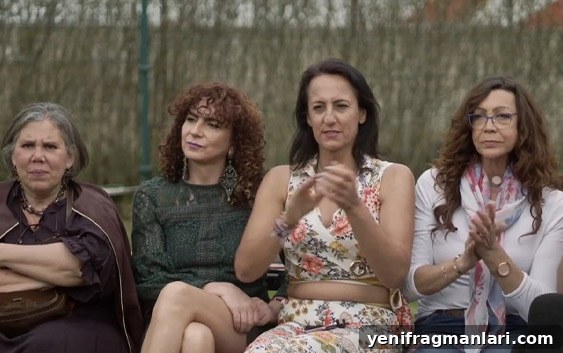
Presented at festivals as a work about layers of identity, Sediments uses a simple but powerful visual metaphor: the film’s participants pause beside a quarry where sedimentary rock reveals its strata, an image that echoes the layers of being each woman carries and displays to the world. The documentary follows a small group of Spanish trans women who gather at a rural retreat to exchange stories, offer practical and emotional support, and accompany Cristina as she prepares to begin her gender transition—a moment she describes as “teetering on the edge of a cliff.”
The film opens with an intimate, unadorned scene in which the group trades accounts of their journeys over a shared lunch. This casual conversation reveals the stark contrast between generational experiences: younger members such as Lena and Alicia report relatively minor reactions—awkward looks or whispered comments when they transitioned between university semesters—while older participants like Yolanda recount brutal encounters with police violence and the hardships of surviving as a sex worker decades earlier. These anecdotes underline the progress made and the distance still to travel for full social acceptance.
Sediments also confronts structural inequality. The film cites a startling unemployment rate among trans women in Spain, emphasizing how pervasive workplace exclusion and discrimination remain. One participant states plainly: “Trans people are human beings and therefore have the right to work… but society doesn’t allow it.” Access to employment, healthcare and basic dignity are presented not as privileges but as rights that many trans people are denied.
Not every story in the film follows the same arc. Lena’s coming-out conversation with her mother and grandmother in Barcelona demonstrates the crucial role that supportive family networks can play. For Lena, that support smoothed the transition; for others, family rejection has been devastating. Sediments acknowledges both realities, showing how chosen family often replaces biological family when acceptance is absent.
Stylistically, Adrián Silvestre adopts a restrained observational approach. The camera is unobtrusive—participants do not perform for it, and the film avoids conventional documentary signposting. Names and captions are withheld until the closing “you have been watching” sequence, allowing the women to speak on their own terms and preserving the sense of a private, lived-in community. Even incidental sounds—a passing train during a quiet shot—are left intact, reinforcing the film’s commitment to authenticity.
Within the group there is warm chemistry and shifting social dynamics. Conversations range from candid humor—jokes about stalactites on a cave tour—to frank discussions of medical procedures such as vaginoplasty. In another scene, the women play an explicit round of “never have I ever,” revealing boundaries and histories with both levity and honesty. These moments balance the film’s heavier material and humanize its subjects.
Cristina’s storyline highlights the emotional complexity of later-life transition. She struggles with insecurity and at times displays passive-aggressive behavior toward others, questioning her place among women who transitioned at younger ages. The group’s responses reflect the imperfect labor of compassion: some members step in with patience, while others find it difficult to support Cristina through particularly combative moments. This tension shows that solidarity is often tested as well as affirmed.
One of the most affecting sequences involves Yolanda recounting her battle with cancer. Lying on a bed, she tells Lena and Alicia about losing her voice and falling into a coma, only to wake and be met by a family who had previously refused to support her. That reunion, however complicated, offered Yolanda renewed determination to live. Her story underscores the documentary’s recurring theme: family can be found and forged in places of mutual care when biological relatives fail to accept someone’s truth.
Sediments does not attempt exhaustive representation of every trans experience—in any group the most outspoken figures will naturally occupy more screen time—but it offers a textured, humane portrait of several women navigating identity, health, work and relationships. By stepping back and allowing the group to author their own narratives, Adrián Silvestre captures moments of tenderness, conflict, humor and resilience. The film affirms that gender exists beyond a binary: “The world has two gender extremes, man and woman. But in the middle, there are a lot of ways to express yourself.”
21/24