
Please note that this article contains spoilers for the films Men, Annihilation, and Ex Machina.
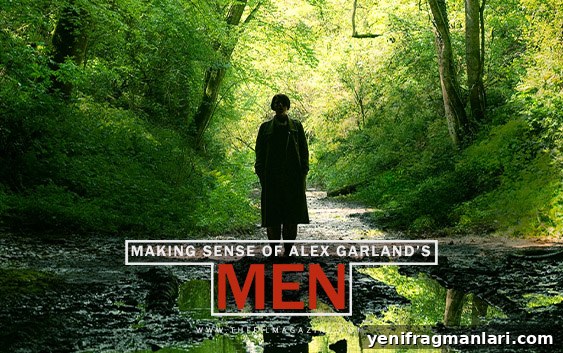
At its surface, Alex Garland’s latest film, Men, tells a deceptively straightforward story. Jessie Buckley plays Harper, a woman whose husband James (Paapa Essiedu) has recently died amid a bitter separation. Their divorce was initiated by Harper after a violent argument in which James struck her and she forced him out. James then returned, slipped trying to force his way back in during the rain, and fell to his death. Harper is tormented by the ambiguity of his death—was it an accident or something more deliberate, given James’s previous threats to kill himself if the divorce went ahead? Haunted by his voice and his past, she leaves London for the countryside hoping a short escape will help her find peace. Instead she endures a harrowing night in which James’s presence keeps resurfacing until she is forced to confront his ghost directly. The film closes on a note that is deliberately ambiguous, but it suggests that Harper may have found some form of resolution.
What makes Men distinctive is not its plot but its presentation. Garland stages the film much like a European art-house work from the 1960s and ’70s, evoking movies such as Repulsion, Persona, Hour of the Wolf, Suspiria, and Possession. There are moments that feel Tarkovskian in their poetry; if Garland’s Annihilation responded to Stalker, then Men reads like an answer to Solaris, with its recurring revenant of the dead spouse. Much of what appears onscreen is filtered through Harper’s subjective perspective, and Garland uses associative editing—interrupting scenes with flashes of nature or other images—to reflect her inner life. For example, when Harper plays the piano, the film cuts to landscapes that echo what she feels while playing.
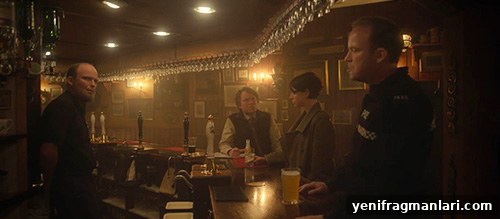
Another striking device is the film’s casting choice: nearly every man Harper meets in the village is played by the same actor, Rory Kinnear. Through makeup, costumes, and selective effects, Kinnear becomes Harper’s landlord, a police officer, a bratty child, the local vicar, a pubkeeper, and others. On one level this functions as a wry observation about small towns and the sense that everyone resembles everyone else. On another, more consequential level, it’s a structural decision: each of these men embodies a different facet of patriarchal authority. Harper’s encounters with them repeatedly mirror the manipulation, patronizing behavior, and outright cruelty she experienced in her marriage. The repetition isn’t literal—it’s psychological and thematic. The men are not James, but they are products of the same cultural system that allowed James’s behavior to exist.
The film ties these encounters into Harper’s grieving process. Small, everyday details in the countryside trigger traumatic memories: drifting dandelion spores recall dust motes in her apartment the night James died, a tunnel in the woods mirrors the baptismal font in the village church. Harper’s growing sense of intrusion culminates in a long, escalating night in which her emotional burden becomes overwhelming. People around her often downplay the danger or dismiss her concerns, reinforcing her isolation. Faced with the relentless recurrence of these male figures—whether subtly patronizing, plainly cruel, or bizarrely intimate—Harper is driven to confront the ghost of James and demand to know what he wants. The answer, “Your love,” is both simple and profoundly ambiguous, leaving her—and us—to wonder whether she is being spoken to honestly or manipulated one last time.
Garland’s film also circles a philosophical problem that recurs throughout his work: the “problem of other minds”—the difficulty of truly knowing whether another being has experiences, intentions, or consciousness like our own. In Ex Machina, this problem appears in the doubt that surrounds Ava, an artificial intelligence whose self-awareness is under scrutiny. In Annihilation, Lena and Kane return from an alien phenomenon called the Shimmer uncertain whether they are still themselves or mere copies. In Men, Harper’s uncertainty about James—was he genuinely desperate, manipulative, or something else?—is another variation on the same philosophical dilemma: how can one ever be certain of another mind’s interiority?
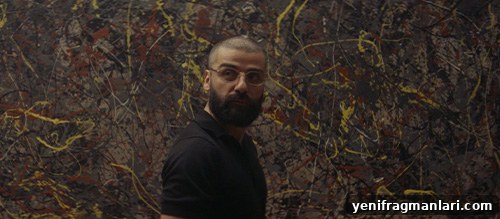
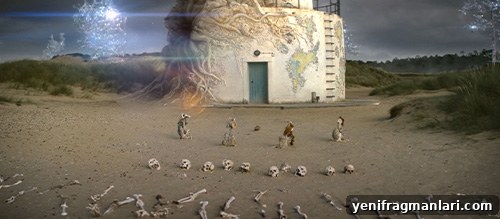
In each of Garland’s films a central, visually resonant image stands in for this dilemma. In Ex Machina it’s a Jackson Pollock painting—a debate about whether apparent chaos hides intentionality. In Annihilation it’s the Shimmer, an alien force that rearranges nature in ways that make its purpose unclear. In Men, the leitmotif is a baptismal font in the village church. The font is carved with two pagan fertility images: the Green Man, a half-man, half-plant figure associated with rebirth, and a Sheela Na Gig, an explicit female figure displaying a vulva. These two icons face opposite directions and, over the course of the film, come to symbolize competing cultural forces: a dominant masculine power and a suppressed feminine presence.
Garland uses the Green Man and Sheela Na Gig to probe how Christianity and other institutions have absorbed and reshaped pagan symbols, privileging patriarchal images while marginalizing more explicit feminine representations. The film draws visual parallels between Christ imagery and the Green Man—wounds, impalement, and ritualized suffering recur on bodies across the story—suggesting that institutional religion, like other social systems, reinterprets and controls older, more ambiguous signs. The recurring stone basin and its pagan carvings show up in unexpected places, and Harper repeatedly finds herself separated from men by thresholds, windows, and doorways—literally on the opposite side of structures where men peer or reach for her.
The ending of Men should be read alongside the ambiguous closures of Garland’s other films. In each case, certainty is withheld: Ava’s consciousness remains open to interpretation in Ex Machina; the Shimmer’s intelligence or randomness remains unresolved in Annihilation. In Men, Harper survives her ordeal and appears to discover a fragile tranquility. The landscape around her softens, flowers change color, and she examines a leaf with a quiet smile—an image that may imply healing, a shift in power, or a final self-deception. Garland doesn’t hand us a single truth; he presents an experience shaped by grief, trauma, and cultural forces that resist easy interpretation. Ultimately, only Harper knows what she thinks and feels, and that unknowability is exactly the point: the problem of other minds isn’t an abstract puzzle but a lived condition that haunts relationships, institutions, and the stories we tell about them.
Written by A. D. Jameson