
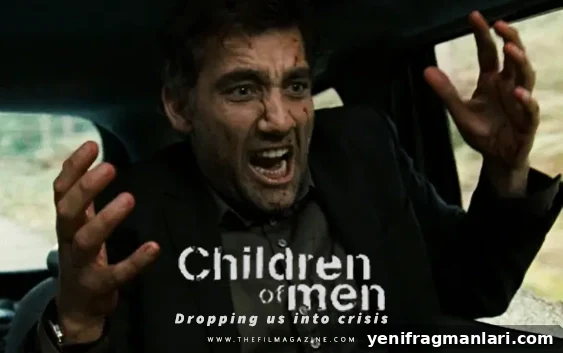
Alfonso Cuarón redefined the portrayal of combat and chaos in his 2006 dystopian landmark, Children of Men. Set in an imagined 2027 London where human infertility has rendered the world sterile, the film creates a tense, claustrophobic atmosphere in which society unravels. With hope evaporated, moral decay spreads: nihilism, institutional collapse, and brutal survival instincts shape a world where the value of life is routinely undermined.
At the center of Cuarón’s story is Theo Faron (Clive Owen), a weary bureaucrat who becomes the reluctant guardian of Kee (Clare-Hope Ashitey), the first pregnant woman in years. Charged with escorting Kee to sanctuary, Theo’s journey through collapsing institutions and violent factions becomes a study in endurance and human dignity. Cuarón’s direction leans into a documentary-inflected realism—recalling the vérité approach of Gillo Pontecorvo’s The Battle of Algiers—so that every sequence feels immediate and unvarnished.
Children of Men deploys action not simply as spectacle but as a structural and emotional engine. The film’s long takes are central to its impact: sustained, precisely choreographed shots that build mounting pressure and immerse the viewer in unfolding peril. Rather than using extended takes as empty flourishes, Cuarón spaces them strategically, varying tempo and intensity so each uninterrupted shot carries narrative weight and psychological urgency.
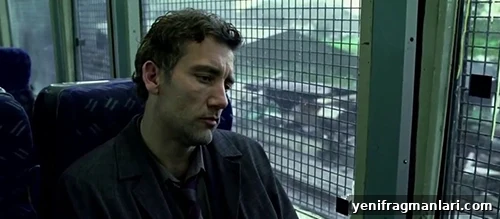
One standout sequence finds Theo, Kee, and Miriam (Pam Ferris) sneaking through a resistance compound at dawn after a shocking revelation. The camera tracks them at ground level in a steady, handheld rhythm that maintains a human scale: it never becomes so jittery as to disorient, nor so flat as to feel staged. Ambient sounds—the distant city, small footsteps, a creak—are magnified, creating a sensory tension where every noise threatens to blow their cover. The scene’s slow-burn suspense resembles high-stakes stealth rather than outright confrontation, and it demonstrates how timing and restraint can amplify dread.
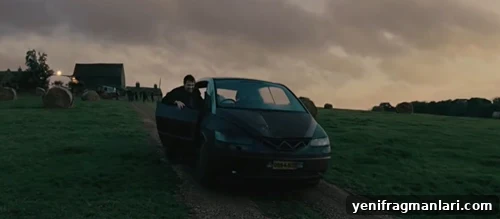
Long takes function stylistically as well as narratively. Recent films like 1917 and Athena show how one-shot techniques can produce drastically different rhythms: 1917’s deliberate, landscape-spanning planning contrasts with Athena’s frantic, handheld immediacy. Children of Men finds a balance between these extremes—rising and falling in tempo to reveal character choices and preserve dramatic momentum. Occasionally a shot lingers past the expected cut, but that lingering usually serves to deepen atmosphere or emphasize consequence.
Technical precision and choreography are integral to these scenes. Cuarón and his longtime collaborator, cinematographer Emmanuel Lubezki, arrange each frame so there is no wasted space: actors, props, and background action all contribute to a living tableau. A pertinent example is the Canterbury forest ambush. What begins as a casual, intimate moment among friends—blowing ping-pong balls and light banter—abruptly turns violent when armed deserters swarm the vehicle. The camera moves inside and around the car, shifting perspective from Theo’s point of view to the surrounding chaos, making a once-open forest feel suffocating and dangerous.
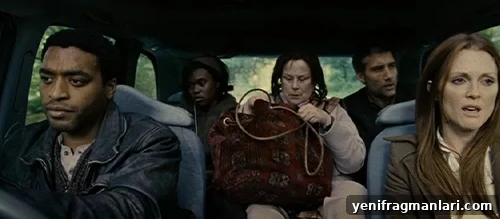
Some cinematic moments may prompt questions—such as how a small group overwhelms a vehicle—but these events serve narrative and thematic ends: they underline fragility, randomness, and the precariousness of hope. Cuarón resists glamorizing heroics. His characters are flawed and vulnerable, their courage shaped by necessity rather than grandeur, which keeps the film emotionally anchored.
The film’s climactic refugee-camp sequence exemplifies Cuarón and Lubezki’s capacity to render large-scale violence with palpable realism. As Theo searches for Kee through a battlefield of collapsing shelters, the handheld camera maintains an unbroken thread of urgency. Explosions and gunfire feel immediate; bullets and debris slice through the frame with brutal consequence. Small details—a camera lens splattered with blood, a passing armored vehicle—intensify the sense of bodily risk, much as Spielberg’s Omaha Beach sequence in Saving Private Ryan did for World War II cinema. Yet where some wartime epics can drift into spectacle, Children of Men remains committed to the human cost of violence.
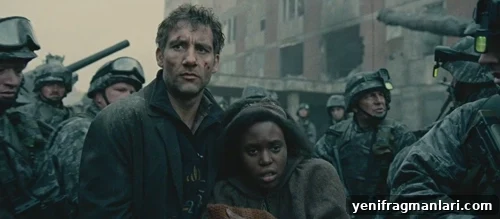
Taken together, these elements make Children of Men a benchmark in modern science fiction and action filmmaking. Its blend of documentary-like immediacy, meticulous long-take choreography, and unflinching narrative realism immerses viewers in a world where every choice carries weight. Cuarón’s film remains a powerful exploration of despair, hope, and survival—an emotionally rich, technically daring work that continues to influence filmmakers and audiences alike.
Written by Mark Serravalle
Support the author on Twitter: @MarkSerravalle