
Steamboat Willie (1928)
Directors: Ub Iwerks, Walt Disney
Screenwriters: Walt Disney, Ub Iwerks
Starring: Walt Disney, Charlotte Jamquie
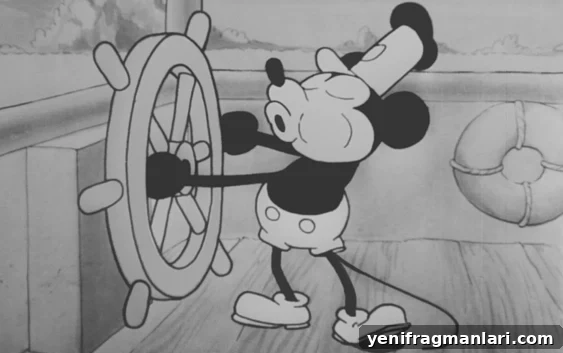
The origins of Walt Disney’s most famous character trace back to a different animal entirely. Before Mickey Mouse captured the public imagination, Walt Disney and animator Ub Iwerks created Oswald the Lucky Rabbit. Despite starring in numerous shorts, Oswald was abandoned after a series of legal and rights disputes with another studio, which prompted Disney to develop a new character he could control. That decision led, ultimately, to the creation of Mickey Mouse and to the film that introduced him to the world: Steamboat Willie.
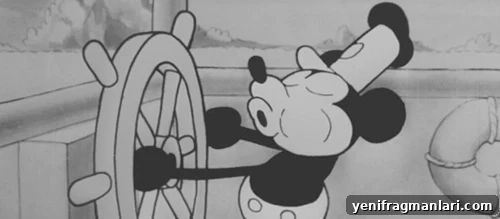
The short centers on Mickey Mouse, who serves aboard a steamboat under the stern Captain Pete. While piloting the vessel and transporting a cargo of farm animals, Mickey meets his girlfriend Minnie Mouse and improvises a lively musical performance using items and animals on the boat as instruments. The eight-minute cartoon blends physical comedy, inventive visual gags and synchronized sound to deliver a compact, entertaining piece of animation.
Steamboat Willie announces itself in the opening credits as “A Mickey Mouse sound cartoon,” signaling early and deliberate character branding. Although the earlier short Plane Crazy was produced and previewed prior to this film, Steamboat Willie was the first to be released widely and thus played a pivotal role in putting Walt Disney and his studio firmly on the cultural map. The short helped define the studio’s identity during a pivotal era of cinema when synchronized sound was transforming film exhibition and audience expectations.
At the time, it was common practice for studios to support feature presentations with short subjects and B-movies. Disney’s use of synchronized sound here was both an artistic and commercial move: the short embraced elaborate musical timing and sound effects, setting a new standard for animated shorts. The film’s musicality and precise timing demonstrate the studio’s emerging skill in pairing lively, whimsical animation with carefully coordinated audio, which would become a hallmark of the Disney approach.
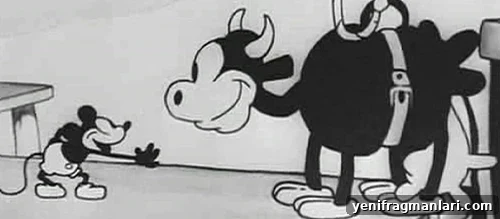
Viewed today, the short is a product of its time, and some scenes can be jarring to modern sensibilities. Much of the comedy relies on cartoonish animal mistreatment used as musical gags: a goat’s tail doubled as a phonograph, a cow’s teeth are tapped like a xylophone, and piglets’ squeals are used rhythmically. While these gags were played for laughter and slapstick effect in the late 1920s, contemporary viewers may see them differently. Similarly, the cartoon borrows elements from vaudeville and minstrel-show performance styles that were common in early cinema—elements reflected in costume bits like white gloves and exaggerated gestures. Recognizing these influences is important for understanding the film’s historical context without oversimplifying its cultural legacy.
Technically, Steamboat Willie is not the most polished work in the Disney catalog. Ub Iwerks’s animation demonstrates an energetic, elastic style—stretch and squash animation that often feels playful and mischievous—but there are moments where the craftsmanship appears hurried or rudimentary. Those imperfections are offset, however, by the short’s sheer inventiveness and the successful marriage of visual ideas to musical cues. The result is a piece that continues to charm despite its age.
As a historical artifact, Steamboat Willie remains fascinating. It represents a turning point in animation history: an early and influential use of synchronized sound in cartoons, the debut of a character who would become a global icon, and a demonstration of Disney’s ability to identify and exploit emerging cinematic trends. The short may not rank among the studio’s most refined works, but its role in shaping the future of animated entertainment is undeniable. For under ten minutes of viewing time, it still offers a lively glimpse into the origins of modern animation and the beginnings of the Disney legacy.
Score: 18/24
Rating: 3 out of 5.
Recommended reading: Disney Renaissance movies ranked