
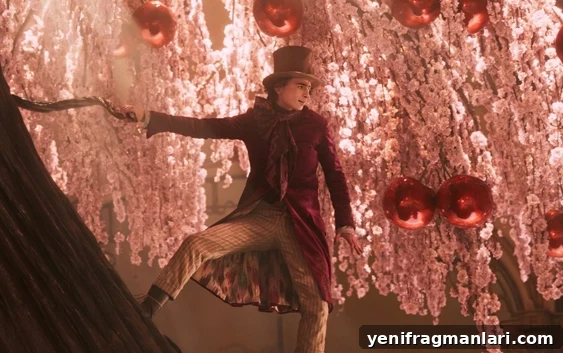
Wonka (2023)
Director: Paul King
Screenwriters: Simon Farnaby, Paul King
Starring: Timothée Chalamet, Calah Lane, Keegan-Michael Key, Paterson Joseph, Olivia Colman, Matt Lucas, Matthew Baynton, Tom Davis, Hugh Grant
Willy Wonka remains one of cinema’s most enigmatic figures. In the 1971 film adaptation of Roald Dahl’s Charlie and the Chocolate Factory, we meet a charismatic, slightly unhinged confectioner who delights in teaching misbehaving children sharp lessons while searching for an heir to his candy kingdom. Gene Wilder gave the role a mischievous warmth that preserved much of Wonka’s mystery: he hinted at layers without fully revealing them, making the character as memorable for what was left unexplored as for what was shown. The original story is ultimately Charlie’s, and the ambiguity around Wonka is part of that magic.
Paul King’s 2023 film Wonka attempts to be a spiritual prequel to the classic, explaining how Willy became the eccentric chocolatier we know. Unfortunately, the film’s origin-story approach peels back those layers only to find a version of the character that feels flattened and overexplained. The movie aims to be a family-friendly holiday musical but struggles to capture the darker edge and imaginative spark that made the original and even the 2005 adaptation compelling.
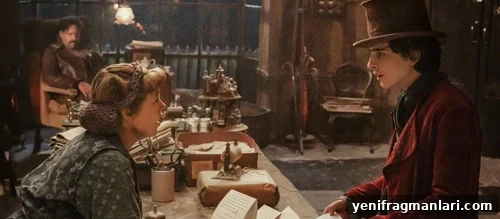
Despite promotional promises that we would witness how “Willy became Wonka,” Timothée Chalamet’s portrayal reads largely as if he already is the character rather than someone transforming into him. The film opens with Willy arriving in a bustling, unnamed city and bursting into his initial “I Want” number, “Hatful of Dreams.” He’s optimistic, driven by memories of his mother and a desire to share his chocolates with the wider world. He quickly finds himself thwarted by established chocolatiers, including the scheming Arthur Slugworth, and falls victim to a manipulative employment contract because he can’t read the fine print. Olivia Colman’s Mrs. Scrubitt serves as an overbearing antagonist, while Calah Lane’s Noodle, an orphaned fellow worker, becomes Willy’s loyal assistant and closest ally.
Chalamet is often the film’s best asset. He brings charm, humor and a visible commitment to the role. Yet his performance is frequently at the mercy of uneven material and direction. When the script’s jokes fail, Chalamet’s delivery falters; when the tone slips, so does his portrayal. He wisely avoids imitating Wilder, but the screenplay doesn’t give him enough depth to make this Wonka feel definitive or fully realized.
A larger problem is structural: nearly every major obstacle in the film is external. Willy reacts to schemes, betrayals and mishaps rather than making consequential choices that shape his journey. That reactive posture undermines the film’s status as an origin story—by design, such stories should chart internal change as much as external events. The writers, Paul King and Simon Farnaby, face the difficult task of connecting this younger Wonka to the reclusive figure audiences first met decades ago, but the screenplay sidesteps the darker possibilities and offers little sense of continuity between Chalamet’s portrayal and Wilder’s iconic performance.
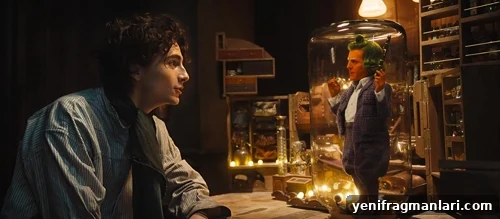
The supporting cast is uneven. The friendship between Willy and Noodle is one of the few genuinely warm elements, but many characters remain thinly sketched. Hugh Grant’s Oompa-Loompa, Lofty, is underused and relies on motion-capture that often feels jarring; other comic elements, like the film’s treatment of gluttony, land awkwardly. A recurring comedic choice—putting an actor in an oversized fat suit for laughs—feels outdated and mean-spirited, trading cheap visual gags for genuine satire or insight.
As a musical, Wonka does not fare much better. The songs, credited to Neil Hannon, Paul King, Simon Farnaby and Joby Talbot, lack memorable hooks and emotional weight. “Hatful of Dreams,” the film’s opening number, often feels perfunctory rather than revelatory; instead of revealing deep longing or conflict, many musical moments exist as decorative set pieces. Chalamet’s singing is serviceable—clear and pleasant, if a touch thin—yet his most affecting vocal moment comes from a rendition of “Pure Imagination,” a song that already carries emotional baggage from previous adaptations. New compositions in the film rarely reach that level of resonance.
Tonally, the film smooths out the quirks and darkness that made previous adaptations compelling. The original 1971 movie offered a dreamlike, sometimes menacing atmosphere akin to classic fantasy; this Wonka favors a well-polished, relentlessly “nice” aesthetic. While that might make it more palatable for family audiences, it also robs the story of bite. Attempts to address themes like poverty, exploitation and greed are handled in passing, with little sustained engagement. The film gestures at social commentary without committing to any meaningful critique, leaving emotional beats underdeveloped and the stakes feeling low.
Production design and visual choices are mixed. The factory reveal in earlier adaptations felt expansive and fantastical; here, many sets—especially the Galeries Gourmet—come across as small or claustrophobic, lacking the technicolor awe that should accompany a confectionery wonderland. Costume and art direction are detailed, but the overall worldbuilding rarely achieves the transporting quality the premise demands.
Prequels promise transformation: the chance to see beloved characters evolve into the figures audiences remember. In Wonka, Willy may be younger and sunnier, but the film does not convincingly show how he becomes the complex, guarded eccentric of the original. Instead it offers a polished, occasionally charming musical that leans so heavily into sweetness that it sometimes suffocates its own charm. For viewers hoping for a deeper, darker, or more inventive take on Wonka’s origins, this movie will likely feel disappointing. For families seeking a gentle, visually cheerful holiday outing, it will provide light entertainment, but little of the original’s enduring magic.
Score: 12/24
Recommended reading: ‘Willy Wonka and the Chocolate Factory’ (1971) earned a place among notable classic films and remains the benchmark for any reinterpretation of the character.