

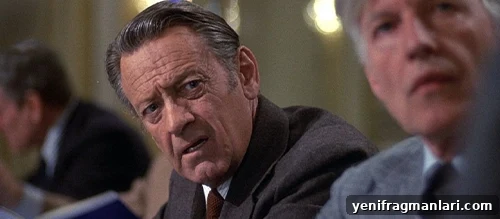
Network (1976)
Director: Sidney Lumet
Screenwriters: Paddy Chayefsky
Starring: Faye Dunaway, William Holden, Peter Finch, Robert Duvall, Ned Beatty
Some lines of dialogue linger in film history because they feel eerily timely long after the credits roll. Few are as famously prophetic as Peter Finch’s Howard Beale shouting, drenched and frantic, “I’m as mad as hell, and I’m not going to take it anymore!”—a performance that earned Finch posthumous awards and remains a defining cinematic moment. In Network, Beale’s breakdown and subsequent transformation into a television sensation are not accidental; they are deliberately manufactured by a network desperate to revive sagging ratings. What begins as the exploitation of a single deranged anchor evolves into a nationwide phenomenon that sustains a corporate empire, and Lumet’s film watches that process with sharp satire and clinical curiosity.
Paddy Chayefsky’s screenplay, bleakly funny and fiercely observant, drives the film’s intelligence. He blends topical references—such as the 1970s oil politics—into the story, and he skewers the way television and corporate interests manipulate public perception. Unusually for social satire, Chayefsky spares no side: he lampoons crusading left-wing groups that squander money fighting the system while still relying on the very institutions they claim to oppose, and he ridicules the corporate executives who treat viewers as commodities. This broad but precise critique echoes other satirical works of the era that mocked both ideological rigidity and institutional hypocrisy.
Lumet and Chayefsky also explore a deeper corruption beyond simple greed. In a pivotal scene, Ned Beatty’s Arthur Jensen delivers a calm, clinical monologue about business as an elemental force—“primal forces of nature”—that supersedes national and democratic ideals. Lumet stages Jensen at the far end of a long conference table in a composition that visually isolates him, underscoring how removed such corporate power has become from everyday reality. The speech anticipates later philosophical discussions about media, simulation, and the erosion of the real; people begin to accept televised re-presentations—images and narratives constructed by networks—as the primary version of truth. The film suggests that we are slipping into a world where appearances and spectacles increasingly replace grounded reality.
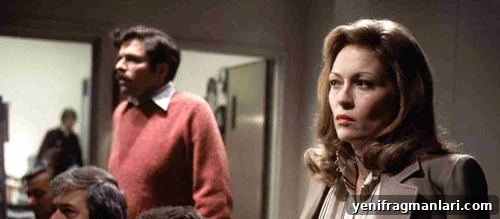
Faye Dunaway’s Diana Christensen is the personification of that system. Ambitious, ruthless, and utterly tuned to the calculus of ratings, Diana treats programming and people as interchangeable assets. She packages sensational footage—psychic charlatans, simulated robberies, and spectacles meant to trigger emotion—to boost numbers. Her personal life mirrors this transactional ethic. Her relationship with Max Schumacher (William Holden), a more traditional journalist and former executive, cannot compete with her devotion to the network’s demands. Max sees Diana as “television incarnate,” a woman who treats relationships like scripts she can rewrite or cut depending on audience response. This disconnect between private desire and professional devotion is a core theme: when a person’s sense of self is shaped by television metrics, intimacy and authenticity suffer.
The film’s conclusion refuses the tidy moral resolutions typical of mainstream storytelling. Consequences land unevenly; villains are not always punished, and heroes do not always triumph. In those final scenes, Elliot Lawrence’s musical score drops away, leaving a stark, soundless reality in which viewers must confront what has unfolded without cinematic cues to shape their emotions. That silence is deliberate: reality, in Lumet’s view, lacks the comforting soundtrack of fiction, and the film forces us to sit with that discomfort.
Lumet ends as he begins, with television screens—multiple channels broadcasting different versions of life—reminding viewers of a simple but chilling truth: if one reality offends, you can switch to another. The film’s repeated assertion, “Television is not the truth. Television is an amusement park,” highlights how media present a curated world more immediately satisfying than messy, inconvenient reality. In this sense, Network anticipates analyses of mass culture where amusement, fantasy, and commercial spectacle come to define collective perception. Television, like other manufactured paradises, often appears more tangible and pleasurable than the actual world.
Howard Beale’s climactic plea for people to scream out their windows—an act of raw, communal catharsis—reads as an attempt to reawaken a public numbed by carefully staged narratives. He becomes for a moment the only character who speaks of an unvarnished truth. Yet even his truth is subsumed and commodified by the network that made him famous. The final irony is sobering: media power survives only as long as audiences grant it attention. Network captures that uneasy bargain and suggests that our complicity—our willingness to tune in and accept convenient fictions—is the engine that keeps corporate spectacle in motion. Viewed from today’s perspective, the film feels remarkably forward-looking: a fierce, intelligent, and unnerving portrait of how entertainment and power can reshape reality.
Score: 22/24
Rating: 4 out of 5.
More Retrospective Reviews