
Sleeping Beauty (1959)
Directors: Clyde Geronimi, Eric Larson, Wolfgang Reitherman, Les Clark
Screenwriters: Erdman Penner, Joe Rinaldi, Winston Hibler, Bill Peet, Ted Sears, Ralph Wright, Milt Banta
Starring: Mary Costa, Bill Shirley, Eleanor Audley, Verna Felton, Barbara Luddy, Barbara Jo Allen, Taylor Holmes, Bill Thompson, Marvin Miller
Disney’s output across the decades has left an indelible mark on global culture. The studio’s long history includes iconic characters and award-winning work, but not every release achieved instant acclaim. Released in 1959 during what is often called Disney’s Silver Age, Sleeping Beauty met a muted reception at the box office and among some critics. Over time, however, the film has attracted renewed attention for its distinctive visual style, classical score, and memorable villainy.
The movie draws its story from Charles Perrault’s 17th-century version of the classic fairy tale and borrows musical inspiration from Tchaikovsky’s ballet of the same name. This heritage is signaled immediately by the film’s opening: an ornate storybook comes to life while a narrator sets the scene, which helps establish the film as a deliberate homage to medieval European tales and illuminated manuscripts. Rather than aiming for realistic animation, the film adopts a highly stylized, decorative look rooted in medieval design, producing some of Disney’s most striking and artful imagery.
The plot centers on the royal household of King Stefan (Taylor Holmes) and Queen when their daughter, Aurora, is born and betrothed to Prince Philip. Three benevolent fairies—Flora (Verna Felton), Fauna (Barbara Jo Allen), and Merryweather (Barbara Luddy)—bestow gifts on the child: beauty and song among them. Before the third fairy can complete her blessing, Maleficent (Eleanor Audley), the self-styled “Mistress of All Evil,” arrives and lays a curse: on her sixteenth birthday, Aurora will prick her finger on a spinning wheel and fall into an eternal sleep. Unable to fully undo the curse, the fairies add a proviso that true love’s kiss can break the spell. To protect Aurora, they hide her in a rural cottage, raising her in secrecy for years. As the sixteenth birthday approaches, Aurora (Mary Costa) is unwittingly drawn to a spindle and the curse appears to take effect. It falls to Prince Philip (Bill Shirley) and the three fairies to confront Maleficent and attempt to rescue the sleeping princess.
Critics and modern viewers often point to Aurora’s limited agency in the story. Some argue the heroine lacks depth, with extended stretches of the film where she remains passive or silent, and that the gifts she receives—beauty and song—do little to develop her into a fully rounded character. These critiques align with broader feminist readings of early Disney princesses that highlight passive arcs and love-as-goal narratives. Despite this, Aurora’s portrayal is only one aspect of a film that features a strong ensemble of female characters.
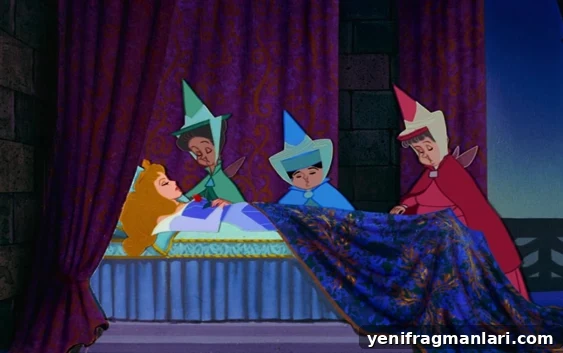
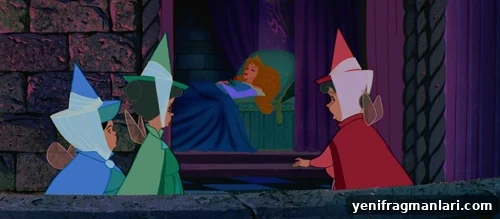
The three fairies drive much of the story’s action. Flora, Fauna, and Merryweather combine distinct personalities—diligence, kindness, and spunk—and use their magic to protect, nurture, and ultimately save Aurora. They handle both practical tasks and critical moments in the plot, such as rescuing Philip and transforming perilous obstacles into less threatening forms. Their presence underlines the film’s focus on female solidarity and resourcefulness, even as traditional domestic tasks appear in a folkloric context.
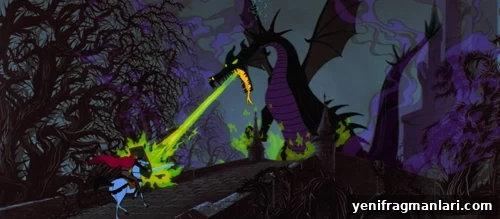
Maleficent remains the film’s most enduring and powerful figure. Elegant, imposing, and theatrically malevolent, she dominates the screen with her dramatic costumes, commanding presence, and a palette of dark purples, blacks, and sickly greens. Her transformation into a colossal, fire-breathing dragon during the climactic battle provides one of the most thrilling and cinematic sequences in early Disney animation. Even when the narrative’s moral divide between good and evil feels straightforward, Maleficent’s design and performance give the film a sense of genuine menace that still resonates.
Musically and visually, the film leans heavily on classic tropes: woodland animals, serendipitous romance, and the archetypal “happily ever after.” “Once Upon a Dream,” the duet sung by Aurora and Philip, remains the most recognizable musical moment, delivered beautifully by Mary Costa, who later became a celebrated opera soprano. The film’s Technicolor presentation and bold, saturated palettes enhance sequences such as the iconic dress-changing scene where Flora and Merryweather argue over whether Aurora’s gown should be pink or blue. While some elements—like the true love’s kiss that awakens Aurora—feel outdated to modern viewers, they reflect storytelling conventions of the period.
On balance, Sleeping Beauty is a film that benefits from reassessment. It may not rank among Disney’s most narratively complex or progressive works, yet it rewards repeated viewings for its artistic ambition: the fusion of Tchaikovskian motifs, medieval-inspired design, and theatrical villainy gives it a distinct place in animation history. The movie’s strengths lie in its visual craftsmanship, memorable antagonist, and the effectiveness of its supporting female characters, even if its central heroine remains comparatively understated.
Score: 18/24