
If you are a film lover just beginning to explore international cinema, certain names quickly become familiar: Jean-Luc Godard, Werner Herzog, and Agnès Varda frequently appear in recommendations and retrospectives. As you dig deeper, the work of Luis Buñuel inevitably emerges as essential viewing. His films offer a distinct, often unsettling perspective that continues to influence filmmakers and challenge audiences.
Buñuel’s career spanned nearly five decades and included shorts, features, documentaries, and even politically charged productions. The variety of his output is vast, yet a consistent thread runs through it all: a commitment to experimentation and an insistence on challenging cinematic and social conventions. His films blend surreal imagery, sharp satire, and acute observations of human behavior.
From an early short created with Salvador Dalí to documentaries documenting rural hardship and feature films that satirize the upper classes and bourgeois norms, Buñuel approached every subject with an unconventional eye. Rather than following established storytelling formulas, he preferred to provoke thought through juxtaposition, dream logic, and a darkly comic sensibility.
In the history of world cinema, where the various 1950s and 1960s new waves are often treated as touchstones, Buñuel occupies a singular position. His work resists easy categorization, and his influence stretches across generations. Below is a concise guide to three essential Buñuel films to start with—carefully chosen to showcase his surreal vision, satirical bite, and human insight.
1. Un Chien Andalou (1929)
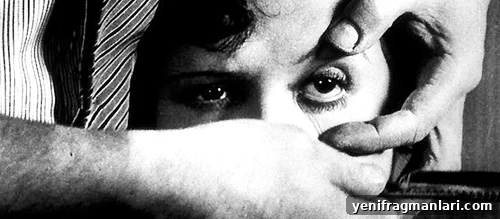
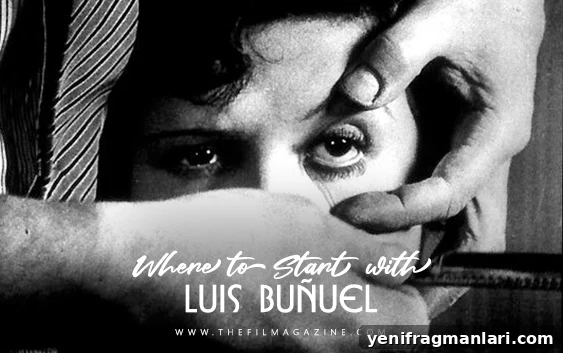
Even if you haven’t watched much of Buñuel’s work, you have likely encountered one of the most iconic images in film history: a woman’s eye, a razor blade, and an abrupt cut to a cloud passing the moon. That shocking sequence comes from Un Chien Andalou, a twenty-minute surrealist short made in collaboration with Salvador Dalí. The film abandons conventional narrative logic in favor of dreamlike associations, creating a series of disjointed but powerfully resonant scenes.
Upon its release, Un Chien Andalou was revolutionary. It deliberately violated expectations of continuity, causality, and taste, using shock and surprise as artistic tools rather than mere gimmicks. The film is still startling today, and it serves as a compact introduction to Buñuel’s radical formal instincts and his fascination with the unconscious, desire, and the absurd. For viewers new to surreal cinema, this short demonstrates why Buñuel became synonymous with cinematic provocation.
2. Belle de jour (1967)

Buñuel’s international reputation grew significantly in the 1960s, and Belle de jour stands out as one of his most accessible and provocative achievements. Starring Catherine Deneuve, the film follows a respectable young woman who by day secretly works in a high-class brothel while maintaining a conventional life with her husband. The film’s premise alone forces viewers to confront assumptions about respectability, desire, and identity.
Belle de jour treats sexual themes with a calm, unsensational tone, avoiding judgment while exploring fantasy, repression, and social hypocrisy. Buñuel’s direction balances elegance and cold observation, letting small, precise details accumulate into a deeper portrait of character and society. For newcomers to Buñuel, this film is a compelling entry point: emotionally rich, stylistically precise, and provocatively humane. It demonstrates how Buñuel could combine narrative clarity with unsettling ambiguity.
3. The Discreet Charm of the Bourgeoisie (1972)
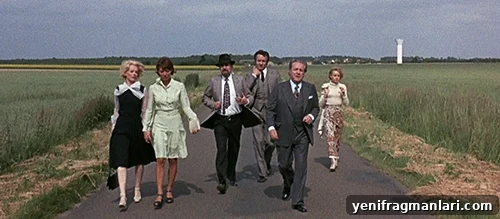
The Discreet Charm of the Bourgeoisie is a razor-sharp satire that tracks a group of upper-middle-class acquaintances who repeatedly fail to share a simple meal together. Each attempt is thwarted by increasingly surreal interruptions, creating a running joke whose point is less the gag itself than what it reveals about entitlement, ritual, and denial. The film’s episodic structure allows Buñuel to layer absurd moments with pointed social critique.
What makes the film so effective is Buñuel’s ability to reveal character through recurring behavior: the protagonists always plan another dinner without learning from previous failures, exposing their complacency and belief in their own exceptionality. Buñuel uses comedy—not sentimental or mocking but keen and precise—to expose hypocrisy and human weakness. The result is both hilarious and unsettling, an experience that entertains while encouraging reflection.
Recommended for you: Where to Start with Pedro Almodóvar
For many viewers, international and arthouse cinema can feel intimidating—assumed to be pretentious, slow, or inaccessible. Buñuel’s films directly counter that stereotype. Rather than wallowing in obscurity, his work uses invention, satire, and visual daring to engage and provoke. He wrote neither for mere shock nor for intellectual posturing; his films ask us to see ourselves more clearly, to question social rituals, and to appreciate the strangeness beneath ordinary life.
If international cinema feels daunting, begin with Buñuel’s clarity of vision: the short, pungent intensity of Un Chien Andalou; the cool, unblinking human portrait of Belle de jour; and the playful, moral satire of The Discreet Charm of the Bourgeoisie. Together they provide a varied, compelling introduction to a filmmaker whose influence and daring remain vital for contemporary audiences.