
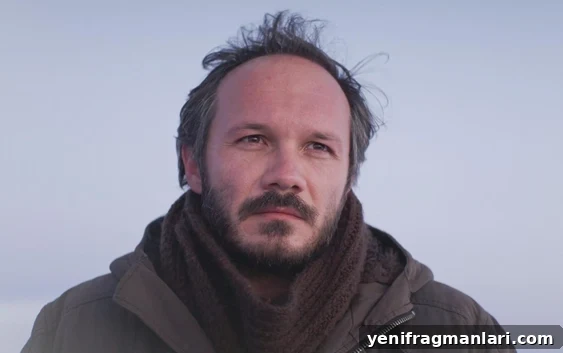
About Dry Grasses (2023)
Director: Nuri Bilge Ceylan
Screenwriters: Nuri Bilge Ceylan, Ebru Ceylan, Akın Aksu
Starring: Deniz Celiloğlu, Merve Dizdar, Musab Ekici
Nuri Bilge Ceylan’s About Dry Grasses arrived with significant expectations. The director, whose previous film won the Palme d’Or and whose work has repeatedly represented Turkey for the Academy Award for Best International Feature Film, returns with a quiet, demanding picture that leans into extended observation and psychological scrutiny. The film centers on a teacher accused of inappropriate conduct with a student and uses an austere, contemplative approach to examine guilt, perception, and the small gestures that reveal inner life.
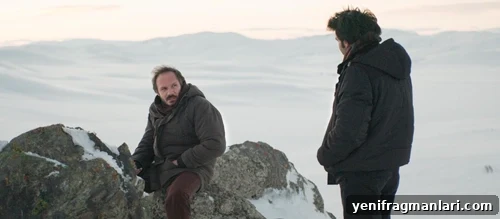
The story unfolds in a remote village in eastern Anatolia during a relentless winter. Snow covers the landscape in an unbroken white, and the photography emphasizes wide, empty horizons and the stillness of a place that feels cut off from the rest of the world. That stark setting becomes a character of its own, a silent pressure that compresses choices and exposes small human actions. The film’s visual economy—few camera flourishes, long takes, and careful framing—directs attention to faces and speech, and the sparse sound design amplifies the smallest breaks in silence: a phone ringing, a knock on a door, or the constant whisper of falling snow.
Ceylan intentionally excludes a musical score, allowing diegetic sounds and silence to structure the viewer’s emotional response. This choice heightens attention but also places heavy demands on the cast. Without musical cues to guide feeling, actors must convey nuance through subtle physicality and vocal inflection. In that regard, the performances are a central achievement of the film.
Deniz Celiloğlu is compelling as Samet, the teacher transferred from Istanbul to the village post. He initially charms with understated warmth, but Celiloğlu gradually complicates that impression; every glance, small movement, and hesitation invites doubt and re-evaluation. His portrayal keeps the audience unsure—was Samet always ambiguous, or does the village’s isolation and gossip reshape how we see him? Ece Bağcı gives an affecting performance as Sevim, the young student at the heart of the accusations. Their interactions are rarely conclusive but consistently provocative, raising questions about power, vulnerability, and the limits of understanding.
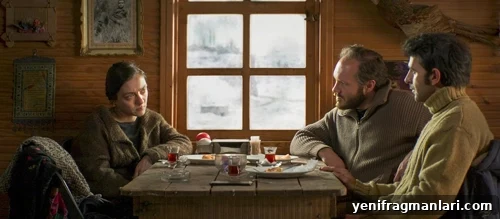
The film structures its central mystery—Is Samet guilty? Can he survive the accusations? Will Sevim escape the pressures around her?—as a series of scenes that interrogate motive and consequence rather than deliver tidy answers. Ceylan and his co-writers emphasize observation over resolution, inviting viewers to sit with ambiguity. That approach allows the film to explore how rumor, memory, and isolation shape truth, and how a community’s response can be as revealing as the alleged act itself.
Occasionally, the narrative drifts into episodes that expand the ensemble: townspeople whose reactions range from comic to cruel, and a subplot concerning a love triangle involving Samet, his colleague Kenan (Musab Ekici), and Nuray (Merve Dizdar), a teacher in a neighboring village. Nuray’s history—she once fought as a guerrilla and lost a leg in a violent incident—adds texture to the film’s portrait of damaged lives and complicated loyalties. These detours deepen character study and generate sharp, sometimes darkly humorous moments, but they can also divert attention from the accusation’s moral urgency. The film’s length allows these tangents to breathe, though some viewers may feel the focus diffuses at times.
Structurally, the screenplay is deliberate and compact in intent: scenes are layered to build a psychological mosaic rather than a linear thriller. Conversations reveal more about how characters see themselves than about indisputable facts, and Ceylan’s camera listens more than it interrogates. That method yields a film that rewards patient viewing. It is not built for easy answers or sensationalism; instead, it offers an immersive study of character and consequence.
Technically, the film’s strengths lie in its cinematography, production design, and soundscape. The pervasive snow and muted palette create a world that feels both beautiful and claustrophobic. Without music, ambient noise becomes dramatically significant, and the film frequently uses silence as a means of psychological pressure. Combined with committed performances, these choices create a mood that lingers long after the credits.
About Dry Grasses is a dense, patient film that values examination over explanation. At roughly two hundred minutes, it demands time and attention; viewers who engage with its slow-burning structure will find a complex portrait of the human mind and of social judgment. The film’s rewards are intellectual and emotional rather than immediate pleasure: it provokes reflection and unease in equal measure, offering a powerful example of how cinema can probe inner life without simplifying it.
Score: 17/24
Also featured at the Glasgow Film Festival: The Beast (2023) — review available elsewhere.