
10 Things I Hate About You (1999)
Director: Gil Junger
Screenwriters: Karen McCullah, Kirsten Smith
Starring: Julia Stiles, Heath Ledger, Joseph Gordon-Levitt, Larisa Oleynik, Andrew Keegan, Gabrielle Union, David Krumholtz, Susan May Pratt, Allison Janney, Larry Miller
Ten Things I Hate About You, the spirited 1999 teen comedy loosely inspired by William Shakespeare’s The Taming of the Shrew, blends sharp humor with sincere emotion. The film follows the complicated and often comic attempts of high school boys to negotiate romance, reputation, and identity under the strict rules of Padua High. At the center of the story is Patrick Verona (Heath Ledger), a confident outsider, and Kat Stratford (Julia Stiles), an outspoken and fiercely independent young woman. Their relationship unfolds through a series of memorable set pieces and honest moments that capture the awkward intensity of adolescence.
One of the film’s defining scenes finds Patrick staging an extravagant public gesture—singing Frankie Valli’s “Can’t Take My Eyes Off You” while a high school band accompanies him across the bleachers—an act that is both ridiculous and oddly romantic. The scene encapsulates why these kinds of big displays matter in romantic comedies: they feel larger than life, and in a coming-of-age story they remind us of how real and consequential youthful feelings can be. That balance—between heightened comedy and grounded emotion—is what makes the film resonate beyond its era.
The plot begins when Cameron James (Joseph Gordon-Levitt), a new student at Padua High, falls for the popular Bianca Stratford (Larisa Oleynik). Bianca’s father, Walter (Larry Miller), is officer-like about dating rules: Bianca can date only if her older sister Kat does. Kat, a fiercely independent student who rejects the ways of her peers, refuses to date, setting up a series of schemes. Cameron and his friend Michael (David Krumholtz) recruit the enigmatic Patrick to charm Kat so Bianca will be free to date. Predictably, the plan goes awry when Patrick actually begins to care for Kat.
The casting was pivotal to the film’s success. Heath Ledger’s Patrick is charismatic with a quietly vulnerable center; he navigates the role with effortless charm that complements Julia Stiles’ guarded but warming portrayal of Kat. Their chemistry is the film’s emotional core: Kat’s defenses gradually lower and the film earns its tenderness without ever softening her independence. Joseph Gordon-Levitt brings earnestness to Cameron’s infatuation, though scenes with David Krumholtz’s Michael often shift attention—Krumholtz brings lively energy and comic timing that make Michael more than a stock “geek” character.
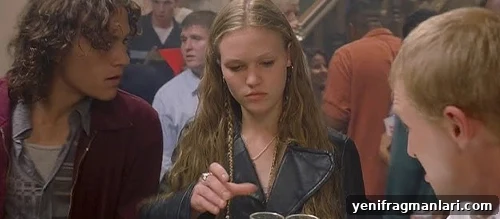
Screenwriters Karen McCullah and Kirsten Smith modernize Shakespeare’s archetypes rather than simply transplanting them. Bianca retains elements of the classic ingenue but is more self-aware and assertive than her predecessor, while Kat resists being “tamed.” The film largely takes Kat’s side, portraying her resistance as principled rather than merely combative. Patrick, who also has a difficult reputation at school, never attempts to change her core identity; instead, the relationship that develops is based on mutual discovery and respect.
The film isn’t without awkward or dated moments. A few jokes and plot devices that seemed acceptable in the late 1990s don’t land as well today, and casting choices reflect the era’s limited diversity. Still, there are surprising moments of self-awareness—an exchange with Kat’s English teacher, Mr. Morgan (Daryl Mitchell), raises questions about privilege that feel thoughtful for a mainstream teen comedy of its time.
Director Gil Junger and cinematographer Mark Irwin craft a visual style that complements the script’s tone, mixing energetic camera movement with playful framing. Small visual flourishes—long tracking shots down hallways, inventive compositions during parties and concerts—add texture without distracting from character moments. The film’s alt-rock soundtrack and well-chosen needle drops help set the mood, anchoring the story in a particular late-90s cultural moment while remaining emotionally resonant.
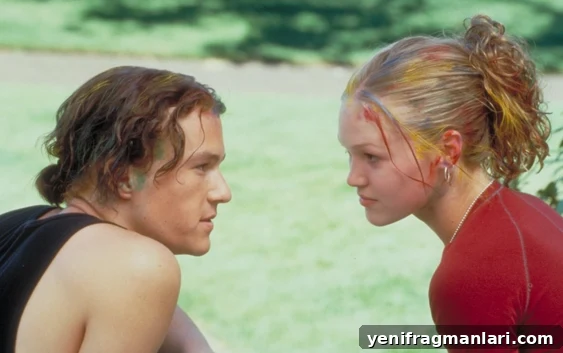
What makes Ten Things I Hate About You endure is its combination of wit, warmth, and respect for adolescent complexity. The script gives its characters room to breathe, allowing intimate scenes—the paintball sequence where Kat and Patrick share a messy, honest first kiss, for example—to become defining moments rather than neat plot devices. The result is a teen comedy that feels indulgent in the best way: it celebrates youthful passion and nerve while arguing that love should illuminate who we are, not erase our edges.
With a charismatic cast, memorable soundtrack choices, and a screenplay that blends humor with emotional intelligence, the film remains a high point of the teen-comedy genre. It captures what it feels like to be young and stubborn, hopeful and uncertain, and it insists that real connection preserves individuality rather than attempting to change it.
Score: 18/24