
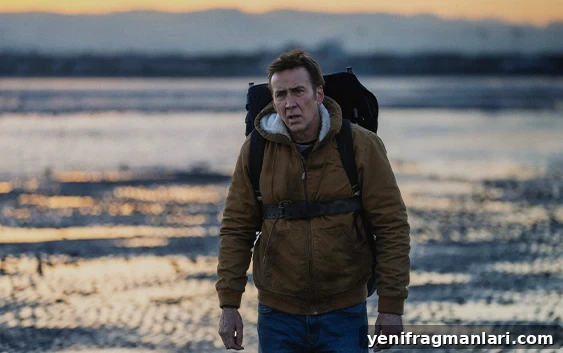
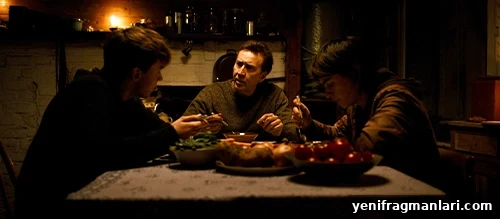
Arcadian (2024)
Director: Benjamin Brewer
Screenwriter: Mike Nilon
Starring: Nicolas Cage, Jaeden Martell, Maxwell Jenkins, Sadie Soverall, Samantha Coughlan, Jow Dizon, Joel Gillman, Daire McMahon
Low-budget filmmakers often turn to horror because the genre can deliver strong returns on minimal resources: confined locations, a small cast, practical effects, and a concentrated atmosphere. Arcadian embraces many of those advantages. Set fifteen years after an unspecified collapse of society, the film centers on a small, isolated family who board up their farmhouse each night to protect themselves from the unknown threats that prowl the outside world. Nicolas Cage plays Paul, the father of two teenage sons, Joseph (Jaeden Martell) and Thomas (Maxwell Jenkins). By day they forage and reinforce their home; by night they hunker down and hope whatever lurks outside doesn’t breach their defenses.
Arcadian’s premise is immediately familiar and effective: a base-under-siege structure combined with the intimacy of a family drama. The brothers have grown up within the constant pressure of survival, creating divergent desires and tensions. One brother wants to push boundaries and experience life beyond scavenging; the other is hardened by necessity. Those interpersonal conflicts should make for compelling drama and provide contrast to the physical threat posed by the monsters.
When the film flips the switch and focuses on action and creature encounters, it proves it can be thrilling. Director Benjamin Brewer stages several sequences with an appreciation for claustrophobic tension and visual detail. One memorable underground sequence delivers tight, breathless action in a manner that calls to mind the best elements of subterranean horror. The creature design avoids generic copycats, offering slightly alien movement and coordinated group behavior that feel fresh. A singular, simple shot—a monster’s arm extended across a room, the camera holding on the image—stands out as a chilling highlight, proving that economy and restraint can be far scarier than furious motion.
The cast makes the most of the material they’re given. Cage offers reliable presence as the protective, sometimes volatile patriarch, while Martell and Jenkins anchor the film’s emotional core with believable brotherly friction. Supporting performances are adequate and contribute to the film’s tighter, more successful sequences. When the ensemble commits to urgency and danger, Arcadian finds its strongest footing and generates genuine tension.

However, the film struggles with an inconsistent rhythm. It frequently alternates between high-energy, focused sequences and long stretches of character setup that slow the momentum. The nearby Rose Farm community, introduced as a contrasting rural safe haven, never feels fully realized. After fifteen years of survival, their defenses and daily operations look implausibly lax, and the community’s apparent complacency undermines the film’s internal logic. Instead of deepening the world-building, these scenes create tonal whiplash: the film moves abruptly from tense and urgent to sleepy and pastoral.
That dichotomy extends to the film’s structure and pacing. Arcadian seems to contain two different movies: one a lean, effective creature feature, the other a slow-building character drama. When the film commits to horror, it shines—Brewer’s direction, thoughtful VFX touches, and focused performances produce suspense and occasional jolts of genuine fear. When the film pivots to interpersonal drama or world-building, however, it loses the tautness that makes the horror sequences succeed. These divergent impulses never fuse cleanly, leaving the film uneven: some sequences are exhilarating and vividly realized, while others feel underdeveloped and inert.
The climax gestures toward a rousing, action-heavy showdown but resolves more quickly than it earns. A longer, more fully committed finale would have better matched the film’s strongest moments and delivered a more satisfying tonal payoff. Instead, the conclusion wraps up in a way that feels restrained relative to the earlier intensity, reinforcing the sense that Arcadian contains promising ideas that are only partially fulfilled.
Overall, Arcadian is a film of contrasts: skillfully executed set pieces and creature work sit beside scenes that stagnate the narrative. Its best moments demonstrate how effective economical filmmaking can be when focused on atmosphere and carefully chosen scares. Yet the inconsistent pacing and uneven world-building prevent the film from reaching its full potential. Arcadian is worth viewing for fans of intimate, low-budget horror and for those who appreciate strong, suspenseful set pieces, but it ultimately lands somewhere in the middle—neither a hidden gem nor a complete misfire.
Score: 12/24
Featured Image: Nicolas Cage in Benjamin Brewer’s ARCADIAN. Courtesy of Patrick Redmond. An RLJE Films and Shudder Release.