The Watchers (2024)
Director: Ishana Night Shyamalan
Screenwriter: Ishana Night Shyamalan
Starring: Dakota Fanning, Georgina Campbell, Olwen Fouéré, John Lynch, Oliver Finnegan
Adapting A.M. Shine’s 2021 folk horror novel The Watchers for the screen is an ambitious task. The novel lives largely inside the minds of its characters, relying on psychological tension, internal dread, and an oppressive atmosphere to create fear. Translating that inward focus into compelling cinematic language requires subtlety: the filmmaker must externalize interior states while preserving the book’s eerie tone. Unfortunately, Ishana Night Shyamalan’s film version struggles to achieve that balance.
Ishana Night Shyamalan, making her directorial debut, is the daughter of well-known filmmaker M. Night Shyamalan. While her film shows flashes of stylistic intent, it ultimately falls short as a coherent horror thriller. The adaptation is uneven, with uneven pacing, dialogue that often functions as exposition instead of character development, and a general lack of dramatic stakes. The result is a film that fails to consistently generate suspense or emotional engagement.
The plot follows Mina (Dakota Fanning), an American expatriate living in Galway and still carrying grief over her mother’s death fifteen years earlier. She works at a pet shop, avoids calls from her more conventional twin sister Julia (also played by Fanning), and wears a wig at night while she frequents local bars — small behavioral notes that the film introduces but then neglects to explore in any meaningful way.
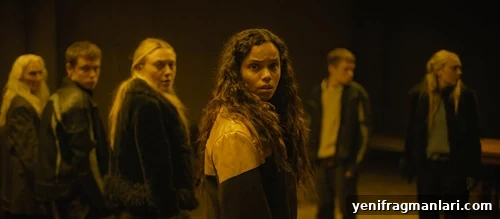
When Mina agrees to transport a valuable yellow parrot to Connemara in western Ireland, her car breaks down and she wanders into a dense forest. There she discovers a cement building with a large glass window and meets Madeline (Olwen Fouéré), the soft-spoken Ciara (Georgina Campbell) and the anxious Daniel (Oliver Finnegan). They explain the rules of their captivity: outside the Coop live mysterious creatures called “the watchers.” These entities observe the group through mirrored glass each night, and anyone caught outside after sundown will be killed. The group has been trapped for months with little hope of escape. Determined to get home, Mina tries to learn what the watchers are and how to outwit them, even if it means breaking the rules that keep the others safe.
A central weakness of the film is its screenplay. Rather than letting performances and visual storytelling convey psychological states and shifting group dynamics, the script frequently resorts to clumsy, literal dialogue that spells out emotions and plot points. Characters ask one another repetitive, obvious questions and narrate the passage of time instead of showing it. This reliance on verbal exposition undermines the film’s capacity to build dread through silence, implication, and image — techniques that the source material uses effectively.
Acting suffers when characters are not fully developed on the page. Dakota Fanning turns in a muted, restrained performance; at times that restraint reads as intentional nuance, but often it feels flat because the script offers little to expand her inner life. Supporting actors, including Fouéré and Campbell, deliver moments of texture, yet the film never affords them enough space to become three-dimensional. Madeline, a pivotal figure whose presence should anchor the film’s final act, remains underwritten; without a clearer setup for her motivations and past, key scenes lose emotional weight.
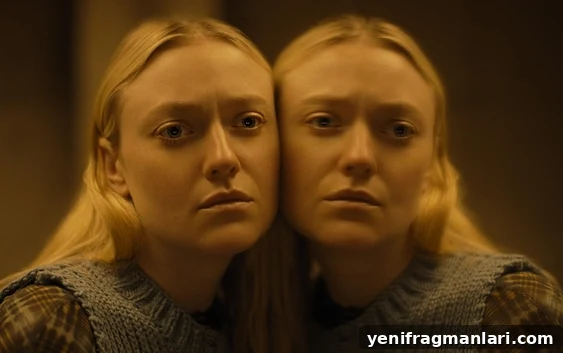
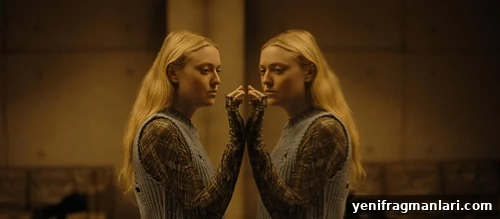
There are intriguing concepts in the film that could have produced memorable imagery. Mirrors and reflection are recurring motifs: at night the Coop’s window becomes something like a mirror, forcing the prisoners to confront doubles or echoes of themselves. The idea of mimics and mirrored identity has strong horror potential, but the film treats these elements as puzzle pieces rather than the core of its thematic engine, leaving audience questions unresolved rather than deepening the mystery.
Production design and costuming show deliberate choices but sometimes feel disconnected from the story’s logic. Madeline’s stylish coat and the characters’ relatively fresh-looking clothes undercut the sense of long-term entrapment. The Coop is furnished with retro objects — a phonograph, an old TV — that create atmosphere but are never integrated into the narrative in a satisfying way.
On the technical side, sound design and the score lift a few sequences, notably a tense scene where Mina and Madeline hide from the watchers in the woods. That sequence demonstrates the film’s potential when sound, editing, and performance align. The creatures themselves, revealed through CGI, are unsettling at moments, though the visual effects occasionally fail to sell the menace consistently.
Ultimately, The Watchers struggles to cohere as either a faithful adaptation or a fully realized original film. It strips away much of the novel’s interior complexity without replacing it with equally strong cinematic tools. The movie hints at a compelling story beneath the surface — a darker, smarter film that might emerge with tighter writing and more confident direction — but as delivered it remains disappointing.
Score: 2/24
Rating: 0.5 out of 5.