

With his deep, commanding voice, piercing gaze, and trademark shaved head, Yul Brynner’s screen image remains one of Old Hollywood’s most recognizable. He became synonymous with the role of King Mongkut in Rodgers and Hammerstein’s musical The King and I, both on stage and in the 1956 film adaptation. A Russian-American actor who rose to prominence in the 1950s, Brynner built a long and varied career that ranged from biblical epics to classic Westerns, even as Hollywood often typecast him in “exotic” roles.
Brynner frequently told colorful and exaggerated stories about his origins, but he was born Yuliy Borisovich Briner on July 11, 1920, in Vladivostok, in the far east of Russia. His ancestry included Swiss-German, Russian, and Buryat roots—the latter an indigenous group in Siberia. His family left Russia shortly after the Soviet Union was established, and he spent parts of his youth in China and France. In France he began performing—singing, playing guitar and joining a circus troupe—before moving to the United States in the 1940s. There he studied acting with Michael Chekhov and learned English while appearing on Broadway. Brynner’s film debut came in 1949 with The Port of New York, but his international breakthrough arrived with The King and I, which earned him an Academy Award for Best Actor. He had already won a Tony Award for originating the role on Broadway. Other notable screen roles include General Sergei Bounine in Anastasia and the Gunslinger, a killer android, in the cult sci-fi film Westworld. He also worked as a television director and photographer.
Brynner’s appearance often led casting directors to place him in roles depicting various ethnicities—a practice common in mid-20th-century Hollywood. He portrayed characters of Middle Eastern, Asian, and other backgrounds over the course of his career. Despite the frequent typecasting, his portrayal of King Mongkut in The King and I overshadowed most other roles and became the defining performance of his life.
1. The King and I (1956)
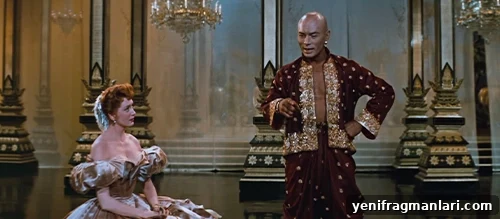
In the 1956 film adaptation of Rodgers and Hammerstein’s stage musical, Brynner plays King Mongkut of Siam, the historical ruler who reigned from 1851 to 1868. The story, adapted from Anna Leonowens’s memoirs, follows Anna—an English widow who arrives in Bangkok to teach the king’s children and household—and her evolving relationship with the monarch. Deborah Kerr portrays Anna, and Brynner’s King is forceful, proud, and intellectually curious. Though their relationship begins with friction, a mutual respect and friendship grow as Anna helps guide the sovereign toward modern reforms.
Brynner’s performance is physically commanding: he often stands with hands on hips and chest thrust forward, projecting authority and charisma. The shaved head, introduced for this role, became his signature look. His voice—baritone with a higher inflection in parts—and the accent he uses in the film reflect the production’s era and theatrical style, which contemporary viewers may find stereotyped or dated. The King and I, viewed through a modern lens, contains elements of white saviorism and cultural simplification. Still, Brynner invests the role with warmth and dignity, and his devotion to the character is evident in the way he inhabited the part on stage and screen for decades. By the time of his death in 1985, he had performed the role thousands of times.
2. The Ten Commandments (1956)
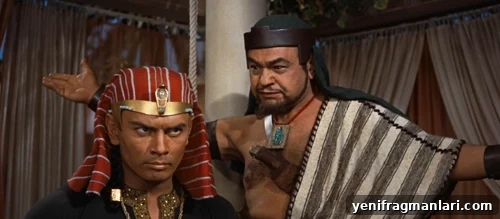
Also released in 1956, Cecil B. DeMille’s The Ten Commandments features Brynner as the proud and ruthless Prince Rameses. In this grand biblical epic, Moses—raised as a prince of Egypt—discovers his Hebrew heritage and confronts his adopted brother, who rules as Pharaoh and resists Moses’s effort to free the enslaved Israelites.
As Rameses, Brynner projects both regal magnetism and petulant insecurity. Decked in ornate jewelry and traditional Egyptian attire, he turns the prince into a layered antagonist: a man of swagger and showmanship who masks deep doubts about his authority. Brynner’s stage-trained presence suits DeMille’s larger-than-life direction, and his chemistry with co-stars—especially Anne Baxter, who plays Nefretiri—underscores the emotional stakes beneath the palace pageantry. The Ten Commandments remains one of cinema’s most successful and enduring epics, with Brynner’s performance standing out as a vivid example of classic Hollywood spectacle and dramatic intensity.
3. The Magnificent Seven (1960)
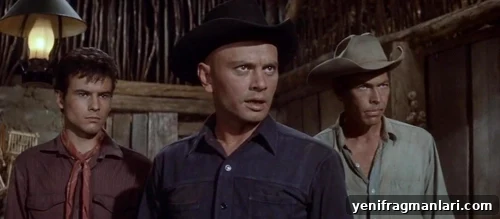
Moving into Western territory, Brynner starred in The Magnificent Seven, a 1960 adaptation inspired by Akira Kurosawa’s Seven Samurai. He plays Chris, a laconic and honorable gunslinger hired by impoverished Mexican villagers to protect them from bandits led by Calvera. Chris assembles a team of seven gunmen who, over time, form a bond with the people they protect and ultimately risk their lives in defense of the village.
Brynner’s Chris embodies the archetypal lone gunfighter: stoic, disciplined, and quietly principled. From under his black cowboy hat he delivers calm, measured performances that emphasize action over talk. The black wardrobe and purposeful presence evoke a dark, resolute figure who operates by a strict moral code. His on-screen partnership with other strong personalities—Steve McQueen among them—helps shape a tense, character-driven dynamic. The Magnificent Seven is widely regarded as a foundational Western whose influence persists, and Brynner’s portrayal helped cement the cinematic image of the rugged, honorable gunman.
Recommended for you: More “Career-Defining Performances” Guides
Yul Brynner’s films have endured for generations, securing his place among Hollywood’s memorable and influential stars. Whether playing monarchs, rulers, or outlaws, he brought a theatrical intensity and physical presence to each role, combining charisma with a clear command of the stage and screen. His image endures not only in film history—he has a star on the Hollywood Walk of Fame—but also in his hometown, where a statue honors his legacy. Though The King and I remains the role most associated with him, Brynner’s varied filmography—spanning musicals, epics, and Westerns—demonstrates a versatility that helped shape moments in American cinema and left a lasting cultural imprint.