
North by Northwest (1959)
Director: Alfred Hitchcock
Screenwriter: Ernest Lehman
Starring: Cary Grant, Eva Marie Saint, James Mason, Jessie Royce Landis, Leo G. Carroll, Philip Ober, Martin Landau, Adam Williams
By 1959 Alfred Hitchcock had been directing films for more than three decades and had explored a wide range of styles. Some of his experiments missed the mark, while others became instant classics. Over time he grew most confident in crime and suspense, and his name became synonymous with psychological tension, clever plotting, and startling visual invention. Films such as The Man Who Knew Too Much, The Thirty-Nine Steps, Rope, Notorious, Rear Window, and Vertigo helped define his reputation. Hitchcock specialized in paranoia, menace, and taut suspense, and by the late 1950s he had refined those elements into a near-perfect cinematic language.
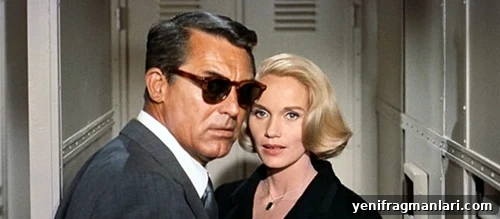
When Ernest Lehman set out to write what he called the ultimate Hitchcock picture, Hitchcock’s direction and Lehman’s script combined to produce North by Northwest, a film that crystallizes many of the director’s signature devices. The story follows Roger Thornhill (Cary Grant), an advertising executive mistakenly identified as a government agent. A band of criminals led by the suave and sinister Philip Vandamm (James Mason) attempts to extract secrets from him. After they drug Thornhill and stage a fatal car crash, he survives by sheer luck. Framed for the murder of a public figure, Thornhill is forced to flee across the United States as he fights to prove his innocence and unravel the mystery that keeps dragging him deeper into danger.
As Hitchcock himself noted, North by Northwest anticipates many of the tropes later seen in quintessential spy franchises: a mistaken identity, shadowy operatives, a mysterious MacGuffin, a charismatic villain, and a glamorous female lead. The film assembles these elements with precision, turning them into both a thrilling espionage story and a knowing tribute to the genre. It blends high-stakes chases with sharp, often deadpan humor, and it pairs physical danger with verbal wit. Cary Grant’s performance as the flustered but resourceful Thornhill provides the emotional center: his comic timing and understated charm make him the perfect reluctant action hero. Opposite him, James Mason’s Vandamm is the epitome of urbane menace—calm, controlled, and convincingly ruthless.
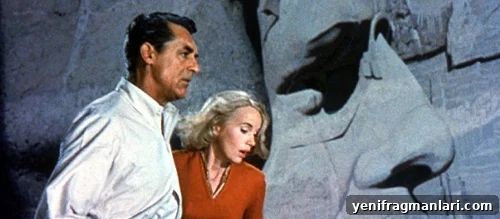
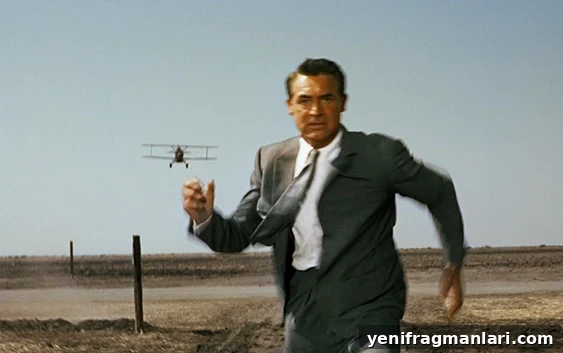
Hitchcock and Lehman crafted several sequences that have endured as landmarks of cinematic suspense. The crop-duster sequence—set in a wide, exposed landscape where the protagonist has nowhere to hide—suspends tension for an extended period and then delivers a shock that remains visceral decades later. That scene alone has generated countless homages and analyses, yet it still retains its power because of precise staging and visual economy. Equally audacious is the film’s climax on Mount Rushmore, a finale that combines spectacle and absurdity in a way only Hitchcock could carry off: the violent confrontation plays out against a monumental, patriotic backdrop, heightening both the surreal and cinematic stakes of the moment.
Despite its darker themes, the film is saturated with humor. Hitchcock balances suspenseful set pieces with moments of levity and verbal sparring, and the director often plays suspense and comedy against each other so that a waiting gunshot can feel as anticipatory as a punchline. The chemistry between Grant and Mason fuels much of the film’s energy, and the supporting cast, including Eva Marie Saint as the enigmatic heroine, adds layers of intrigue and style. The dialogue is sharp, the plotting is nimble, and the film’s visual design—costumes, sets, and cinematography—reinforces the tone of sleek danger and playful intelligence.
More than a single great set piece or a memorable performance, North by Northwest functions as a sustained masterclass in popular suspense. It satirizes and celebrates the spy thriller at once, elevating genre conventions into cinematic art. Its influence can be traced through later action and espionage films that borrow its rhythms, visuals, and bravura set pieces. The movie’s enduring appeal lies in its combination of elegance and audacity: flawless pacing, imaginative staging, and the kind of cinematic confidence that makes every frame feel purposeful.
Score: 24/24
★★★★★
Rating: 5 out of 5.
Recommended read: Alfred Hitchcock and Cary Grant — cinema’s greatest collaborations