
Beetlejuice Beetlejuice (2024)
Director: Tim Burton
Screenwriters: Alfred Gough, Miles Millar
Starring: Michael Keaton, Winona Ryder, Catherine O’Hara, Jenna Ortega, Justin Theroux, Monica Bellucci, Willem Dafoe
Tim Burton’s career has long balanced whimsical imagination with a dark, gothic sensibility. Over the past decade and a half his aesthetic has sometimes drifted toward glossy studio spectacle, and many critics point to his 2010 take on Alice in Wonderland as the moment his unique edge began to smooth out into broadly commercial design. But with Beetlejuice Beetlejuice, Burton returns to one of his earliest and most distinct creations and, in doing so, rediscovers a happier alignment of tone, invention, and oddball heart.
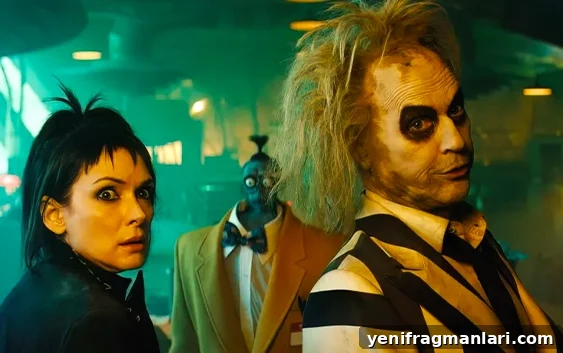
This sequel arrives 36 years after the original Beetlejuice and wisely chooses to extend the world rather than simply rehash old jokes. The story centers on Lydia Deetz (Winona Ryder), who has grown into a complicated, compromised version of the young goth we first met. Now a television personality who exploits her ability to see the dead for a supernatural reality show, Lydia occupies a modern landscape of fame, blurred moral lines, and performative strangeness. Her relationship with Rory (Justin Theroux), the show’s producer and her partner, exposes a marriage of convenience driven more by publicity than connection.
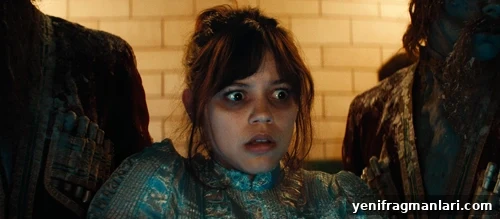
Lydia’s family life is strained. Her husband disappeared years earlier in the Amazon, and the couple’s daughter, Astrid (Jenna Ortega), is a sharp, environmentally aware teenager who resents her mother’s public persona and doubts the existence of ghosts because Lydia can’t contact her missing father. When Lydia is forced to return home after the discovery and funeral of her own father—whose death is explained in a darkly comic aside—she begins seeing fleeting signs of a familiar striped suit, signaling that the mischievous and meddlesome Betelgeuse (Michael Keaton) is near.
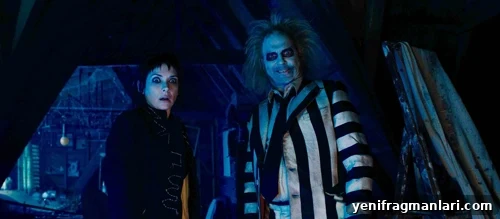
Below the mortal plane, Betelgeuse is far from thriving: he’s stalled in the afterlife’s bureaucracy, clinging to a faded photograph of Lydia and scheming for a return. When Lydia turns to him to help rescue Astrid from supernatural danger, Betelgeuse sees one last chance to escape the monotony of the underworld. From that setup unfolds a lively, often giddy chain of set pieces that play to Burton’s strengths—inventive creatures, practical effects, and black-comic absurdity.
Beetlejuice Beetlejuice revels in its own surreal logic. The plot often functions as connective tissue between imaginative set pieces, but that approach feels intentional rather than lazy: Burton and his collaborators use the framework to showcase vivid production design and practical craftsmanship. The depiction of the afterlife bustles with color, offbeat architecture, and a carnival-like energy. Danny Elfman’s score amplifies the chaos with playful, theatrical cues that nod to the original film without becoming a mere copy.
The film leans into a mix of techniques—claymation, puppetry, makeup and prosthetics—favoring tactile, handmade effects that recall classic horror-comedy traditions and stand out in a CGI-heavy era. This physicality gives the world texture and personality, ensuring that even the most grotesque or silly moments feel grounded in artful design rather than digital sheen.
Performance-wise, the cast anchors the material with strong instincts. Michael Keaton returns with manic energy, balancing sleaze and comic timing in a way that makes Betelgeuse both repulsive and oddly charismatic. Winona Ryder brings restrained vulnerability to Lydia, portraying a woman who has been reshaped by grief, fame, and the commodification of her gift. Catherine O’Hara provides consistent comic fire, elevating every scene she inhabits, while Jenna Ortega offers a compelling counterpoint as the punked-out, skeptical younger generation—angry, wounded and fierce.
Monica Bellucci, cast as Betelgeuse’s ex-wife Delores, and Willem Dafoe, playing a flamboyant ghost-detective, infuse the film with memorable supporting turns. Their scenes are indulgent in the best sense: playful, visually striking, and emblematic of Burton’s capacity to marry homage with fresh invention. Justin Theroux’s Rory is the weakest link; his comic beats don’t always land and his character occasionally feels underwritten compared to the vivid eccentricities surrounding him.
Notably, the sequel resists becoming an exercise in nostalgia. It acknowledges the original when necessary for context but refuses to be hamstrung by a need to replicate earlier triumphs. The absence of the Maitlands—Barbara and Adam, played previously by Geena Davis and Alec Baldwin—feels deliberate and appropriate; their story was complete, and centering Lydia’s arc allows the film to grow organically. The production also addresses the absence of the original actor who played Lydia’s father with a darkly comic aside that fits the film’s tonal register.
Ultimately, Beetlejuice Beetlejuice restores a sense of creative play to Burton’s work. It’s not a flawless film—its narrative can be diffuse and some supporting elements don’t always cohere—but it succeeds where it matters: in imagination, mood, and the pleasure of watching a director return to the peculiar visual and emotional territory that made his earlier films so distinct. For fans and newcomers alike, the movie is a spirited, occasionally messy reminder of why Burton’s oddball sensibility still matters.
Score: 18/24