
Smile 2 (2024)
Director: Parker Finn
Screenwriter: Parker Finn
Starring: Naomi Scott, Rosemarie DeWitt, Kyle Gallner, Lukas Gage, Miles Gutierrez-Riley, Peter Jacobson, Raúl Castillo, Dylan Gelula, Ray Nicholson
The original Smile arrived in 2022 as a compact, effective piece of commercial horror that managed to turn a modest budget into notable box office success. That film’s straightforward premise — a contagious, unnerving smile that spreads and distorts reality — proved fertile ground for a sequel. Smile 2 follows that premise closely while attempting to broaden its themes and ambitions, but the result is uneven: a film that aims for psychological depth while repeatedly defaulting to tired jump scares and an overlong runtime.
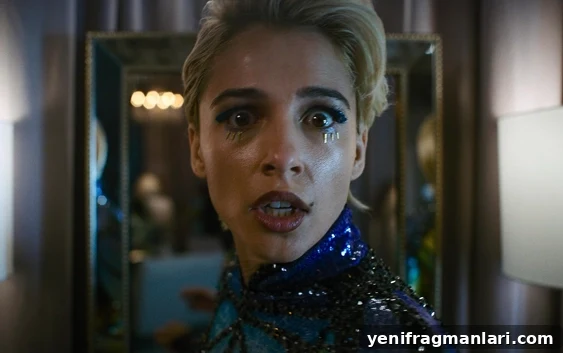
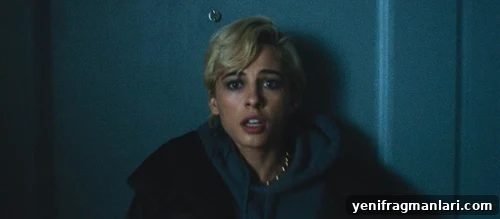
In this installment the story centers on pop star Skye Riley (Naomi Scott), a rising star preparing for a comeback tour after a drug-related car accident the previous year. While seeking pain medication from a contact, she witnesses a shocking incident in which a man smiles at her and then violently injures himself. From that moment on, the smile begins to appear everywhere in Skye’s life. Her sense of reality frays just as the pressure of an imminent tour and the spotlight of fame intensify her vulnerability. The film frames the smiling phenomenon as both literal terror and a metaphor for the emotional strain placed on young artists in an industry that commodifies pain.
Writer-director Parker Finn appears to be stretching the original concept into psychological territory inspired by well-known reality-bending films. The sequel attempts an introspective turn, exploring grief, identity, and the hollowing effect of fame. These themes are potentially interesting: Skye’s breakdown can read as a commentary on the pressures of stardom, public scrutiny, and the mental health crisis faced by performers pushed to produce at all costs. Unfortunately, the film’s execution undercuts much of that promise.
A central problem is pacing. Scenes meant to build tension often drag, and long, repetitive sequences slowly deflate rather than escalate suspense. When scares finally arrive they are more often sudden edits and loud stings than the payoff of a well-crafted setup. That approach dilutes both the psychological material and the horror elements: the movie neither commits fully to slow-burn dread nor delivers a satisfying series of shocks. The sporadic hallucinatory moments aim to unsettle, and there is at least one striking image — headlights shining through a skull — that demonstrates what the film could achieve visually, but such flashes are too rare to sustain the atmosphere.
Performance-wise, Naomi Scott invests Skye with genuine vulnerability. Her portrayal of panic and disintegration is convincing at times, and she anchors the film’s emotional throughline even when the material around her falters. Supporting cast members do competent work, but many are given little to do beyond react to Skye’s collapse. The screenplay offers character beats that hint at complexity — exploitation by managers, the isolation behind fame, addiction and recovery — but it does not always develop those threads into coherent, memorable arcs.
Structurally, the sequel does not significantly expand on the mythology of the original entity. It recycles the central mechanic — a contagious, reality-warping smile — and occasionally borrows imagery and ideas reminiscent of earlier supernatural thrillers, but it avoids meaningful world-building. The result is a film that feels more like a variation on an established formula than a bold or necessary continuation of the story. For viewers hoping for new revelations about the entity or its origins, the narrative will likely feel unsatisfying.
Another notable drawback is the film’s length. Clocking in at over two hours, the story overstays its welcome. Tightening the editing and focusing on a clearer balance between psychological exploration and genre thrills might have produced a far stronger movie. As it stands, the pacing lapses and redundant scenes make the runtime feel burdensome rather than immersive.
In summary, Smile 2 is a mixed bag. It contains moments of visual inventiveness and a committed lead performance, and its attempt to frame the horror as an allegory for the costs of fame is worthwhile. However, uneven writing, lackluster scare execution, and a bloated runtime keep the film from delivering on that ambition. Fans of the first film may find enough here to satisfy casual curiosity, but viewers seeking a sharper, more original psychological horror will likely leave disappointed.
Score: 5/24
Rating: 1 out of 5.