
The Lord of the Rings: The War of the Rohirrim (2024)
Director: Kenji Kamiyama
Screenwriters: Jeffrey Addiss, Will Matthews, Phoebe Gittins, Arty Papageorgiou, Philippa Boyens
Starring: Brian Cox, Gaia Wise, Luke Pasqualino, Miranda Otto, Lorraine Ashbourne, Yazdan Qafouri, Benjamin Wainwright, Laurence Ubong Williams, Shaun Dooley, Michael Wildman
Fans of The Lord of the Rings have not lacked material in recent years. Two decades after Peter Jackson’s celebrated film trilogy, audiences have since seen a Hobbit trilogy and the expansive prequel series The Rings of Power, all of which kept J.R.R. Tolkien’s Middle-earth in the public eye. The War of the Rohirrim arrives as an animated take on Rohan’s history, focusing on the horse-lords who feature prominently in The Two Towers. Peter Jackson returns here as an executive producer and Philippa Boyens shares a story credit, while creature, weapon and armor designs remain faithful to the visual language established by Weta Workshop. Yet this production is primarily the vision of director Kenji Kamiyama, known for his work on Ghost in the Shell: Stand Alone Complex, who brings a fresh, anime-driven perspective to the familiar world.
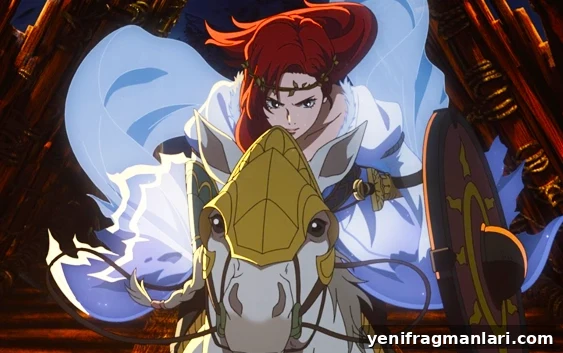
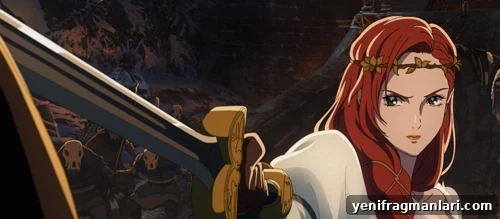
The story is framed by Éowyn (Miranda Otto reprising her role), who recounts events that took place two hundred years before the War of the Ring. Rohan endures a bitter conflict after a gathering of lords turns tragic. Civil war erupts between those loyal to King Helm Hammerhand (Brian Cox) and the far larger force led by the ambitious and vengeful Wulf (Luke Pasqualino). As Helm’s forces dwindle and key leaders fall, the burden of defending the realm increasingly rests on his only daughter, Héra (Gaia Wise), who must hold the Hornburg in a desperate stand to protect her people.
If you expect the sweeping, massed battles of The Two Towers or Return of the King, this film offers a different approach. Rather than endless waves of combatants, the animation favors a sequence of smaller, imaginative skirmishes culminating in a climactic battle at a very familiar stronghold. Anime excels at kinetic, close-quarters encounters: camera movement, acrobatic choreography and stylized combat emphasize personal rivalries. Consequently, the most compelling fight scenes are those driven by intimate motives and character stakes, where individual duels carry emotional weight.
Larger set-piece clashes appear too, including a night engagement between Rohan’s cavalry and enormous Mumakil lit by torches, and a final confrontation that mirrors Helm’s Deep—albeit on a far smaller scale. These moments contain striking imagery but sometimes lack the momentum and distinct identity that define the franchise’s most memorable battles.
From its opening, when Héra rides out to feed a giant eagle a cartoonishly large leg of meat, the film establishes its central theme: what does it mean to be a determined woman in a patriarchal age? Tolkien’s original work, shaped by its historical and literary influences, often afforded female characters smaller roles, though figures like Galadriel and Éowyn demonstrated real power and agency. Héra follows Éowyn’s example—expected to fulfill royal duties yet sidelined when the time comes to lead in war. The film explores the compelling idea of warrior women—akin to historical shieldmaidens—within a fantasy setting. Héra’s journey to self-actualization positions her as both defender and symbol for all of Rohan, regardless of gender. Her handmaiden Olwyn, older but still fierce, provides notable moments of action and poignancy, recalling past battles fought alongside the king.
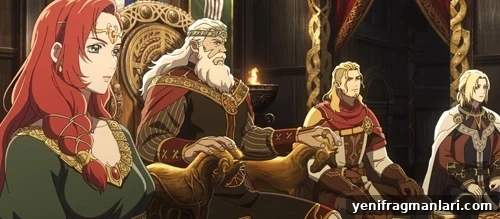
Unlike The Hobbit films or The Rings of Power, this story does not expand Middle-earth with new territories or peoples. The film revisits familiar locations—Edoras, Isengard, and Helm’s Deep—rendered in Japanese-style animation that closely matches their live-action counterparts. At times the film suffers from what might be called prequel-itis: clumsy attempts to tie directly into the live-action films through repetitive dialogue and heavy-handed character setup. When freed from those constraints and allowed to act as a focused tale of a princess-turned-warrior, the narrative is far more compelling and satisfying.
Comparisons to Studio Ghibli’s Princess Mononoke are inevitable, and the film willingly draws on that tradition of a ferocious fantasy heroine. Gaia Wise gives Héra genuine steel and vulnerability, creating a character who stands up to the imposing presence of Brian Cox’s King Helm. The animation rises to the occasion when it embraces full anime spectacle rather than merely reproducing iconic images from the live-action films. Standout sequences include an unexpected clash between two colossal creatures in a forest lagoon, Helm Hammerhand’s berserker fury amid a blizzard that earns his fearsome moniker, and dramatic scenes involving the franchise’s famously large eagles.
Technically, The War of the Rohirrim is accomplished: animation quality, voice performances, and sound design are all strong. Howard Shore’s Rohan themes return, lending familiar musical authority. Yet the film occasionally feels one step removed from the emotional core of its characters, and much of its imagery recalls scenes already established in live-action. For devoted Tolkien fans, the film offers a worthwhile expansion of lore and a refreshing female-centered perspective, but it may not feel essential to every viewer. Still, this anime interpretation brings its own merits and memorable moments, making it a distinct, if imperfect, addition to the broader Middle-earth canon.
Score: 14/24
Recommended for you: 10 Best The Lord of the Rings: The Fellowship of the Ring Moments (feature article and highlights)