
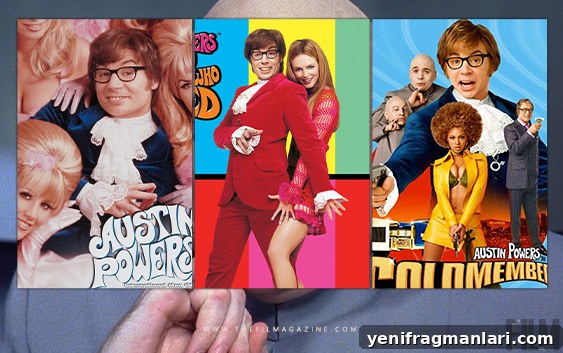
Born from a running joke between writer and star Mike Myers and his wife, the British secret agent Austin Powers — a deliberately flirtatious, overconfident parody of Cold War-era spies — rose from low-budget cult curiosity to mainstream phenomenon between 1997 and 2002. In that short span, Myers, already famous from Saturday Night Live and Wayne’s World, cemented Austin Powers as one of the decade’s most memorable comedy creations.
Directed by Jay Roach and produced on progressively higher budgets ($16.5 million, $33 million and $63 million respectively), the Austin Powers trilogy reflects both the changing economics of studio comedy and the period’s shifting cultural sensibilities. While some elements of the films feel rooted in 1990s attitudes and humor, the trilogy endures as a smart, affectionate parody of spy cinema — particularly the Sean Connery-era James Bond films and Peter Sellers’ comic lineage — and remains highly quotable and culturally resonant.
The character borrows visual cues from Michael Caine’s Harry Palmer, right down to the glasses, while consistently lampooning the tropes of classic espionage cinema. The films give space to supporting characters, blend broad physical comedy with clever cultural references, and maintain an undercurrent of warmth that prevents the jokes from feeling purely mean-spirited. In this ranked look at the trilogy, we evaluate the movies based on laugh-out-loud comedy, cultural importance, artistic merit and the joy they continue to provide.
3. Austin Powers in Goldmember (2002)
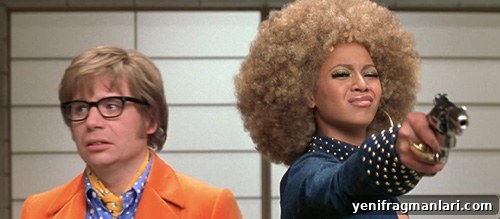
Goldmember leans heavily into meta-humor, stacking cameos and pop-culture references while including a film-within-a-film gag centered on an in-universe Austin Powers movie. Beyoncé appears as a sidekick who riffs on blaxploitation archetypes, and Michael Caine plays Austin’s father, adding a new family angle to the saga.
This third entry amplifies parody and spectacle, which gives it more memorable set pieces and quips but also dilutes some of the emotional grounding that made the earlier films resonate. Goldmember often reads like a greatest-hits compilation of Powers moments: it’s packed with jokes and sight gags, but the narrative thread and deeper character moments are less consistent than in the first two films.
With a bigger budget and Myers’ rising star power, Goldmember delivers laughs and flashy production value, yet it sits at the bottom of this list because the trilogy’s original balance of satire, character empathy and sharp comic pacing feels weakened by a vignette-heavy structure.
2. Austin Powers: International Man of Mystery (1997)
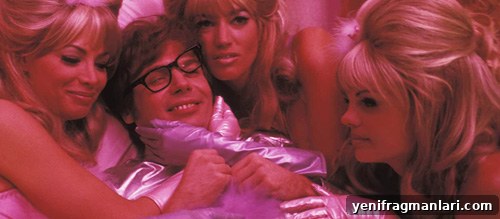
The first Austin Powers film introduces a fish-out-of-time hero awakened from cryogenic stasis to battle his arch-nemesis, Dr. Evil. The premise—a 1960s-styled spy coping with modern culture—allowed Myers and Roach to both parody and pay homage to classic Bond films while lampooning outdated attitudes and hyper-masculinity.
Made on a modest budget, International Man of Mystery thrives on clever writing, character-driven gags and retro production choices that echo the era it mimics. Some effects and transitions show their low-budget origins, but those limitations often enhance the parody rather than hinder it. The film’s charm lies in its commitment to character and tone: Austin is ridiculous but oddly endearing, and the supporting cast gets room for memorable moments.
Though it takes a little time to build momentum, the first film established the template and tone that made Austin Powers a cultural phenomenon and remains an essential entry in modern comedy.
1. Austin Powers: The Spy Who Shagged Me (1999)
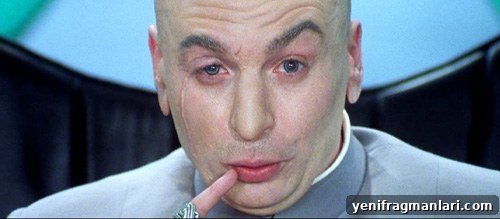
The Spy Who Shagged Me is the trilogy’s high-water mark: faster, bolder and relentlessly funny. When Dr. Evil attempts to steal Austin’s mojo, the stakes become personal, and the film mines both broad sight gags and sharper character-based humor. New characters, including Fat Bastard, expand the comedic palette while maintaining strong momentum.
This second film perfects the series’ balance of British wit and American pop-culture reference. It frequently breaks the fourth wall and moves at a breakneck pace, firing joke after joke with impeccable timing. Beneath the absurdity, the movie touches on themes of aging and obsolescence in a way that gives its silliness emotional weight, making the laughs feel earned rather than empty.
Myers’ performances—across multiple roles—are at their most confident and inventive here. The Spy Who Shagged Me not only cemented Austin Powers as a defining comedy character of the late 1990s but also demonstrated how the franchise could be both wildly irreverent and surprisingly tender.
Across the three films, Austin Powers evolved from a low-budget parody into a major studio comedy franchise, reflecting changes in culture, comedy and Hollywood economics. Whether you prefer the original’s affectionate satire, the sequel’s rapid-fire inventiveness, or the third film’s meta spectacle, the trilogy remains a key touchstone for contemporary comedy. Would you welcome Austin Powers back for another adventure, or is it better to let the character remain frozen in time? Share your thoughts where you discuss films and follow outlets and critics for more essays and rankings about classic comedies and influential film franchises.