
Barton Fink (1991)
Directors: Joel Coen, Ethan Coen
Screenwriters: Joel Coen, Ethan Coen
Starring: John Turturro, John Goodman, Judy Davis, Michael Lerner, John Mahoney, Tony Shalhoub, Jon Polito, Steve Buscemi, Richard Portnow, Christopher Murney
Barton Fink, the Coen brothers’ fourth feature, is an unsettling and richly layered film that both rewards and resists close analysis. Written quickly during the period when Joel and Ethan Coen were finishing their previous work, the screenplay became one of their most enigmatic achievements. The film won the Palme d’Or and Best Director at Cannes and earned multiple Academy Award nominations, yet it remains a divisive piece — admired by critics for its audacity and craft, while leaving many viewers puzzled. Three decades on, it still provokes discussion about authorship, ambition, and the strange pressures of Hollywood.
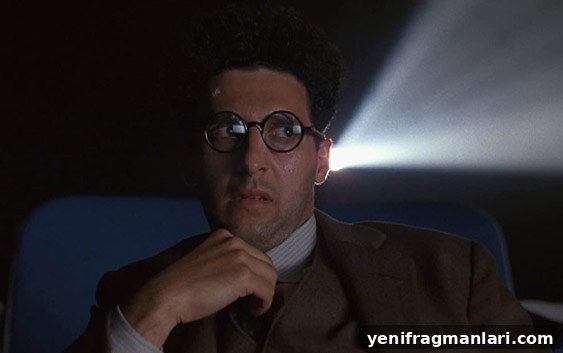
The film opens with a deceptively mundane close-up of Art Deco wallpaper, then pulls back to reveal the backstage machinery of a theater where playwright Barton Fink (John Turturro) watches a performance with nervous intensity. Fresh from a celebrated New York run, Barton is invited to Hollywood to parlay his theatrical success into screenwriting. He moves into the dilapidated Earle Hotel, where the claustrophobic atmosphere, bizarre service staff, and stifling heat mirror his growing creative paralysis. As Barton attempts to write a crowd-pleasing boxing picture for the studios, his grip on both his craft and reality begins to fray.
Turturro gives a finely tuned performance as Barton, creating a writer who is alternately inspired and awkward, fierce in private conviction but inept in social exchange. Barton is a figure of contradictions: a self-proclaimed champion of the working class who nevertheless luxuriates in his own rhetoric. His repeated assertion that “a writer writes from his gut” becomes increasingly hollow as he fails to listen to others or to recognize the limits of his own perspective. The film positions him as a kind of literary narcissist, someone who loves the sound of his own convictions more than the messy work of representing other lives.
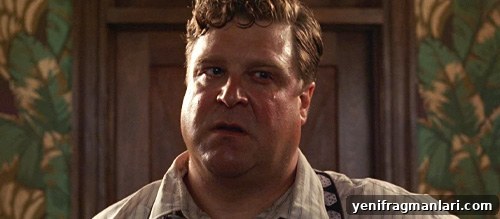
John Goodman’s Charlie Meadows, Barton’s neighbor at the hotel, is one of the film’s most memorable presences. Announced offscreen by an unnerving mixture of laughter and sobbing, Charlie arrives with disarming friendliness and a bottle of whiskey. Goodman balances charm and menace so effectively that the character remains unpredictable throughout, serving as both confidant and catalyst for Barton’s unraveling. The chemistry between the two actors anchors the film and allows the Coens to explore trust, spectacle, and the uncanny inside the hotel’s cramped world.
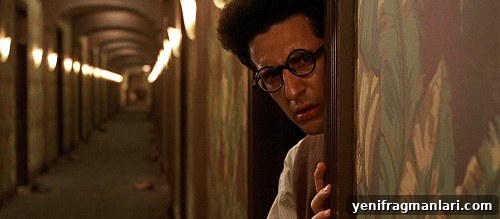
The Earle Hotel itself functions like another character. Its small details — the persistent ringing of a reception bell, the dusty uniform of the bellhop, the shuffling elevator operator — create an atmosphere of decay and unease. Much like Stanley Kubrick’s Overlook Hotel in The Shining, the Earle exerts a pressure that warps the protagonist’s psyche. Cinematographer Roger Deakins, on his first collaboration with the Coens, frames the hotel and its interiors with a precision that intensifies the film’s mood: the texture of the wallpaper, the glare of the heat, and the cramped composition of rooms all contribute to a sense of claustrophobic dread.
Occasionally the narrative wanders beyond the hotel and loses some of its focus. Barton’s fast-developing relationship with a writer’s mistress and his confrontations with sailors and policemen introduce noirish elements and further complications, but these sequences sometimes feel secondary to the central psychological drama. Still, the film deliberately mixes genres — comedy, psychological horror, and studio satire — to unsettle expectations and to probe the contradictions at the heart of creative life under commercial pressure.
At its core, Barton Fink is a film about the difficulty of listening. Barton believes he speaks for the common man, yet he rarely absorbs the people and realities he claims to serve. The Coens stage this failure as both personal and systemic: the idealism of a Broadway playwright collides with the transactional world of studio filmmaking, and the collision is often grotesque and absurd. Symbolism and recurring motifs — from the literal and figurative boxes in the story to recurring images of confinement and judgment — accumulate across the film, producing meanings that reward repeated viewings.
The final act leans heavily into allegory and surreal imagery, using heaven-and-hell language and stark visual metaphors to complicate any straightforward reading. Some elements remain intentionally opaque, and viewers may need multiple screenings to decode layers of intent and reference. What remains constant is the film’s formal control: the Coens’ darkly comic tone, the taut performances (notably Turturro and Goodman), and the meticulous production design all combine to create a world that is both mundane and nightmarish.
For viewers interested in film history, auteur studies, or the mechanics of storytelling, Barton Fink offers a rich case study. It interrogates the compromises demanded by commercial art, the loneliness of creative labor, and the dangerous allure of ideological certainty. The Coen brothers, collaborating with Roger Deakins and a strong ensemble cast, crafted a film that resists neat answers but continues to fascinate. Whether approached as a studio satire, a psychological horror, or a meditation on authorship, Barton Fink remains one of the most striking and unsettling films of the early 1990s.
19/24