
Delphine’s Prayers/Les prières de Delphine (2021)
Director: Rosine Mbakam
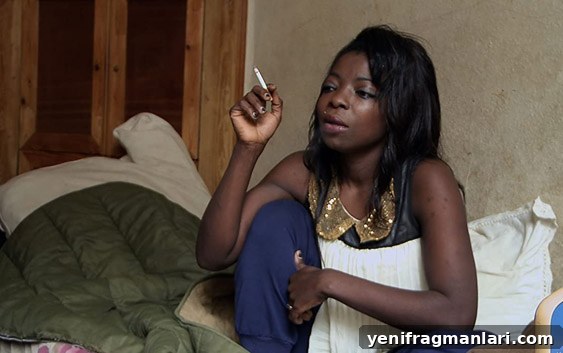
Rosine Mbakam’s latest feature documentary, Delphine’s Prayers, offers a powerful, intimate portrait of a young Cameroonian woman navigating life as an immigrant in Belgium. Mbakam, known for her empathetic films about African migrant women, frames this work as an extended, candid interview with Delphine, a 30-year-old whose personal history is both moving and difficult. The film functions as Delphine’s own testimony—her memoir on screen—allowing her to tell, unvarnished, the events that shaped her life.
Delphine speaks directly to the camera for much of the film. At times she admits she did not initially want to revisit her past, but she came to understand the value of sharing it. Her account is intended not only as catharsis for herself but also as a mirror for viewers, offering perspective on hardship, resilience and the complex meanings of migration and survival.
The documentary traces a childhood marked by extreme deprivation: the death of Delphine’s mother when she was five, persistent hunger and poverty, and episodes of exploitation in which she and her sisters were forced into prostitution with older men in order to feed the family. In a particularly wrenching passage, Delphine recalls caring for her sister’s child who had malaria and being compelled to sell her body to pay for the child’s hospital treatment. Her tender reassurance—“Auntie De, everything will be fine now”—is enough to move the viewer profoundly.
Family conflict plays a central role in Delphine’s story. She describes violent quarrels with her sisters and a fraught relationship with her father, whose indifference and cruelty compounded her suffering. One of the film’s most painful moments is Delphine’s recollection of being raped as a pre-teen and then blamed and shamed by her father when she confided in him. That episode visibly silences her; when asked to explore it further she offers only fractured commentary: “He lived like a man without children… I can’t make myself hate him.” This restraint underscores the emotional complexity of surviving trauma while still confronting ties to family.
Interspersed with the interviews are quiet, domestic scenes: Delphine applying makeup, answering the door, family photographs and shots of the weather outside. These ordinary moments give the film a measured rhythm and allow both the subject and the audience room to breathe. They remind viewers that a life is composed of small, everyday acts as well as dramatic events, and that the telling of painful memories requires pauses of gentleness.
The film also examines the bureaucratic and cultural hurdles Delphine faced when she sought to leave Cameroon. She recounts the humiliations of applying for a visa at the Belgian embassy—being asked to pledge she would remain in Belgium even if she struggled—and the strategic decisions she made to secure her family’s future. Her marriage to a Belgian man, described as pragmatic rather than romantic, was a sacrifice intended to provide better opportunities for her children. She speaks candidly about the man she loved before marrying for migration: a French partner who had shown deep care for her but could not offer the security she ultimately needed abroad.
Delphine’s account of marriage and cultural assimilation is frank and nuanced. She resists the idea of erasing her past to fit into a new culture, observing that personal history cannot simply be wiped away. Her husband, though unseen, is portrayed through her recollections as domineering and insensitive to the complexities of her identity. This tension—between survival strategies and the preservation of self—runs throughout the film.
The documentary’s final section centers on a poignant, extended scene in which Delphine prays aloud for work, stability and protection for her children. Mbakam’s camera pulls back at moments, granting Delphine privacy and dignity in her most vulnerable spiritual plea. The sequence is both intimate and universal, capturing the precarious faith many migrants place in prayer while they contend with uncertainty and responsibility.
Mbakam appears at the film’s close, and she explains how chance and circumstance brought her and Delphine together in Belgium. Though they share a Cameroonian background, their social positions in Cameroon were so different that they would never have met had they remained there. In Belgium they find a shared identity as immigrants, even as their personal experiences diverge. Mbakam’s restrained directorial approach—trusting long takes, unobtrusive framing and a focus on emotional truth—lets Delphine’s voice remain central.
Delphine’s Prayers is often difficult to watch because of the rawness of its subject, but it is never sensationalist. Instead, it offers a humane, unvarnished portrait of survival, dignity and complexity. The film’s strength lies in Delphine herself: her candor, her warmth and the steady courage with which she confronts her story. Under Mbakam’s sensitive guidance, the documentary becomes an essential record of resilience and a vivid account of what it means to rebuild life in a foreign land.
21/24