Embers (2023)
Director: Christian Cooke
Screenwriters: Dave Florez, Christian Cooke
Starring: Ruth Bradley, Christian Cooke, Clare Perkins, Samuel Anderson, David Wilmot
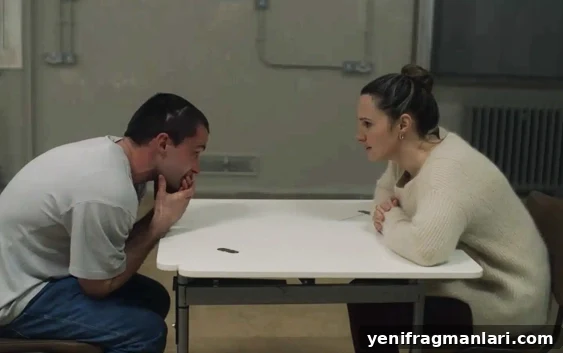
Tension in film doesn’t always require a traditional thriller structure. Christian Cooke’s independent drama Embers demonstrates how quiet, character-driven storytelling can create an edge-of-your-seat atmosphere through mood, performance, and a tightly focused premise. Ruth Bradley plays Amy, an intimacy therapist whose work uses carefully regulated physical contact to help patients reconnect with their bodies. Clare Perkins appears as Helen, Amy’s boss, who enlists her to try to break through to Dan (Christian Cooke), a 33-year-old man who has remained silent for eighteen years while held in a secure mental health ward following an incident long ago.
From the moment the film begins, it carries the sense of a coiled fuse — something that could spark at any second. The performances at the center of the film are consistently strong. Bradley brings an empathetic intensity to Amy, while Christian Cooke’s controlled portrayal of Dan keeps the audience guessing about where his emotions and intentions lie. Samuel Anderson, as Amy’s boyfriend Joe, provides a necessary counterpoint: his relationship with Amy introduces another axis of tension that threads through the story and complicates her professional responsibilities.
The film deliberately cultivates discomfort in productive ways. The premise — an intimacy therapist using touch to treat a patient who has chosen silence — naturally raises ethical and emotional questions. Cooke stages the story to maintain uncertainty about Dan; for a long stretch the audience is denied a full read on his expression and motivations, which heightens the suspense. Isobel Waller-Bridge’s score supports this approach, its tremulous motifs and restrained textures underscoring the film’s unease without ever overpowering the intimate performances.
Beyond tension, Embers functions as a thoughtful examination of how institutions and individuals misunderstand mental illness. The film depicts the pressure placed on clinicians by bureaucratic systems that demand results on fixed timelines, a dynamic that often clashes with the gradual, unpredictable nature of psychological recovery. Amy’s efforts to engage Dan showcase a mix of professional curiosity, compassion, and the weariness that comes from working within such constraints. Several scenes of trial-and-error therapeutic approaches feel authentic: they illustrate both the creativity and the desperation required when conventional methods don’t produce immediate progress.
The third act is the film’s most divisive element. While the opening two acts build a taut, immersive atmosphere, some late choices read as narratively predictable for viewers familiar with similar psychological dramas. Those decisions, however, are not entirely out of character; they reflect human fallibility and the impulsive errors people make when pushed to emotional extremes. The screenplay places hints throughout to prepare the audience for the developments that follow, and Dan’s revelations toward the end offer a fresh perspective on his past and how trauma can be misread or oversimplified by outsiders.
What makes Embers especially effective is how it treats its audience as part of the therapeutic experiment. The film works to break down assumptions about therapy and mental illness, encouraging viewers to reconsider quick judgments and simplistic labels. With a modest budget and a confined number of settings, it relies on careful staging, restrained cinematography, and strong performances to achieve a sustained emotional impact. Intimacy and confinement are used to dramatic advantage, turning limited resources into creative strengths.
Although not flawless, the film leaves a lasting impression. Its exploration of trust, professional ethics, and the complex realities of severe mental health struggles elevates it above many small-scale dramas. The balance of suspense and empathy, allied with committed acting and a sensitive score, results in a compact, powerful piece of filmmaking that lingers after the credits.
Score: 19/24
Rating: 4 out of 5.