
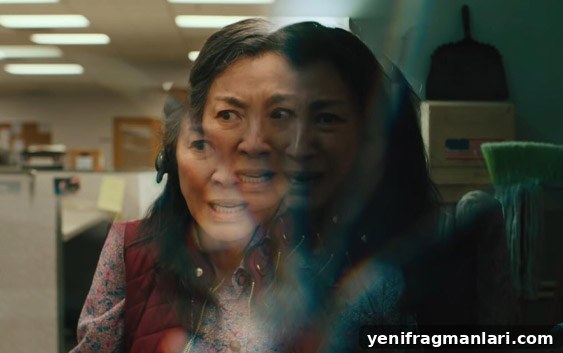

Everything Everywhere All at Once (2022)
Directors: Dan Kwan, Daniel Scheinert
Screenwriters: Dan Kwan, Daniel Scheinert
Starring: Michelle Yeoh, Stephanie Hsu, Ke Huy Quan, James Hong, Jamie Lee Curtis, Jenny Slate, Harry Shum Jr, Tallie Medal
Dan Kwan and Daniel Scheinert, collectively known as the Daniels, follow up their offbeat debut with a wildly inventive and emotionally resonant film. Whereas their earlier work leaned into surreal black comedy, this film expands their palette into an interdimensional family drama that still retains plenty of blunt humor, astonishing visual ideas, and kinetic martial-arts action.
Evelyn Wang (Michelle Yeoh) runs a struggling laundromat with her mild-mannered husband Waymond (Ke Huy Quan). As they face a tense IRS audit led by the intimidating Deirdre (Jamie Lee Curtis), Evelyn’s daughter Joy (Stephanie Hsu) visits for Chinese New Year with her partner Becky (Tallie Medal). Simultaneously, Evelyn’s traditional father (James Hong) arrives, escalating tensions in an already fragile household. The domestic pressures only grow stranger when an alternate-dimension Waymond appears and reveals that Evelyn — along with countless alternate versions of herself — must prevent a catastrophic collapse of the multiverse.
At the heart of the film is a sharp observation about human priorities: mundane personal failures often feel far more terrifying than cosmic annihilation. The Daniels use this idea to ground the high-concept premise in relatable anxiety — people worry more about embarrassing setbacks at work or in relationships than hypothetical universal doom. That inward focus is the emotional engine of the story and gives the film genuine heart beneath its outrageous spectacle.
The film explores regret and the roads not taken. Evelyn is the archetype of someone who believes she has become the disappointing version of herself, haunted by choices that might have led to different lives. The multiverse concept becomes a literalization of these possibilities: every decision spawns another reality where life took another turn. Rather than relying solely on sci-fi thrills, the film uses this premise to examine family dynamics, identity, and the quiet ways people long for courage, authenticity, or forgiveness.
Creatively, the Daniels squeeze enormous comedic and narrative mileage from the multiverse idea. Small jokes or background details in one reality often repurpose into major beats in another, making the film feel both unpredictable and cleverly economical. The result is a steady stream of surprising visual gags and emotional reversals — from surreal absurdities to surprisingly tender moments — all tied together by a consistent sense of inventiveness.
A memorable sequence turns an exposition-heavy scene into a comic marvel: Evelyn must absorb the rules of interdimensional travel while pretending to focus on an audit interview. The Daniels stage this as a rapid-fire, humorous montage that both explains the stakes and deepens Evelyn’s character through how she reacts to and adapts within the chaos.

Ke Huy Quan delivers a standout performance that showcases his range. In different universes he adopts wildly varied styles, including a sequence that pays homage to moody Hong Kong cinema with neon-lit streets and poetic exchanges. Quan’s physicality and nuanced shifts between versions of his character highlight his comeback as a performer who can handle both comedy and pathos.
Stephanie Hsu is equally impressive, matching Michelle Yeoh’s intensity in emotionally fraught and physically demanding scenes. The film’s action is inventive and often comic, choreographed to emphasize absurdity as much as skill. The stunt work — reportedly assembled from unconventional sources — produces creative fights that feel fresh and unpredictable. Cinematographer Larkin Seiple captures the film’s eclectic visuals with clarity and energy, while Son Lux’s score propels emotional beats and set pieces alike.
Michelle Yeoh anchors the film with magnetic presence. The Daniels cleverly reference moments from her long career to justify Evelyn’s surprising skills across multiple realities, and Yeoh makes each life version feel lived-in and convincing. A vivid montage of alternate Evelyns underscores the film’s willingness to experiment with tone, shifting rapidly between comedy, action, and quiet pain.
Above all, the movie is a moving depiction of family, particularly the fraught mother-daughter relationship at its center. It joins a growing body of recent films that explore immigrant family dynamics with nuance and empathy, but it stands out by using genre chaos to illuminate everyday emotional truths. The Daniels suggest that parents must balance control with acceptance, and that small cruelties or misunderstandings can ripple outward in ways both literal and metaphorical.
Technically bold, emotionally clear, and wildly inventive, the film cements the Daniels as a directing duo to watch. Their second feature is more confident than their first, packing more heart and sharper invention into a far leaner budget than many big studio spectacles. The experience is exhilarating: funny, touching, surprising, and at times unexpectedly profound. It leaves you smiling, occasionally breathless, and frequently moved.
Score: 22/24