Halloween Kills (2021)
Director: David Gordon Green
Screenwriters: David Gordon Green, Danny McBride, Scott Teems
Starring: Jamie Lee Curtis, James Jude Courtney, Judy Greer, Andi Matichak, Will Patton, Anthony Michael Hall, Thomas Mann
Halloween Kills arrives as the next chapter following the 2018 revival of the franchise, picking up mere minutes after that film’s conclusion. Instead of continuing with focused storytelling, this installment largely resembles a collection of violent set pieces stitched together with thin connective tissue. The result is a bloated, uneven film that relies heavily on gore and nostalgia callbacks rather than coherent character development or a compelling narrative arc.
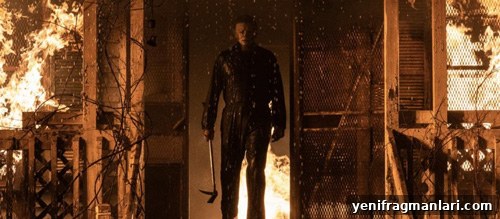
The story resumes with Laurie Strode, Karen, and Allyson rushed to the hospital after an attempt to burn Michael Myers. As firefighters arrive and chaos unfolds, Michael unsurprisingly escapes, setting off a sequence of killings that becomes the film’s primary propulsion. Carpenter-era characters such as Tommy Doyle, Lindsay Wallace, and Nurse Marion Chambers return, apparently to satisfy long-time fans, but their involvement often feels perfunctory and underused.
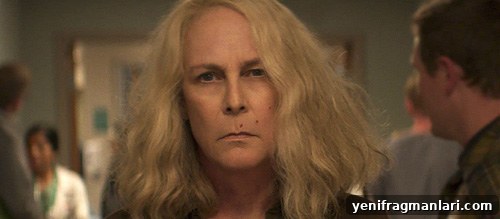
There are a few salvaging elements. Jamie Lee Curtis delivers the presence audiences expect whenever she’s on screen, and the practical gore effects are well executed, if abundant. The score occasionally recaptures the classic mood, though its repetitiveness dulls impact over time. These strengths, however, are scattered and insufficient to remedy the film’s deeper problems.
The film’s most glaring issue is its screenplay. Plotlines are introduced and abandoned, motivations are muddled, and Laurie—central to the franchise—contributes little onscreen to the film’s forward motion. A subplot about Tommy Doyle rallying Haddonfield’s residents into a vengeful mob tries to explore how fear breeds violence and paranoia. It gestures toward an interesting idea: that collective hysteria can create monsters of ordinary people. But the execution is unsubtle, misaligned with Michael Myers’ inscrutable menace, and often feels like thematic filler borrowed from another, more focused drama.
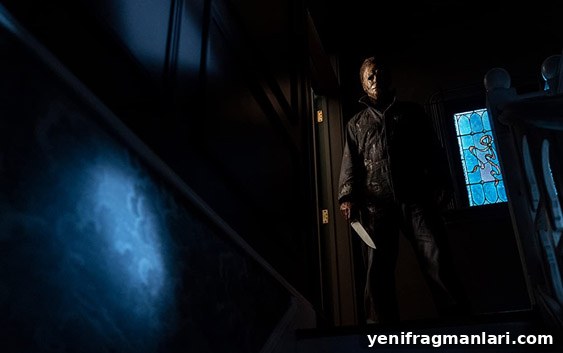
Structurally, Halloween Kills alternates between relentless slasher beats and recycled flashbacks to the original films. These intercuts sometimes recreate iconic moments, ostensibly in service of legacy, yet they often amount to distracting references rather than meaningful additions. The editing is uneven: scenes lurch from one murder to the next with little regard for suspense, tension, or emotional payoff. At times the film even leans into odd stylistic choices—a slow-motion sequence that frames Myers in almost heroic terms—undercutting the horror of his actions and producing tonal whiplash.
Cinematography and direction compound these problems. David Gordon Green’s approach here recycles visual shorthand from the series but adds intrusive zooms and uneven pacing that diminish immersion. Moments that could build dread instead land as procedural jolts. The camera rarely lingers in ways that allow fear to accumulate; instead, it jumps forward to the next shock. When a film lacks dramatic coherence, craft choices matter more—and here, they often frustrate rather than enhance.
Character beats go unresolved. Many victims are introduced only to be dispatched and then forgotten; their deaths serve as spectacle rather than narrative consequence. The attempt to weave an emotional arc toward the end feels truncated and unsatisfying—the film stops abruptly without a true climax, leaving key threads dangling. Viewers are left to assume that certain plotlines will be wrapped up in a sequel, but that expectation does not excuse the absence of a self-contained, meaningful conclusion.
Despite its flaws, Halloween Kills does demonstrate moments of craftsmanship: practical effects that show care for grisly detail, and performances that periodically cut through the muddle. Yet those moments are intermittent, overwhelmed by an overarching sense of purposelessness. The film reads like the middle installment of a trilogy that wasn’t given the room or clarity to stand on its own, and it suffers from the common middle-chapter ailment: too much setup, too little resolution.
For franchise fans seeking callbacks, familiar faces, and a steady tempo of kills, Halloween Kills offers rewards. For viewers hoping for a taut psychological horror that deepens Laurie Strode’s journey or refines Michael Myers’ mythos, the film disappoints. It prioritizes volume over depth, spectacle over suspense, and nostalgia over narrative coherence.
7/24