The Birds (1963)
Director: Alfred Hitchcock
Screenwriter: Evan Hunter
Starring: Tippi Hedren, Rod Taylor, Jessica Tandy, Suzanne Pleshette, Veronica Cartwright, Ethel Griffies, Charles McGraw, Ruth McDevitt, Lonny Chapman
Alfred Hitchcock’s The Birds (1963) remains one of cinema’s most memorable natural-horror films. Coming two years after the director’s seismic hit Psycho, this unsettling picture exchanges conventional musical scoring for an abrasive, electronic soundscape and trades clear-cut explanations for stark, haunting imagery. The film explores fear and unpredictability through a seemingly inexplicable and escalating series of bird attacks on a small coastal community.
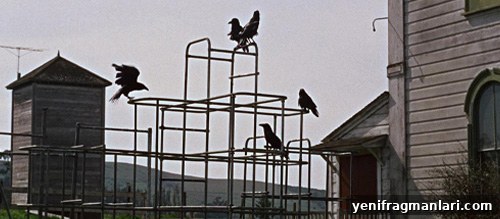
The story begins when Melanie Daniels (Tippi Hedren), a stylish and independent young woman, impulsively follows a charming lawyer, Mitch Brenner (Rod Taylor), to the seaside town of Bodega Bay to play a prank. What starts as flirtation and mild mischief soon turns alarming as flocks of birds—seagulls, sparrows and crows—begin to behave aggressively toward the town’s residents. As the attacks escalate, the town descends into chaos, and ordinary life is upended by an element of nature that refuses to be domesticated.
Hitchcock based the film on a short story by Daphne du Maurier and on a real-life event in which birds attacked people without warning. Rather than offer a tidy scientific or supernatural explanation, Hitchcock deliberately preserves mystery. The absence of reason becomes part of the film’s power: the unknown threat and the human reactions to it create sustained tension and unease.
One of the film’s most revolutionary contributions is its sound design. Composer and sound designer Oskar Sala used the Mixtur-Trautonium, an early electronic instrument, to craft a chilling audio landscape of metallic shrieks and layered bird cries. The result is a score that functions less like traditional music and more like an immersive, intrusive presence that amplifies dread and complements the images on screen.
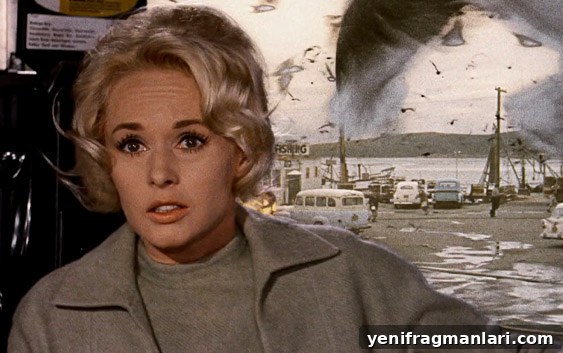
Visually, The Birds pushed the boundaries of special effects for its era. The film employed a sodium vapor process—similar to techniques used later in visual effects—to composite live-action plates with separately filmed bird elements. Effects artist Ub Iwerks helped create sequences in which vast numbers of birds appear to overwhelm people and locations. These scenes combine real birds, trained birds on set, puppetry and optical compositing to sell the menace. While some wide shots reveal the limits of 1960s effects technology, many moments remain striking and effective even decades later.
Tippi Hedren makes a striking screen debut as Melanie. Her performance captures vulnerability, determination and a certain fragile glamour—she wears a memorable mint green suit—and while her acting range was still emerging, she brings credibility to moments of alarm and courage. Rod Taylor plays Mitch with the steadiness of a romantic lead and natural protector. Jessica Tandy, as the widowed Lydia Brenner, delivers a quietly authoritative turn that grounds the film with emotional ballast.
Supporting performances add texture: Suzanne Pleshette portrays schoolteacher Annie with subtle chemistry opposite Melanie, and Veronica Cartwright’s portrayal of Cathy, the anxious child, provides some of the film’s most affecting moments. Several characters are sketched economically, often reduced to a few defining traits, but this economy of characterization keeps the focus on the mounting crisis rather than on prolonged backstory.
The film also benefits from Hitchcock’s masterful control of suspense and pacing. He allows dread to accumulate through quiet domestic moments and small behavioral clues before unleashing large-scale attacks. These set pieces—families huddled indoors, frantic attempts to seal windows and doors, desperate escapes through streets and fields—would go on to influence later survival and siege narratives in horror cinema, including many films in the zombie subgenre.
At times The Birds can feel deliberately elliptical: characters make choices that seem unlikely by modern standards, and the film’s refusal to resolve its central mystery can frustrate viewers who prefer clear explanations. Yet this ambiguity is part of Hitchcock’s design. By denying catharsis and leaving the ending uncertain, he extends the film’s unease beyond the final frame.
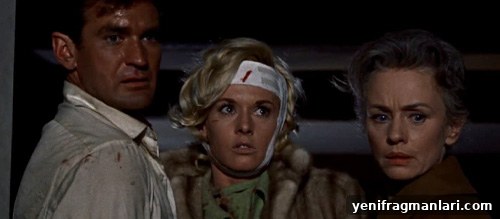
Violence in The Birds is visceral for its time. Attack sequences produce battered and wounded bodies and convey the psychological toll of sustained terror. The film does not flinch from the physical consequences of the attacks, and the realism of small details contributes to its lasting impact.
Overall, The Birds remains a distinctive achievement in Alfred Hitchcock’s filmography and in the broader history of horror cinema. Its innovative sound design, ambitious effects work, and patient construction of dread continue to make it compelling. While certain elements—character depth and some composited shots—reflect the film’s era, its emotional and sensory intensity endures. For viewers interested in classic suspense, evolutionary special effects, and the study of how films manipulate fear, The Birds is essential viewing.
Score: 17/24