
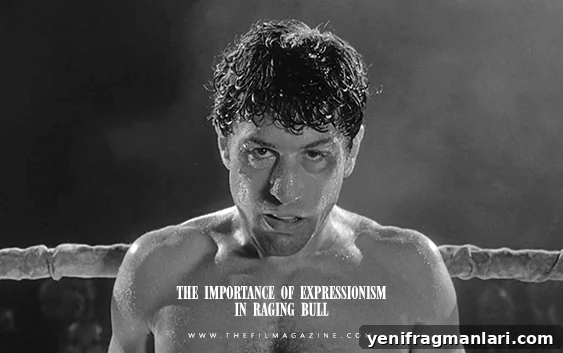
Raging Bull: Expressionism, Violence and the Inner Life of Jake LaMotta
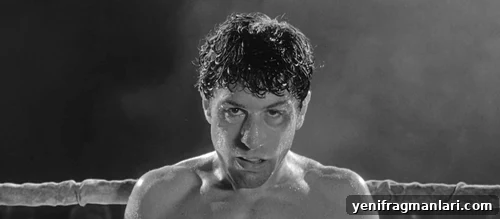
Martin Scorsese’s 1980 biopic Raging Bull chronicles one man’s turbulent battle with his own demons. The film pairs muted, monochrome visuals with brutally visceral depictions of violence, producing a hypnotic and unsettling cinematic experience. Straddling a line between classic Hollywood storytelling and avant-garde expression, Scorsese adapts Jake LaMotta’s autobiography to portray both the boxer’s public persona and his private psychological collapse. While Robert De Niro’s Academy Award–winning performance is rightly celebrated, it is Scorsese’s use of expressionist film techniques that most powerfully communicates LaMotta’s inner torment.
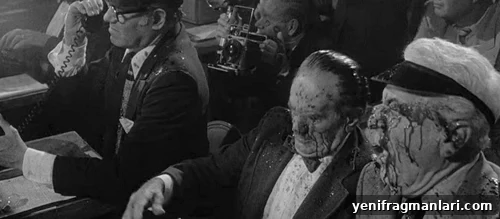
In the bout with Janiro, Scorsese exaggerates the sight of blood until it becomes almost unreal—spurting like a burst pipe rather than a natural wound. The judge’s table and the ringside area are drenched with such force that the effect reads as intentionally theatrical. Photographers’ glasses are splattered in a single, cartoon-like instant. These distortions are hallmarks of filmic expressionism: rather than presenting events objectively, the camera reshapes visual reality to externalize the characters’ psychological states. In this scene the exaggerated blood functions symbolically, underlining LaMotta’s uncontrollable appetite for brutality. Scholar Kasia Boddy observes that exploding flashbulbs and amplified punches operate like a musical score, heightening the violence’s surreal, abstract quality.
Shooting in black-and-white reduces the visceral shock of blood while amplifying moral contrasts. The high-contrast monochrome palette reinforces the film’s central motif: LaMotta’s internal tug-of-war between violence and conscience. Even during the most brutal moments, the lack of color gives the imagery a formal, almost classical quality that recalls German Expressionism and Film Noir. To achieve a striking look for the blood, Scorsese employed unconventional techniques—Hershey’s Chocolate was layered to create a specific texture and tone on-screen, a practical effect that echoes earlier cinematic experiments such as Hitchcock’s Psycho. Likewise, the use of operatic music, notably Pietro Mascagni’s Cavalleria Rusticana, lends the film a tragic, theatrical grandeur.
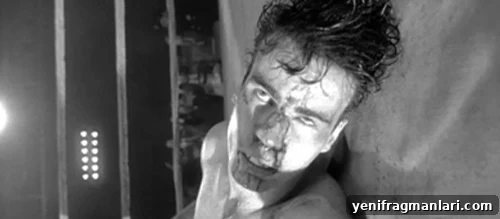
Aestheticizing violence is not the same as celebrating it. Though Scorsese uses familiar Hollywood devices—rapid cutting and enhanced sound design—to make the fight sequences gripping, he frames the violence in a way that distances the audience from LaMotta. After LaMotta knocks Janiro out, a slow descending pedestal shot follows Janiro’s fall precisely, rotating with his head as it hits the canvas. This camera movement forces viewers into Janiro’s point of view, creating shared subjectivity with the victim and fostering a moral estrangement from LaMotta.
Temporal manipulation further reveals LaMotta’s interior life. In the Sugar Ray Robinson fight, the moment when LaMotta waits for Robinson to rise is stretched in slow motion, reflecting LaMotta’s impatient hunger for more violence. Likewise, slow-motion point-of-view shots register Jake’s paranoid gaze when Vickie talks with other men in a bar. Through these elongated moments, ordinary interactions are warped into perceived threats, showing how LaMotta’s jealousy and suspicion distort reality and prolong his sense of grievance.
After LaMotta’s controversial loss to Robinson, Scorsese employs a heat-haze effect—a rippling distortion achieved by lighting a flame beneath the lens—to visually convey LaMotta’s fury. The blurred, shimmering image reads like a mirage above a fire, turning the ring into a psychological inferno and signaling that LaMotta’s emotional life is burning away at him from within.
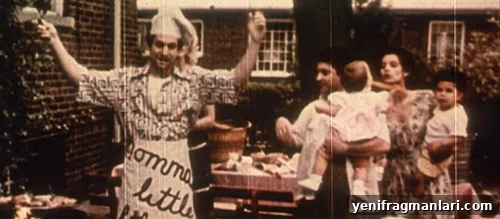
One notable departure from the film’s predominantly monochrome palette is a found-footage home-video sequence presented in color. Scorsese desaturated and optically degraded the footage—scratching the negative to produce a grainy, aged look—to emulate vernacular family films. These warm glimpses of barbecues, weddings and children at play are the rare scenes where the LaMotta family appears genuinely content, and they provide a fleeting respite from the film’s hostility. Intercut with black-and-white boxing images, the sequence contrasts two kinds of triumph: public victories in the ring and imagined domestic happiness. If the color footage represents Jake’s idealization of family life, those moments reveal themselves as fragile fantasies; his only unambiguous successes remain confined to the arena.
Scorsese’s aesthetic choices produce an interpretive ambiguity that benefits the film. We never receive a single, stable portrait of LaMotta. Instead, perspective alternates between his distorted subjectivity and a more detached viewpoint. Film theorist Steve Neale suggests identification with characters is “multiple, fluid and contradictory,” and Raging Bull exploits that instability: by forcing the audience occasionally into LaMotta’s destructive point of view, the director paints a vivid, unsettling image of a man consumed by jealousy, rage and self-delusion. When LaMotta pleads in his jail-cell speech, “I’m not an animal,” the performance and the film’s techniques together make clear how his behavior betrays that very claim.
Written by Callum McGrath
Reel – Studies in Cinema
Bibliography
Boddy, Kasia, Boxing: A Cultural History, London: Reaktion, 2008.
Mortimer, Barbara, “Portraits of the Postmodern Person in Taxi Driver, Raging Bull, and The King of Comedy,” Journal of Film and Video, 49.1-2 (1997), 28–38.