
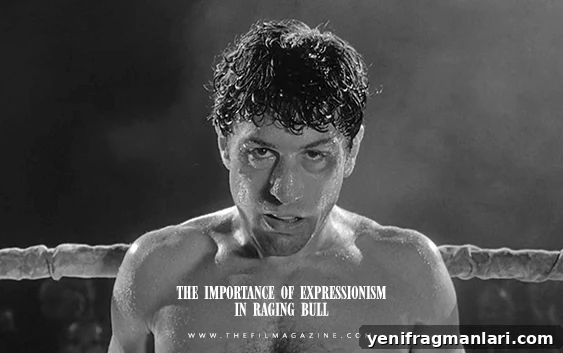
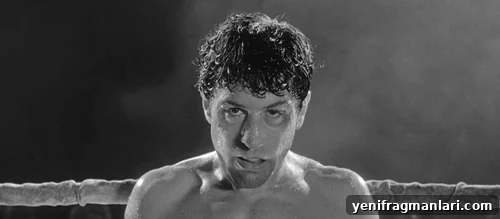
Martin Scorsese’s 1980 biopic Raging Bull chronicles one man’s turbulent battle with his inner demons. The film pairs muted, monochrome visuals with brutally visceral depictions of physical violence, creating a memorable cinematic experience that sits on the edge between mainstream Hollywood storytelling and experimental expressionism. Based on Jake LaMotta’s autobiography, the film follows the life of the 1940s American middleweight boxer, detailing his rise in the ring and the collapse of his private life. While Robert De Niro’s Academy Award-winning performance is often the focal point of discussion, Scorsese’s use of expressionist techniques best reveals the depth of LaMotta’s psychological turmoil.
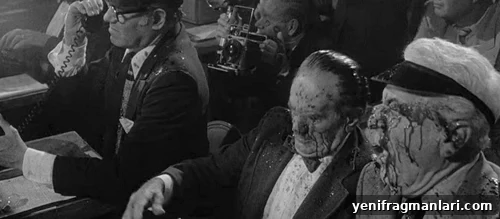
Scorsese deliberately distorts on-screen reality to convey internal states. In the fight with Janiro, blood erupts in an exaggerated, almost cartoonish manner—spurting across the judge’s table and splattering the lenses of ringside photographers with the same absurd intensity. These deliberate excesses depart from naturalistic representation and instead function as visual metaphors for LaMotta’s appetite for violence. Film scholar Kasia Boddy has noted how exploding flash bulbs and amplified punch sounds operate like a musical score, heightening the surreal and abstract nature of the violence.
Shooting in black-and-white softens the immediate shock of gore by rendering blood less visibly red, while the stark high-contrast palette underscores the film’s central opposition between good and evil. The monochrome aesthetic lends even the most brutal sequences a formal beauty, echoing the look of early German Expressionism and classic Film Noir. Scorsese employed unconventional practical methods—such as using chocolate to simulate blood—to achieve the desired texture and contrast. The film’s operatic soundtrack, including Pietro Mascagni’s Cavalleria Rusticana, further elevates the violence into a stage-like spectacle and gives the narrative an almost tragic grandeur.
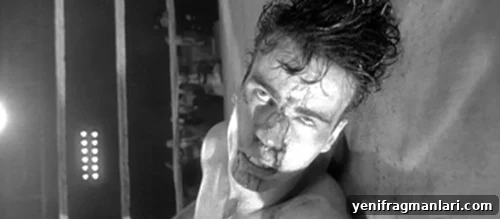
But aestheticizing brutality is not the same as celebrating it. Although Scorsese employs conventional cinematic techniques—fast cutting, amplified sound design, and dynamic camera movement—to make the boxing scenes gripping, he frames the violence in ways that encourage critique rather than admiration. One striking example follows LaMotta’s knockout of Janiro: a slow, descending pedestal shot tracks Janiro’s fall and rotates as his head meets the canvas. The camera forces viewers into the downed man’s perspective, producing a sense of empathy and distancing us from LaMotta’s aggression.
Temporal manipulation and slow motion are recurring expressionist tools in the film. In the Sugar Ray Robinson fight, LaMotta’s wait for Robinson to rise is stretched in slow motion, communicating the boxer’s impatient, almost predatory mindset. Similarly, subjective slow-motion POV shots show Jake watching Vickie at a bar; his paranoid gaze makes mundane social encounters seem disproportionately long and threatening, revealing how his jealousy warps reality and turns every man she speaks to into an imagined rival.
Scorsese also uses visual distortion to suggest emotional states. After LaMotta loses to Robinson, the frame takes on a shimmering, heat-haze quality, achieved by briefly warming the film stock. This rippling effect reads as a mirage or an infernal heat rising from the ring, visually encoding LaMotta’s burning anger and the hellish atmosphere of the boxing arena.
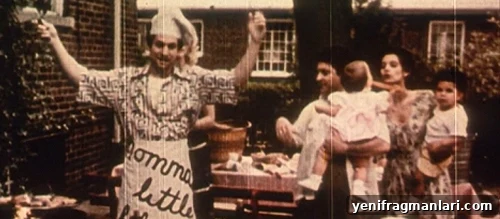
Amidst the dominant black-and-white presentation, Scorsese inserts a color home-movie sequence. This found-footage segment is intentionally desaturated, scratched, and optically aged to mimic fading family films. It shows the LaMotta family at barbecues, weddings, and play—rare moments of warmth and apparent happiness. These color interludes offer brief emotional respite and stand in stark contrast to the brutality that defines Jake’s life. Two consecutive shots—one in the ring with Jake’s hands raised, the other at a family gathering with his hands raised in celebration—underscore the irony that the only arena where he consistently feels victorious is the boxing ring.
The film’s aesthetic choices create a fundamental ambiguity in how we experience LaMotta. Scorsese alternates between subjective and more detached perspectives, so our identification with characters is fluid, multiple, and often contradictory. By using expressionist visual strategies to allow viewers a glimpse into LaMotta’s destructive subjectivity, the director builds a powerful portrait of a man whose self-image and behavior are deeply fractured. In a late jail cell scene, LaMotta insists tearfully, “I’m not an animal.” Yet the film’s portrayal of his actions makes that claim tragically uncertain.
Written by Callum McGrath
Website: Reel – Studies in Cinema
Bibliography
Boddy, Kasia, Boxing: A Cultural History, London: Reaktion, 2008
Mortimer, Barbara, “Portraits of the Postmodern Person in Taxi Driver, Raging Bull, and The King of Comedy”, Journal of Film and Video, 49.1-2 (1997), 28-38.