
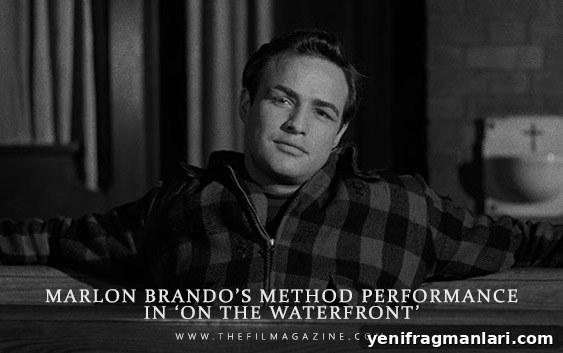
Marlon Brando and the Method in On the Waterfront
One of Hollywood’s most influential approaches to acting is the Method, widely popularized in the 1950s. The Method encourages actors to inhabit their characters from the inside out, to become the person on screen rather than merely imitating behavior. Marlon Brando is commonly linked with Method-style acting, and his work in On the Waterfront (1954) earned him his first Academy Award for Best Actor. But what made Brando’s performance so compelling to audiences, critics, and other filmmakers? Why does it still rank among the great screen performances? And what specific elements on camera demonstrate the Method in practice?
Although Brando did not formally train at the Actors’ Studio, his work captures the spirit of Method ideas and demonstrates how those techniques reshaped film acting. His performance in On the Waterfront stands out because of the preparation and training behind it—choices and habits developed off camera that resulted in a portrayal no other actor could have delivered in the same way.
On the Waterfront follows a community of dockworkers dominated by a local crime boss, Johnny Friendly, played by Lee J. Cobb. The men often feign ignorance when asked about the boss’s illegal activities. Brando’s character, Terry Malloy, is a dockworker connected to Friendly through his brother. Terry’s involvement in an early violent event—a death shown at the film’s opening—haunts him. That guilt and his slowly emerging conscience shape the emotional core of the story, particularly as he grows close to the sister of the deceased man.
It can be difficult to point at a performance and say exactly how the Method affected it, since every actor aims to appear natural in a role. The main distinction between the Method and more classical techniques lies in where the actor sources their emotion and how they bring a role to life. Classical approaches lean “outside-in”: the actor studies and reproduces the external traits—mannerisms, voice, posture—of a character. The Method, particularly as it was taught in the United States by figures such as Lee Strasberg, emphasizes an “inside-out” process. Actors use improvisation, psychological exercises, and memory-based techniques to conjure real feelings that fuel authentic reactions on screen. Instead of imitating sadness, for example, the performer evokes a personal memory that generates a genuine emotional state, which then manifests as the character’s response.
Brando’s approach to Method acting was not a strict application of Strasberg’s techniques. He is often linked with Stella Adler’s influence, which encouraged relaxation, clarity of movement, and a separation between actor and character. Adler emphasized the importance of doing over merely feeling—training that included voice work, mime, physical theater, and an understanding of theater history. That training helped Brando develop a flexible, physical style that let him transform through posture, gesture, and facial nuance rather than only through emotional recall.
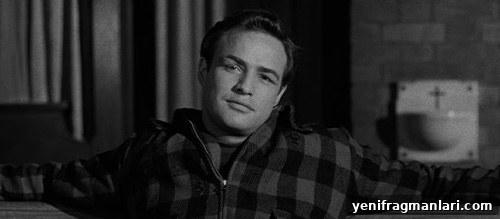
This physical expressiveness is evident across Brando’s career and is especially visible in On the Waterfront. Film scholar James Naremore pointed out that Brando’s physical presence—his slouch, his mumble, his unpredictable gestures—marked a departure from classical leading-man rhetoric. Those physical choices are integral to how Terry Malloy reads on screen: a rough-edged, stooped figure who can suddenly reveal tenderness or vulnerability. Knowing Brando’s background makes these choices legible, but even without that context, the performance conveys a lived, textured inner life.
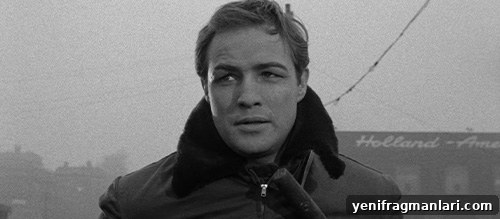
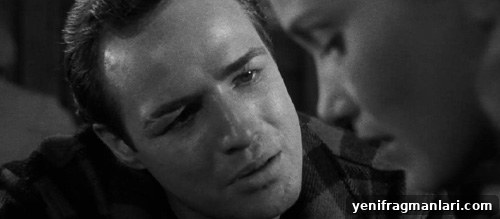
Brando also used makeup and physical detail to shape Terry. The character’s scarred eyebrow, a relic of his boxing past, alters Brando’s usual handsome appearance and anchors Terry’s physical history. After a brutal beating later in the film, Brando applied the blood effects himself, and the camera moves in close to capture the raw impact. The combination of makeup and performance—his face drenched in blood, an expression that mixes anger, sorrow, and stubborn endurance—creates a lasting cinematic image. The way Terry staggers away from the pier after the assault, as if like a boxer refusing to go down after a knockout, communicates his grit and refusal to be defeated. The visual transformation is important, but it’s Brando’s physical choices—the tension in his neck, the shifting weight of his body, the tilt of his head—that carry the emotional truth.
The film presents Terry as a man of contrasts, and Brando plays both sides convincingly. On one hand he is the tough, seemingly dim boxer who can be intimidated or used by those in power; on the other hand he is a reflective, wounded young man aware of squandered opportunities. A scene in Johnny Friendly’s bar demonstrates this split. When Friendly greets him with a rough, mimed boxing gesture, Terry puts on a brief façade—an instinctive pose rooted in his past life as a fighter. But when Friendly picks him up and the power dynamics shift, Terry shrinks into a slouch and a softer demeanor, revealing his discomfort and insecurity. Brando layers reaction upon reaction—gestural, physical, and vocal—to indicate Terry’s history and his changing relationship to those around him.
One of the film’s most famous, seemingly casual moments underscores the Method’s influence. After rescuing Edie (played by Eva Marie Saint), Terry retrieves her dropped glove, brushes the dirt from it, and puts it on his own hand while they sit on a swing. The action is small, improvised-feeling, and deeply revealing: it captures his childlike helpfulness, his curiosity, and a yearning to be tender rather than tough. The glove becomes a symbol of his desire to change. Coupled with his mimed boxing, his scarred brow, and his bloodied face, this intimate gesture completes a portrait of a man shaped by violence but capable of gentleness.
Although many critics have associated Brando with Strasberg’s internal-focused Method, his technique was eclectic. He blended traditions that emphasized physical transformation with approaches that encouraged authentic internal states, producing a style that felt spontaneous and lived-in. Without his particular training and instincts, Terry Malloy might have become a one-note stereotype. Instead, Brando’s layered choices—gesture, voice, posture, and small improvisations—turn Terry into a fully realized individual. Even when viewers cannot point to a single Method technique on screen, the work’s overall feeling of authenticity testifies to those methods at play.
Bibliography
Colombani, Florence. Anatomy of an Actor: Marlon Brando. Translated by Lucy McNair and Brandon Hopkins, Phaidon Press, 2013.
Naremore, James. Acting in the Cinema. University of California Press, 1988.