
We live in an era of CGI dreamscapes, where on many modern productions any on-set mistake can be “fixed in post” by teams of artists and technicians. Whether it’s a strand of hair drifting into an actor’s eye or an entire environment that can’t be built physically, visual effects teams stand ready to shape every element of a film’s world. Big studio pictures and auteur-driven films alike now rely on this craft to achieve visions that were once impossible.
For all the criticism CGI sometimes attracts from purists, it has undeniably improved certain aspects of cinema. Directors with precise visual instincts can realize ambitious ideas more faithfully. Studios can depict cosmic battles, sprawling fantasy cities and other phenomena at a scale that would once have been unimaginable. In that sense, cinema’s reputation as a “dream factory” is truer than ever: modern filmmaking often blurs the line between imagination and reality, and the boom in comic-book and fantasy adaptations across the 21st century is a major indicator of that shift.
One director closely associated with the rise of contemporary CGI-driven filmmaking is Steven Spielberg. A friend and collaborator of George Lucas and his visual-effects pioneers at Industrial Light & Magic, Spielberg embraced cutting-edge technology early in his career. From the bold visual ambitions of Close Encounters of the Third Kind (1977) through the fantastical flourishes of E.T. the Extra-Terrestrial (1982) and Hook (1991), Spielberg consistently explored the potential of effects to enrich storytelling.
“I think I’m extinct.”
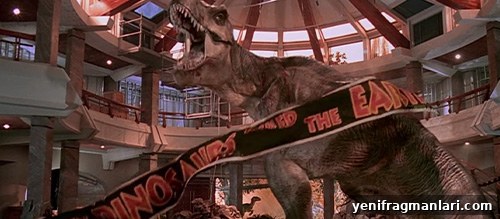
Spielberg’s most consequential moment for CGI came in 1993 with Jurassic Park, a film widely recognized as a turning point for photorealistic digital creatures. Universal and Spielberg’s Amblin Entertainment partnered with Industrial Light & Magic to produce dinosaur effects that astonished audiences and professionals alike. The reaction from veteran practical-effects artist Phil Tippett—who reportedly said, “I think I’m extinct”—captured the industry’s shock at what the new technology could achieve.
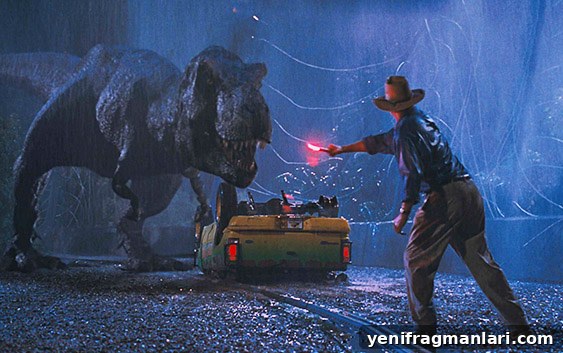
The climactic T. rex sequence in the rain remains one of the most convincing uses of photorealistic CGI ever committed to film. The dinosaur’s presence lodged itself in cultural memory as firmly as classic cinematic icons; without CGI, many of those confrontations—most notably the T. rex chasing Dr. Ian Malcolm or the terrifying velociraptor sequences—could not have been staged with the same visceral impact.
Crucially, Jurassic Park’s effects arrived before other landmark films like Titanic, before the widespread influence of computer-animated features, and well ahead of many later visual-effects milestones. Great VFX work existed prior to 1993, but Jurassic Park endures as a gold standard not because the technology has stopped evolving, but because Spielberg integrated the new tools into a filmmaker’s language at the height of his craft.
Schematically, Spielberg intended Jurassic Park to rely as much as possible on practical effects. By today’s standards he largely succeeded, but at the time it was daring to build a major motion picture around software still in its infancy. Many of the film’s full-dinosaur shots hinged on unproven digital techniques, and Spielberg navigated studio doubts by blending practical craftsmanship with computer-generated imagery, always prioritizing what would convince an audience.
Jurassic Park remains the VFX gold standard because Spielberg did what all filmmakers strive to do: he made us believe.
Spielberg amplifies the film’s realism through careful staging and blocking. Although Jurassic Park is an expensive and effects-heavy blockbuster, many of its most effective moments feel restrained and deliberate. Small, character-driven scenes build rapport and context, while the sequences with the dinosaurs demonstrate Spielberg’s mastery of cinematic space. He makes those creatures feel present in the same world as the human characters, so their impact is not just visual but physical and emotional.
Early in the film a practical velociraptor hatches from an egg; Richard Attenborough’s John Hammond gently removes shell from the newborn—an intimate, tactile moment that anchors the creature in reality. Later, when Sam Neill’s Alan Grant presses his weight against a fallen triceratops, the audience senses the solidity of the animal because the characters are interacting with it. Those interactions are not window dressing: they are the key to the film’s believability.
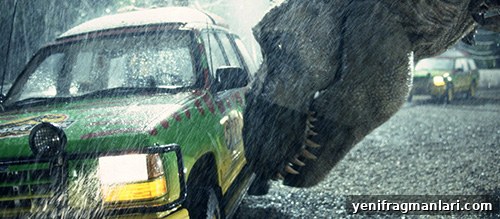
That believability culminates when the tyrannosaurus rex escapes. Spielberg combines an animatronic head for close-ups with wide shots that use CGI, and his meticulous attention to detail makes the sequence extraordinary. He stages the scene so the environment reacts—the electric fence bows, water trembles in response to the creature’s weight, and the physical world changes as the T. rex moves. These responses tell the viewer the dinosaur is more than an image; it is an agent that causes real consequences for the people we know.
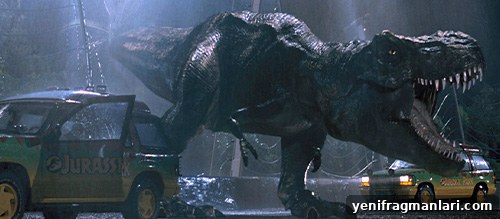
The T. rex’s eye constricts when light hits it, rain soaks its skin, and children in a car press plexiglass between themselves and the animatronic jaws—details that bind the fantasy to physical sensations. As the scene progresses the dinosaur upends a car, sends characters tumbling down a slope, and crushes objects in its path. The camera frames these moments so that the effects are not isolated spectacles but part of a single coherent environment.
Spielberg’s achievement is cinematic rule-setting: he teaches the audience how to understand his film’s world quickly and practically. Like Jaws before it, Jurassic Park functions as blockbuster horror—the T. rex becomes a monstrous antagonist, velociraptors are agile predatory threats—and to terrify effectively those creatures must inhabit the world convincingly. The rippling water, the breath fogging a window, a velociraptor opening a door: these small, tactile details compound into a convincing reality.
Later sequences underline the point. Dennis Nedry’s fate at the jaws of a smaller dinosaur has tangible consequences for a car and a human body; a velociraptor’s breath fogs glass in an enclosed kitchen; the raptor smashes into cabinets and manipulates door handles. Spielberg focuses on everyday objects so the audience can relate: if a dinosaur can open a door, it can enter your house at night—an idea that transforms cinematic spectacle into genuine dread.

Nearly every character in Jurassic Park interacts with something in their environment, and Spielberg uses those interactions to establish tangible reality from the very first scene. Even when the visual effects show more obvious age—such as some early wide shots of dinosaurs—the director’s control of perspective and reaction elevates the spectacle. In the iconic first reveal, Spielberg holds on Alan Grant’s stunned reaction before finally cutting to the dinosaur, using camera movement to emphasize scale and to make the creature’s presence feel physically consequential.
Whether it’s helicopter dust covering fossil remains, a child trembling while holding a spoonful of jelly, or a dinosaur stripping leaves from a branch, Jurassic Park fills its frames with interactions that reinforce the world’s tangibility. The film’s CGI is impressive, but its enduring power comes from Spielberg’s disciplined filmmaking choices: by embedding digital creatures into a convincingly reactive environment, he made the extraordinary feel real.
Cinema’s breakthroughs rarely rest on a single technical novelty. Landmark films like Shrek or Monsters, Inc. are remembered for whole packages of creative and technical risk. Jurassic Park took a similar leap by investing in emerging technology and using it within a rigorous cinematic framework. Three decades on, its combination of practical effects, groundbreaking CGI and precise direction still stands as the gold standard for visual effects. For filmmakers and VFX teams, Jurassic Park remains an essential reference—less as a museum piece and more as a practical guide on how to make audiences truly believe.
Recommended for you: Jurassic Park / World Movies Ranked