
Mad God (2021)
Director: Phil Tippett
Screenwriter: Phil Tippett
Starring: Alex Cox, Niketa Roman, Satish Ratakonda
Phil Tippett’s name may be more familiar to film fans for his extraordinary visual effects work than for directing. His long career includes contributions to major franchises and landmark genre films, which has made him a respected figure behind the scenes for decades. With Mad God, Tippett moves from the background into the spotlight, presenting a personal, painstakingly crafted feature-length stop motion project that reflects his singular vision.
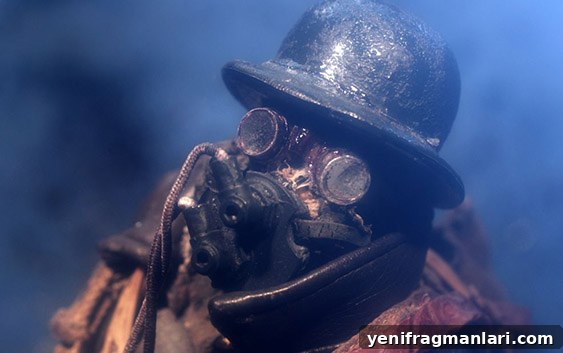
Mad God is best described as a post-apocalyptic, nightmarish descent through a handcrafted world of cruelty, decay and grotesque invention. The film follows an unnamed figure, completely shrouded in steampunk-like gear — a gas mask, thick coat and layered apparatus — who makes a slow, methodical journey into the bowels of a collapsing universe. There is no dialogue; the story is told through atmosphere, texture and image, relying on the tactile poetry of stop motion to communicate mood and meaning.
In an era when stop motion is often associated with family-friendly productions or alternative animated features with intimate, humanist themes, Tippett embraces the medium’s capacity to unsettle. The jerky, tactile motion of stop motion here enhances a sense of wrongness and unease that would be harder to achieve in CGI or traditional 2D animation. Every twitch of a puppet, every minute adjustment to a sculpted creature, contributes to a world that feels both ancient and newly imagined.
The environments and characters in Mad God are densely detailed. As the protagonist descends, the viewer encounters an escalating parade of atrocities and machinery of torment. Each vignette suggests a broader, unseen history — the kind of implied backstory that invites speculation rather than spelling everything out. Tippett’s sets are filled with tiny bits of narrative debris: rusted instruments, half-finished machines, bodies and rituals that hint at cultural systems gone wrong. The accumulation of these details creates a convincing if horrific ecology.
Although stop motion is the film’s central technique, Tippett intersperses short segments of live action. These moments aim to contrast the handmade worlds with a different register of reality, but the transitions are sometimes abrupt and the blending of techniques feels uneven. The rough joins between live action and animation can be distracting; they reveal the film’s experimental spirit more than they advance a seamless aesthetic. Still, the attempt to mix modes reflects Tippett’s desire to push the project beyond a single formal approach.
The production history of Mad God is itself remarkable. Tippett began developing the project during the production of RoboCop 2 in the late 1980s, and the work was periodically set aside and resumed over the following decades. The result is a labor of obsession: the film’s visuals carry the imprint of many years of incremental work, revisions and refinements. Each frame feels like the accumulation of patient craftsmanship, a testament to traditional techniques in an age dominated by digital effects.
Because the film deliberately abandons conventional narrative structure, it reads as a series of tableaux and moods rather than a plot-driven story. This method highlights Tippett’s strengths as an image-maker and world-builder, but it also exposes the film’s limitations. At 83 minutes, Mad God is relatively short, yet its pacing sometimes lags; a sequence may linger on a single grim reveal long after the initial shock has passed, which can make the viewing experience feel repetitive. The film repeatedly circles themes of decay, entropy and systemic violence, and while the imagery is memorable, the thematic ground is familiar to viewers of dystopian art and cinema.
Visually, the film will linger with viewers: many sequences are brilliantly imagined, grotesquely beautiful and crafted with an attention to tactile detail that few contemporary films attempt. Tippett’s creatures, apparatus and ruined spaces demonstrate an artist conversant in both technical skill and macabre imagination. However, the viewing experience can be frustrating; the film alternates between dazzling set pieces and stretches where the mood and momentum slow. The emotional payoff is often more intellectual than visceral, leaving some viewers wondering what the film ultimately wants to say beyond presenting a series of unsettling images.
For audiences interested in the craft of filmmaking, stop motion art, or the workings of a longtime visual effects master, Mad God is a significant work. It reveals the scale of Tippett’s ambition and the tenacity required to see such a singular vision through to completion. For viewers seeking a tightly structured narrative or sustained dramatic engagement, the film may feel uneven. Ultimately, Mad God should be appreciated as an artisanal achievement — an obsessive, often brilliant exploration of form and texture — even as it frustrates in places with its pacing and repetitiveness.
11/24