
Mean Girls (2024)
Directors: Samantha Jayne, Arturo Perez Jr.
Screenwriter: Tina Fey
Starring: Angourie Rice, Renee Rapp, Auli’i Cravalho, Jaquel Spivey, Avantika, Bebe Wood, Christopher Briney, Jenna Fischer, Busy Phillips, Tina Fey, Tim Meadows
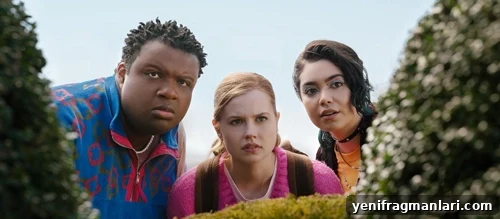
The core issue with the 2024 adaptation of Mean Girls is visible from the first frame: this version alters the story’s viewpoint in a way that strips much of the original film’s personality. The movie opens with Janis (Auli’i Cravalho) and Damian (Jaquel Spivey) performing through an iPhone screen, introducing the narrative with a musical number called “Cautionary Tale.” In the stage musical these two serve as quasi-narrators, but transferring that function wholesale to the screen removes the intimate point of view that made the 2004 film resonate. Without Cady Heron’s internal perspective anchoring the story, the film feels scattered—composed of bright fragments that don’t cohere into a satisfying whole.
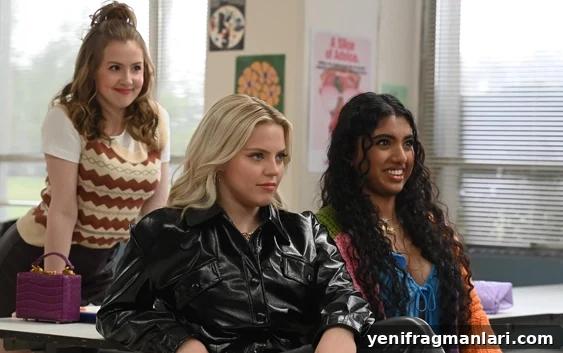
Plot-wise the musical film keeps the same broad beats as the original. Cady Heron, a homeschooled girl who grew up in Kenya, arrives at North Shore High School and quickly encounters its complex social hierarchies. Janis and Damian adopt her as their friend and guide her through the cliques. Regina George (Renee Rapp) spots Cady and invites her into the Plastics: Gretchen Weiners (Bebe Wood) and Karen Shetty (Avantika). Janis pushes Cady to infiltrate the Plastics and dismantle Regina’s influence as revenge for a past betrayal. Those familiar beats remain, but the emotional logic behind them is often weakened in this adaptation.
In the 2004 original, Cady’s perspective—expressed through voiceover—makes us sympathize with her even as she makes questionable choices. Lindsay Lohan’s performance carried nuance and allowed the audience to follow Cady’s moral decline and eventual growth. Here, Angourie Rice’s Cady frequently reads as disconnected and bewildered. Her performance often feels flat; her vocal and emotional range are not given the space to guide the audience through the story. As a result, her transition into the world of mean girls lacks convincing motivation, and many of the film’s intended emotional payoffs land hollow.
Many of the film’s structural problems can be traced back to the source material and its adaptation choices. Tina Fey adapted her own screenplay for the stage and now for the screen again, but the result sometimes feels like chunks of the original movie and the stage production were pasted together rather than reimagined for a new medium. Several scenes and lines are recycled without being recontextualized, and opportunities to modernize the story are not fully realized. The film hints at social media’s impact but never deeply integrates how platforms like TikTok or Instagram shape teen identity and cruelty in 2024. That missed opportunity leaves the update feeling surface-level rather than insightful.
The film also blunts the sharper edges that made the original so memorable. Regina should feel threatening and active in her cruelty; in this version much of that menace is implied rather than enacted. Renee Rapp is a commanding singer and brings strong vocal performances, but the script gives her fewer concrete moments of manipulation and vindictiveness, which dilutes Regina’s role as an effective antagonist. The film also handles certain sensitive topics unevenly: some problematic jokes from the original are removed, but the movie still struggles with fatphobia and misses chances to thoughtfully examine changing beauty standards.
Janis and Damian are the film’s most electrifying presences. Auli’i Cravalho and Jaquel Spivey bring vivacity and charisma to their roles, and their musical numbers often stand out. Cravalho’s rendition of “Revenge Party” is especially infectious and nearly redeems some of the script’s weaker moments. Yet even these characters are undercut by a tendency to make their identities feel like incidental traits rather than fully explored aspects of their lives. Janis’s queerness is acknowledged but not given narrative weight, which reduces the potential emotional richness of her arc.
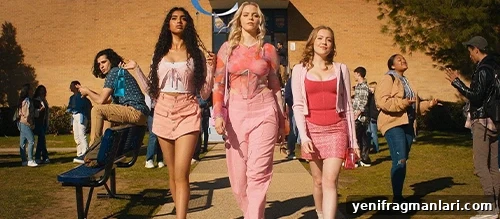
Technically the film often feels flat and derivative. The cinematography favors a barrage of close-ups and medium shots, which limits spatial awareness and diminishes the choreography of group scenes. In moments that should feel dynamic—like Cady’s first encounter with the Plastics—the staging instead reads stiff and stagebound, as if the camera captured a touring production rather than creating a cinematic experience. The production design and costuming occasionally evoke late-2000s nostalgia, but much of the visual palette is dominated by cold blues and muted greens that yield an unflattering, studio-bound atmosphere. When the movie hits brighter, more colorful musical numbers, those scenes pop—but they are too infrequent to counterbalance the overall inconsistency.
Music, arguably the film’s most promising element, is disappointingly truncated. Several songs from the stage show are cut or shortened, and moments that should build character or emotional connection are replaced with recycled dialogue. This editing choice weakens character development—most notably the relationship between Cady and Aaron, whose musical moment that could have added heart was removed. Christopher Briney does what he can with limited material, but without the songs that would have given his character depth, he remains peripheral.
Despite flashes of strong performance and a few catchy numbers, Mean Girls (2024) never quite finds its identity. It borrows the shape and many memorable beats of the original while losing the internal perspective and emotional clarity that made the 2004 film a cultural touchstone. Moments of genuine humor and insight appear, especially when Janis and Damian are on screen, but they are too sporadic to lift the movie into something fresh or resonant. Ultimately this adaptation feels like a thinner, less convincing echo of what came before—visually uneven, tonally uncertain, and emotionally undernourished.
Score: 6/24